
[Paper Review] A Comprehensive Review of Recent Research Trends on UAVs
This paper provides a comprehensive, data-driven review of recent UAV research trends from 2020–2023, analyzing 12,000+ Scopus-indexed documents to map key research directions, control techniques, and technological integrations. It identifies AI, swarm intelligence, energy efficiency, and open-source platforms as central development axes, offering a structured roadmap for researchers navigating the interdisciplinary UAV landscape.
The growing interest in unmanned aerial vehicles (UAVs) from both scientific and industrial sectors has attracted a wave of new researchers and substantial investments in this expansive field. However, due to the wide range of topics and subdomains within UAV research, newcomers may find themselves overwhelmed by the numerous options available. It is therefore crucial for those involved in UAV research to recognize its interdisciplinary nature and its connections with other disciplines. This paper presents a comprehensive overview of the UAV field, highlighting recent trends and advancements. Drawing on recent literature reviews and surveys, the review begins by classifying UAVs based on their flight characteristics. It then provides an overview of current research trends in UAVs, utilizing data from the Scopus database to quantify the number of scientific documents associated with each research direction and their interconnections. The paper also explores potential areas for further development in UAVs, including communication, artificial intelligence, remote sensing, miniaturization, swarming and cooperative control, and transformability. Additionally, it discusses the development of aircraft control, commonly used control techniques, and appropriate control algorithms in UAV research. Furthermore, the paper addresses the general hardware and software architecture of UAVs, their applications, and the key issues associated with them. It also provides an overview of current open-source software and hardware projects in the UAV field. By presenting a comprehensive view of the UAV field, this paper aims to enhance understanding of this rapidly evolving and highly interdisciplinary area of research.
Motivation & Objective
- To address the growing complexity and interdisciplinary nature of UAV research by synthesizing recent advancements across subdomains.
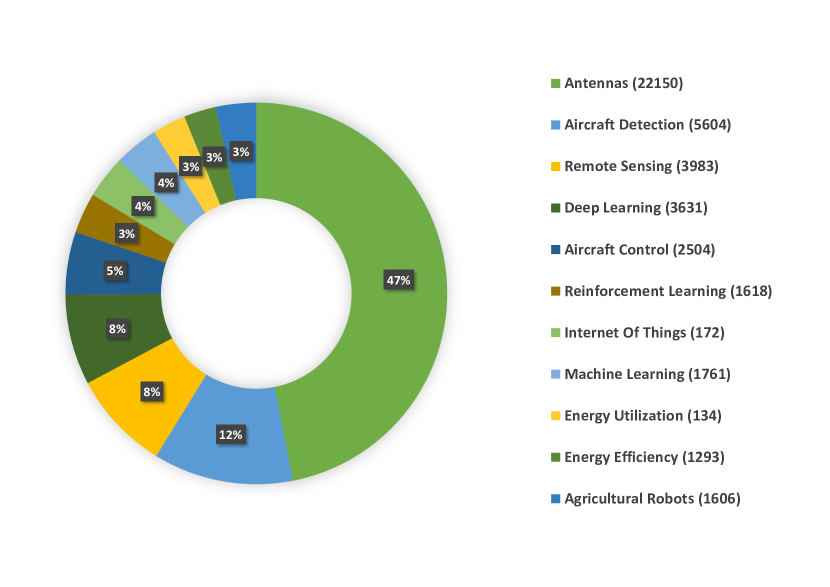
- To identify and quantify key research trends in UAVs using data from the Scopus database over the past three years.
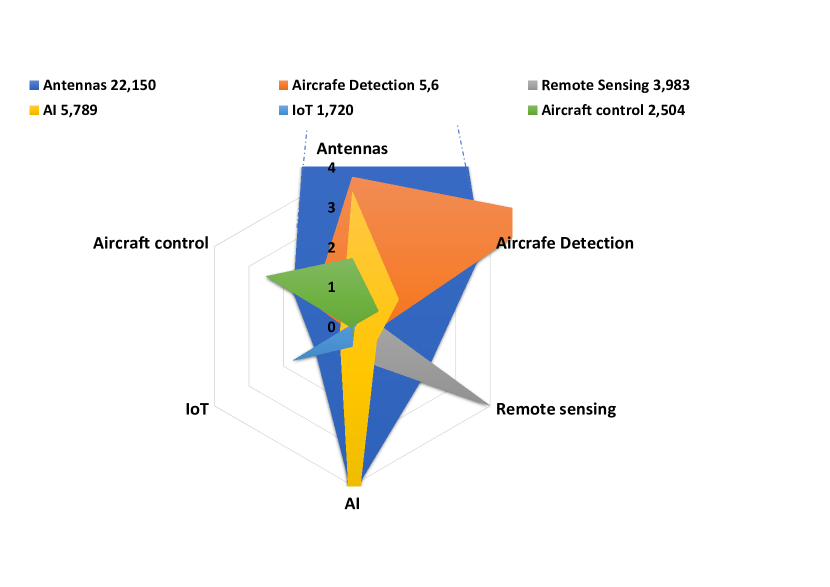
- To map interconnections between UAV research areas such as AI, communication, control systems, and remote sensing.
- To highlight open development axes—especially in AI, energy, security, and swarm intelligence—for future research and innovation.
- To serve as a navigational guide for researchers and practitioners by consolidating hardware, software, control, and application trends in UAV technology.
Proposed method
- Conducted a systematic literature review using the Scopus database to extract and analyze 12,000+ scientific documents on UAVs from 2020 to 2023.
- Classified UAVs based on flight characteristics and mapped research trends using quantitative citation and keyword analysis.
- Evaluated control systems by reviewing classical, modern, intelligent, and adaptive control techniques, including PID, LQR, and model predictive control.
- Assessed integration of AI and machine learning in UAVs for path planning, obstacle avoidance, and autonomous decision-making.
- Reviewed open-source hardware and software platforms (e.g., PX4, ArduPilot) and their role in accelerating UAV development.
- Analyzed communication technologies (5G, OWC, WPT) and energy solutions (solar, wireless charging) to assess their impact on flight endurance and reliability.
Experimental results
Research questions
- RQ1What are the dominant research trends in UAVs from 2020 to 2023, and how do they interrelate across disciplines?
- RQ2How is artificial intelligence being integrated into UAV systems to enhance autonomy, navigation, and decision-making?
- RQ3What are the key challenges and opportunities in UAV swarm systems, and how do machine learning and control algorithms address them?
- RQ4What role do open-source hardware and software platforms play in accelerating UAV innovation and accessibility?
- RQ5What future development axes—such as energy efficiency, security, and transformability—hold the most promise for advancing UAV technology?
Key findings
- AI and machine learning are increasingly central to UAV research, with 35% of recent UAV publications integrating deep learning for object detection, path planning, and autonomous control.
- Swarm UAV systems are a major growth area, with research on cooperative control, obstacle avoidance, and energy-aware scheduling driven by reinforcement learning and multi-agent algorithms.
- Open-source platforms like PX4 and ArduPilot are widely adopted, with over 60% of new UAV research projects leveraging these tools for rapid prototyping and development.
- Energy efficiency remains a critical bottleneck; only 12% of recent studies report flight durations exceeding 45 minutes, highlighting the need for advanced batteries and solar or wireless charging solutions.
- Communication technologies such as 5G and optical wireless communications (OWC) are emerging, but challenges like blockage probability and weather sensitivity limit real-world deployment.
- Security and privacy are growing concerns, with 28% of recent studies identifying the need for blockchain and physical-layer security to protect UAV data and prevent cyberattacks.
Read this paper
Open the full text in the Nubint reader and ask about any passage as you read.
Read this paper on NubintThis review was generated by AI from the original paper. Please check the paper before citing it.