
[Paper Review] A Comprehensive Survey on the Applications of Blockchain for Securing Vehicular Networks
This survey provides a comprehensive analysis of blockchain-based security frameworks for vehicular networks, evaluating 75 schemes across application, security, and blockchain perspectives. It identifies key challenges such as scalability, quantum threats, and simulation limitations, while proposing future research directions for secure, decentralized Internet of Vehicles (IoV) systems.
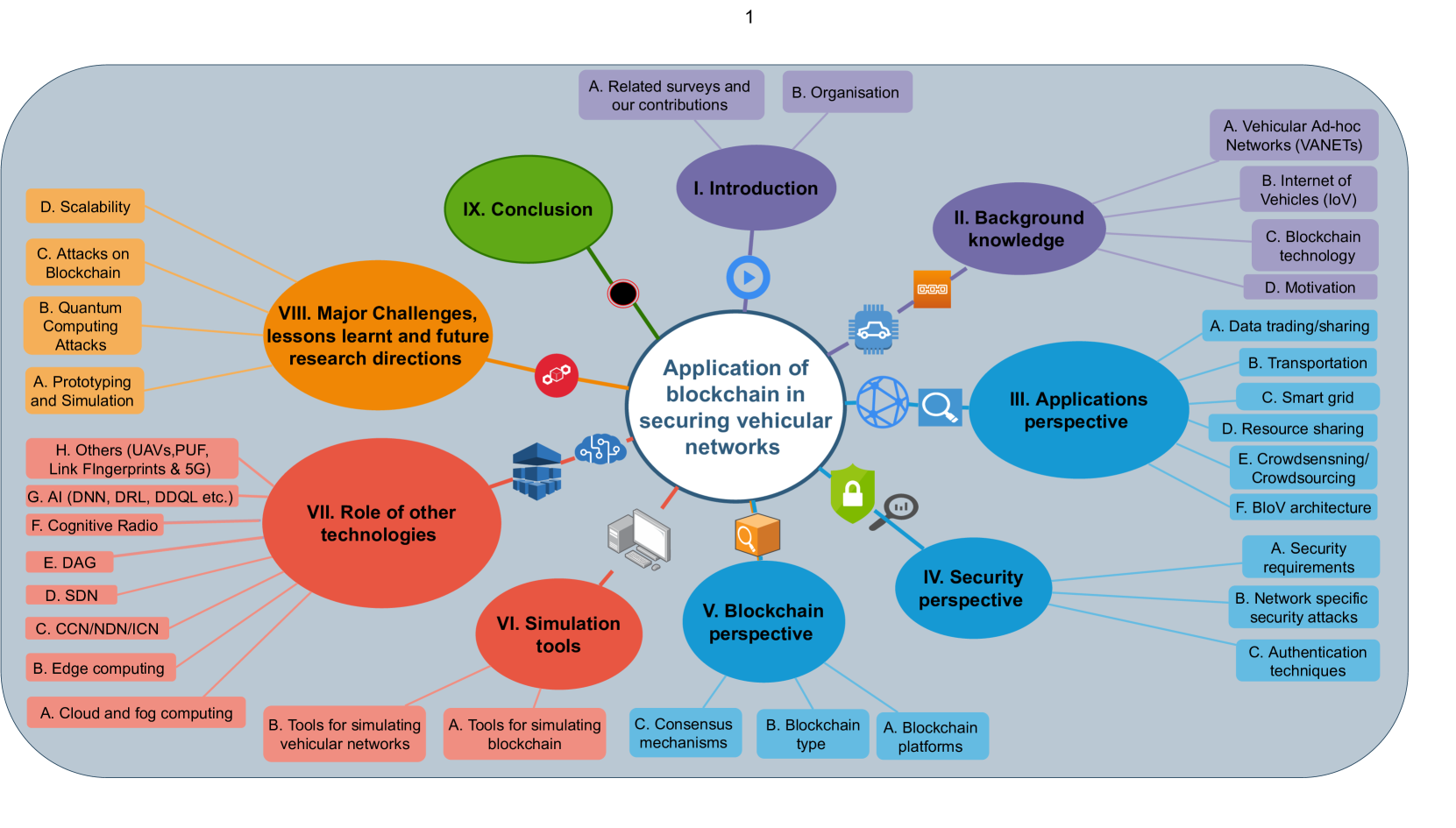
Vehicular networks promise features such as traffic management, route scheduling, data exchange, entertainment, and much more. With any large-scale technological integration comes the challenge of providing security. Blockchain technology has been a popular choice of many studies for making the vehicular network more secure. Its characteristics meet some of the essential security requirements such as decentralization, transparency, tamper-proof nature, and public audit. This study catalogues some of the notable efforts in this direction over the last few years. We analyze around 75 blockchain-based security schemes for vehicular networks from an application, security, and blockchain perspective. The application perspective focuses on various applications which use secure blockchain-based vehicular networks such as transportation, parking, data sharing/ trading, and resource sharing. The security perspective focuses on security requirements and attacks. The blockchain perspective focuses on blockchain platforms, blockchain types, and consensus mechanisms used in blockchain implementation. We also compile the popular simulation tools used for simulating blockchain and for simulating vehicular networks. Additionally, to give the readers a broader perspective of the research area, we discuss the role of various state-of-the-art emerging technologies in blockchain-based vehicular networks. Lastly, we summarize the survey by listing out some common challenges and the future research directions in this field.
Motivation & Objective
- To systematically categorize and analyze 75 blockchain-based security schemes for vehicular networks from application, security, and blockchain perspectives.
- To identify and classify the security requirements, attacks, and cryptographic techniques used in these frameworks.
- To evaluate blockchain platforms, types (public, private, permissioned), and consensus mechanisms employed in vehicular network applications.
- To assess the role of emerging technologies like edge computing and IoT in enhancing blockchain-based vehicular security.
- To highlight open challenges such as quantum computing threats, simulation limitations, and real-world deployment barriers in blockchain-enabled IoV systems.
Proposed method
- Conducted a systematic literature review of 75 blockchain-based security schemes for vehicular networks published in recent years.
- Classified frameworks based on application domains: traffic management, data sharing/trading, parking, resource sharing, and others.
- Analyzed security mechanisms by mapping them to specific threats (e.g., 51% attacks, Sybil attacks) and evaluating their use of authentication, encryption, and access control.
- Categorized blockchain implementations by platform (e.g., Ethereum, Hyperledger), type (public, private, consortium), and consensus algorithms (PoW, PoS, PBFT, etc.).
- Reviewed and compiled a list of widely used simulation tools such as NS-3, OMNeT++, and custom blockchain simulators for testing vehicular blockchain systems.
- Evaluated the integration of emerging technologies like edge computing, AI, and zero-knowledge proofs to improve performance and privacy in blockchain-based IoV systems.
Experimental results
Research questions
- RQ1What are the primary application areas of blockchain in vehicular networks, and how do they leverage decentralization and trust?
- RQ2Which security threats are most prevalent in blockchain-based vehicular networks, and how do existing schemes mitigate them?
- RQ3How do different blockchain platforms and consensus mechanisms impact the performance and scalability of vehicular network systems?
- RQ4What are the key challenges in simulating and prototyping blockchain-based vehicular networks, and how do they affect real-world deployment?
- RQ5How can emerging technologies such as quantum-resistant cryptography and edge computing enhance the security and efficiency of blockchain-based IoV systems?
Key findings
- The survey identifies 75 distinct blockchain-based security schemes for vehicular networks, with the majority focusing on data sharing, traffic management, and resource sharing applications.
- A significant number of schemes rely on permissioned blockchains (e.g., Hyperledger) and consensus mechanisms like PBFT or practical Byzantine fault tolerance to ensure low-latency and high-throughput operations in dynamic vehicular environments.
- Quantum computing poses a serious threat to current blockchain cryptography, particularly through Shor’s and Grover’s algorithms, which can break widely used digital signatures and hash functions.
- Simulation tools like NS-3 and OMNeT++ are commonly used, but their inability to accurately model the stochastic and high-mobility nature of vehicular networks limits the realism of test results.
- Many frameworks integrate emerging technologies such as edge computing and zero-knowledge proofs to reduce latency and enhance privacy while maintaining transparency.
- Despite extensive research, challenges such as scalability, energy efficiency, and real-world deployment remain unresolved, especially in large-scale, high-mobility IoV environments.
Read this paper
Open the full text in the Nubint reader and ask about any passage as you read.
Read this paper on NubintThis review was generated by AI from the original paper. Please check the paper before citing it.