
[Paper Review] A Context-Aware Citation Recommendation Model with BERT and Graph Convolutional Networks
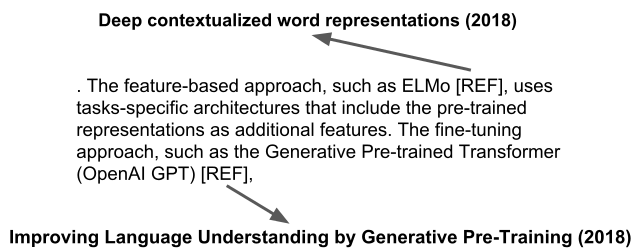
This paper proposes a context-aware citation recommendation model using BERT for contextual text encoding and Graph Convolutional Networks (GCN) to model citation relationships, achieving state-of-the-art performance with a 28% improvement in mean average precision (MAP) and recall@k. It introduces the FullTextPeerRead dataset, the first well-organized benchmark dataset combining context sentences and paper metadata for citation recommendation.
With the tremendous growth in the number of scientific papers being published, searching for references while writing a scientific paper is a time-consuming process. A technique that could add a reference citation at the appropriate place in a sentence will be beneficial. In this perspective, context-aware citation recommendation has been researched upon for around two decades. Many researchers have utilized the text data called the context sentence, which surrounds the citation tag, and the metadata of the target paper to find the appropriate cited research. However, the lack of well-organized benchmarking datasets and no model that can attain high performance has made the research difficult. In this paper, we propose a deep learning based model and well-organized dataset for context-aware paper citation recommendation. Our model comprises a document encoder and a context encoder, which uses Graph Convolutional Networks (GCN) layer and Bidirectional Encoder Representations from Transformers (BERT), which is a pre-trained model of textual data. By modifying the related PeerRead dataset, we propose a new dataset called FullTextPeerRead containing context sentences to cited references and paper metadata. To the best of our knowledge, This dataset is the first well-organized dataset for context-aware paper recommendation. The results indicate that the proposed model with the proposed datasets can attain state-of-the-art performance and achieve a more than 28% improvement in mean average precision (MAP) and recall@k.
Motivation & Objective
- To address the lack of standardized benchmark datasets for context-aware citation recommendation, which hinders reproducible research and model evaluation.
- To improve citation recommendation performance by integrating contextual text understanding via BERT with structural citation network modeling using GCN.
- To develop a reproducible, well-structured dataset—FullTextPeerRead—that includes context sentences, reference metadata, and citation links from scientific papers.
- To investigate the impact of context length and citation frequency on model performance in citation recommendation tasks.
- To provide a new state-of-the-art model that outperforms existing methods in MAP, MRR, and recall@k metrics.
Proposed method
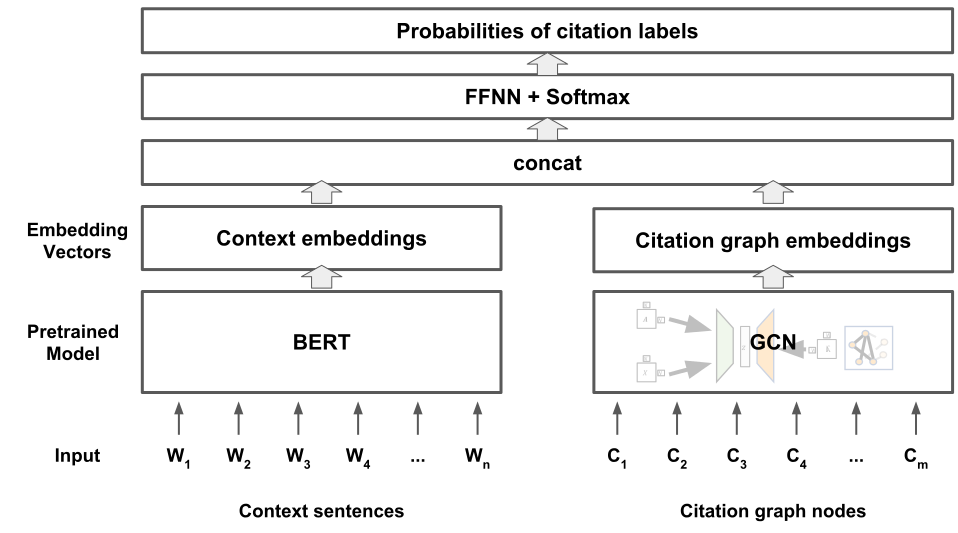
- The model uses a dual-encoder architecture: a BERT-based context encoder for encoding surrounding text around citation placeholders.
- A Graph Convolutional Network (GCN) layer processes citation network data, learning latent representations from paper citation graphs.
- Variational Graph Autoencoders (VGAE) are applied to regularize the GCN encoder and reduce overfitting to local context patterns.
- The final representation combines contextual embeddings from BERT and graph-based embeddings from GCN to compute similarity scores for candidate citations.
- The FullTextPeerRead dataset is constructed by parsing LaTeX-based PDFs via arXiv Vanity, extracting context sentences and metadata, and enriching the PeerRead and AAN datasets with context-aware citation information.
- The model is trained end-to-end using contrastive learning to optimize for ranking relevant citations higher in the recommendation list.
Experimental results
Research questions
- RQ1How does integrating BERT and GCN improve citation recommendation performance compared to using BERT alone?
- RQ2To what extent does the length of the context sequence affect model performance in citation recommendation?
- RQ3How does citation frequency of target papers influence the model's ability to recommend them accurately?
- RQ4Can a unified, well-structured dataset like FullTextPeerRead enable consistent benchmarking and reproducibility in citation recommendation research?
- RQ5What is the contribution of graph-based citation structure modeling (via GCN) in improving relevance estimation beyond text-only context?
Key findings
- The proposed BERT-GCN model achieves a 28% improvement in mean average precision (MAP) and recall@k compared to baseline models.
- The model with GCN integration outperforms the BERT-only model, with a MAP of 0.6736 at citation frequency 5, compared to 0.6593 for BERT alone.
- Performance gains plateau when context length exceeds 100 tokens, indicating diminishing returns beyond a certain context window.
- Higher citation frequency of target papers correlates with improved model performance, suggesting that frequent citations provide more reliable training signals.
- The FullTextPeerRead dataset enables accurate and consistent context extraction, with well-structured metadata and context sentences from real scientific papers.
- GCN enhances performance by capturing citation network structure, improving similarity estimation beyond text-based embeddings alone.
Read this paper
Open the full text in the Nubint reader and ask about any passage as you read.
Read this paper on NubintThis review was generated by AI from the original paper. Please check the paper before citing it.