
[Paper Review] A full-stack view of probabilistic computing with p-bits: devices, architectures and algorithms
This paper presents a full-stack framework for probabilistic computing using p-bits—hardware-abstraction units that exploit intrinsic nanomagnetic noise to perform energy-efficient probabilistic sampling. By integrating spintronic devices with CMOS architectures, the approach enables scalable, parallelized sampling for combinatorial optimization, probabilistic machine learning, and quantum simulation, achieving orders-of-magnitude improvements in energy efficiency and sampling speed over conventional methods.
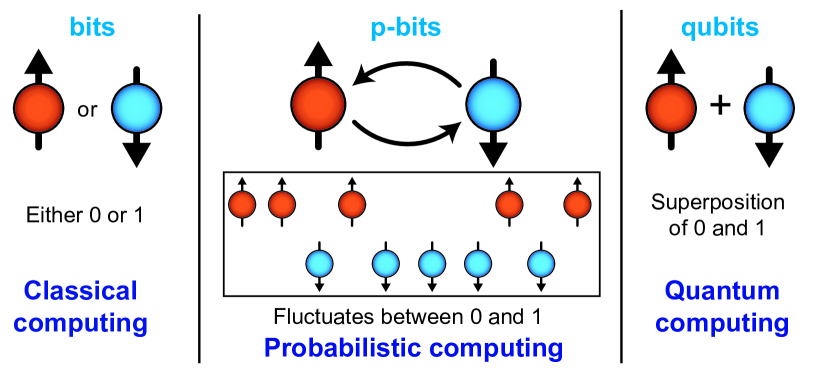
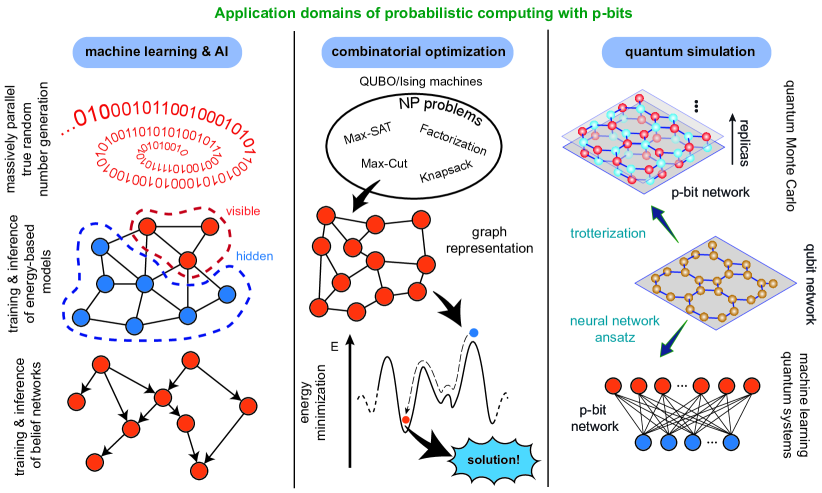
The transistor celebrated its 75${}^ ext{th}$ birthday in 2022. The continued scaling of the transistor defined by Moore's Law continues, albeit at a slower pace. Meanwhile, computing demands and energy consumption required by modern artificial intelligence (AI) algorithms have skyrocketed. As an alternative to scaling transistors for general-purpose computing, the integration of transistors with unconventional technologies has emerged as a promising path for domain-specific computing. In this article, we provide a full-stack review of probabilistic computing with p-bits as a representative example of the energy-efficient and domain-specific computing movement. We argue that p-bits could be used to build energy-efficient probabilistic systems, tailored for probabilistic algorithms and applications. From hardware, architecture, and algorithmic perspectives, we outline the main applications of probabilistic computers ranging from probabilistic machine learning and AI to combinatorial optimization and quantum simulation. Combining emerging nanodevices with the existing CMOS ecosystem will lead to probabilistic computers with orders of magnitude improvements in energy efficiency and probabilistic sampling, potentially unlocking previously unexplored regimes for powerful probabilistic algorithms.
Motivation & Objective
- To develop a full-stack approach to probabilistic computing using p-bits as a low-energy alternative to traditional transistor scaling.
- To address the rising energy demands of AI and machine learning workloads by leveraging intrinsic noise in nanomagnets for stochastic computation.
- To enable scalable, hardware-aware implementations of probabilistic algorithms through co-design of devices, architectures, and algorithms.
- To demonstrate the feasibility of p-computers in solving complex problems such as combinatorial optimization and quantum many-body simulations.
Proposed method
- p-bits are implemented using stochastic magnetic tunnel junctions (MTJs) with low energy barriers, enabling intrinsic probabilistic behavior through thermal fluctuations.
- The system models p-bit dynamics using a stochastic update rule: $ m_i = \text{sign}[\tanh(\beta I_i) - r_{[-1,+1]}] $, where $ I_i $ is the effective input current.
- The architecture employs sparse, hardware-aware graph topologies to map complex models like Restricted Boltzmann Machines (RBMs) onto p-bit networks via minor-embedding.
- A hybrid classical-p-computer pipeline performs iterative sampling and weight updates, enabling variational quantum simulation using p-bit samplers.
- The framework supports algorithm-architecture-device co-design, incorporating advanced sampling techniques such as parallel tempering and nonequilibrium Monte Carlo.
- Energy efficiency is enhanced through massive parallelization, pipelining, and sparsification, reducing synaptic fanout and power consumption.
Experimental results
Research questions
- RQ1Can p-bits built from spintronic nanomagnets achieve energy-efficient, scalable probabilistic sampling for real-world applications?
- RQ2How can p-bit architectures be co-designed with algorithms to maximize sampling speed and solution quality in combinatorial optimization?
- RQ3To what extent can p-computers simulate quantum many-body systems using variational quantum Monte Carlo methods?
- RQ4What role does hardware-aware graph embedding play in enabling efficient mapping of deep probabilistic models onto p-bit systems?
- RQ5Can co-design of algorithms, architectures, and devices lead to orders-of-magnitude improvements in sampling throughput and energy efficiency?
Key findings
- p-bits implemented in stochastic magnetic tunnel junctions enable intrinsic probabilistic behavior with minimal energy input, achieving high sampling rates through thermal noise.
- The use of sparse, hardware-aware graph topologies enables efficient mapping of RBMs onto p-bit networks, reducing fanout and enabling scalable implementation.
- Hybrid classical-p-computer pipelines successfully simulate the ground state of a 1D FM Heisenberg Hamiltonian using variational Monte Carlo with p-bit sampling.
- The system demonstrates potential for orders-of-magnitude improvements in energy efficiency and sampling speed compared to conventional CMOS-based samplers.
- Advanced sampling techniques such as parallel tempering and nonequilibrium Monte Carlo can be integrated into p-bit systems to further enhance solution quality and convergence.
- Co-design of algorithms, architectures, and devices enables p-computers to access previously unexplored regimes in probabilistic computing, particularly for quantum simulation and energy-based AI models.
Read this paper
Open the full text in the Nubint reader and ask about any passage as you read.
Read this paper on NubintThis review was generated by AI from the original paper. Please check the paper before citing it.