
[Paper Review] A Hyperbolic-to-Hyperbolic Graph Convolutional Network
This paper proposes H2H-GCN, the first hyperbolic graph convolutional network that performs graph convolution directly on hyperbolic manifolds without relying on tangent space approximations. It introduces a manifold-preserving graph convolution using hyperbolic feature transformation with orthogonal constraints and Einstein midpoint-based neighborhood aggregation, achieving state-of-the-art performance on link prediction, node classification, and graph classification tasks by preserving global hyperbolic geometry.
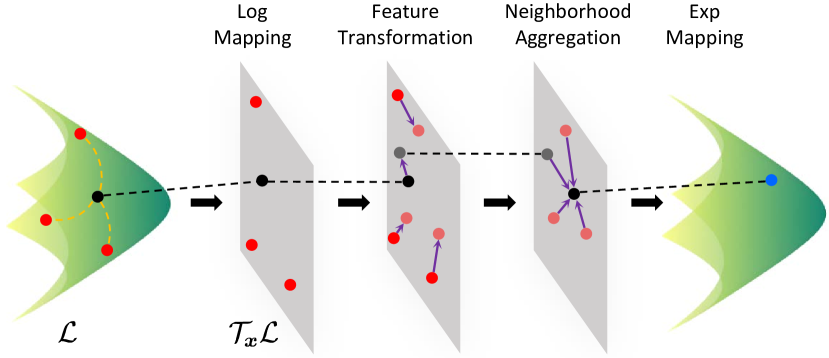
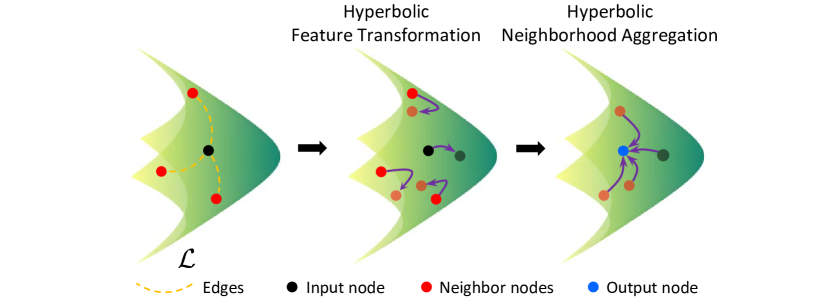
Hyperbolic graph convolutional networks (GCNs) demonstrate powerful representation ability to model graphs with hierarchical structure. Existing hyperbolic GCNs resort to tangent spaces to realize graph convolution on hyperbolic manifolds, which is inferior because tangent space is only a local approximation of a manifold. In this paper, we propose a hyperbolic-to-hyperbolic graph convolutional network (H2H-GCN) that directly works on hyperbolic manifolds. Specifically, we developed a manifold-preserving graph convolution that consists of a hyperbolic feature transformation and a hyperbolic neighborhood aggregation. The hyperbolic feature transformation works as linear transformation on hyperbolic manifolds. It ensures the transformed node representations still lie on the hyperbolic manifold by imposing the orthogonal constraint on the transformation sub-matrix. The hyperbolic neighborhood aggregation updates each node representation via the Einstein midpoint. The H2H-GCN avoids the distortion caused by tangent space approximations and keeps the global hyperbolic structure. Extensive experiments show that the H2H-GCN achieves substantial improvements on the link prediction, node classification, and graph classification tasks.
Motivation & Objective
- To address the distortion caused by tangent space approximations in existing hyperbolic GCNs, which only locally approximate hyperbolic manifolds.
- To develop a graph convolutional network that operates directly on hyperbolic manifolds, maintaining the global geometric structure of hierarchical graphs.
- To improve representation learning for graphs with hierarchical structures by eliminating the need for manifold-to-tangent-space mappings.
- To demonstrate that direct hyperbolic operations yield superior performance compared to tangent space-based approaches on benchmark graph learning tasks.
Proposed method
- Proposes a hyperbolic-to-hyperbolic graph convolutional network (H2H-GCN) that operates entirely on hyperbolic manifolds, avoiding tangent space mappings.
- Introduces a hyperbolic feature transformation using a block diagonal matrix with a scalar 1 and an orthogonal matrix to preserve manifold membership after transformation.
- Employs the Einstein midpoint as a weighted aggregation method for neighborhood information, ensuring the updated node representation remains on the hyperbolic manifold.
- Designs a manifold-preserving graph convolution that combines hyperbolic feature transformation and hyperbolic neighborhood aggregation, both respecting the intrinsic geometry of hyperbolic space.
- Uses Riemannian optimization to train the model while maintaining all operations within the hyperbolic manifold.
- Employs a uniform experimental protocol with standardized data splits to ensure fair comparison with state-of-the-art Euclidean and hyperbolic GCNs.
Experimental results
Research questions
- RQ1Can a graph convolutional network be designed to operate directly on hyperbolic manifolds without relying on tangent space approximations?
- RQ2Does eliminating tangent space mappings lead to improved representation learning for hierarchical graphs?
- RQ3How does direct hyperbolic graph convolution compare to tangent space-based hyperbolic GCNs in terms of performance on link prediction, node classification, and graph classification?
- RQ4To what extent does preserving global hyperbolic geometry enhance model performance across varying embedding dimensions?
Key findings
- H2H-GCN achieves 78.2% ± 3.3 accuracy on the D&D dataset, outperforming DGCNN by 1.6% and setting a new state-of-the-art on this benchmark.
- On the Proteins dataset, H2H-GCN reaches 74.4% ± 3.0 accuracy, surpassing DiffPool by 0.7% and demonstrating consistent improvement over existing methods.
- On the Enzymes dataset, H2H-GCN achieves 61.3% ± 4.9 accuracy, exceeding GIN by 1.7% and showing superior performance on a challenging hierarchical graph classification task.
- At all tested embedding dimensions (3 to 128), H2H-GCN consistently outperforms HGCN and HGNN, with a 2.3% improvement over HGCN at dimension 3 and a 1.9% gain at dimension 256.
- The performance gap between H2H-GCN and HGNN persists across all dimensions, indicating that the distortion from tangent space approximations is not resolved by increasing dimensionality.
- H2H-GCN demonstrates that direct manifold-based operations preserve global hyperbolic structure, leading to more effective representation learning than tangent space-based alternatives.
Read this paper
Open the full text in the Nubint reader and ask about any passage as you read.
Read this paper on NubintThis review was generated by AI from the original paper. Please check the paper before citing it.