
[Paper Review] A lanthanide-rich kilonova in the aftermath of a long gamma-ray burst
The paper reports a kilonova following a long-duration GRB (GRB 230307A), best described by two lanthanide-rich ejecta components, with late-time bolometric decay and evidence for r-process element production.
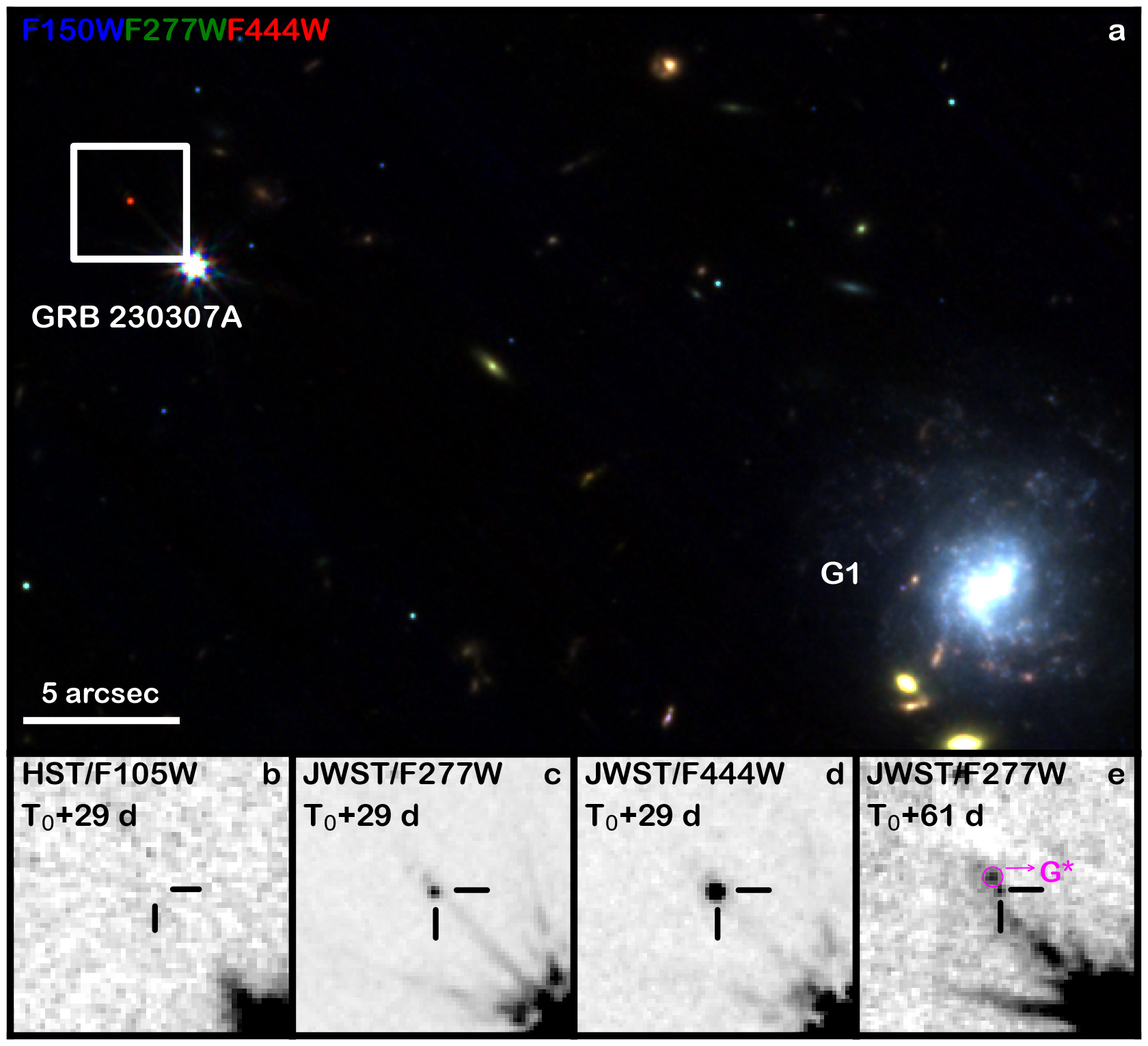
Kilonovae are a rare class of astrophysical transients powered by the radioactive decay of nuclei heavier than iron, synthesized in the merger of two compact objects. Over the first few days, the kilonova evolution is dominated by a large number of radioactive isotopes contributing to the heating rate. On timescales of weeks to months, its behavior is predicted to differ depending on the ejecta composition and merger remnant. However, late-time observations of known kilonovae are either missing or limited. Here we report observations of a luminous red transient with a quasi-thermal spectrum, following an unusual gamma-ray burst of long duration. We classify this thermal emission as a kilonova and track its evolution up to two months after the burst. At these late times, the recession of the photospheric radius and the rapidly-decaying bolometric luminosity ($L_{ m bol}\propto t^{-2.7\pm 0.4}$) support the recombination of lanthanide-rich ejecta as they cool.
Motivation & Objective
- Motivate the search for kilonovae associated with long gamma-ray bursts and test whether such events synthesize heavy r-process elements.
- Characterize the late-time emission to distinguish kilonova thermal components from non-thermal afterglow.
- Constrain the ejecta properties (mass, velocity, opacity, composition) and assess the role of lanthanide-rich material in powering the light curve.
- Investigate the GRB progenitor scenario and host galaxy environment to evaluate compact binary merger origins for GRB 230307A.
Proposed method
- Joint spectral energy distribution modeling of optical, near-infrared, and X-ray data using XSPEC with power-law plus blackbody components (including zphabs/zdust and zigm for redshift sensitivity).
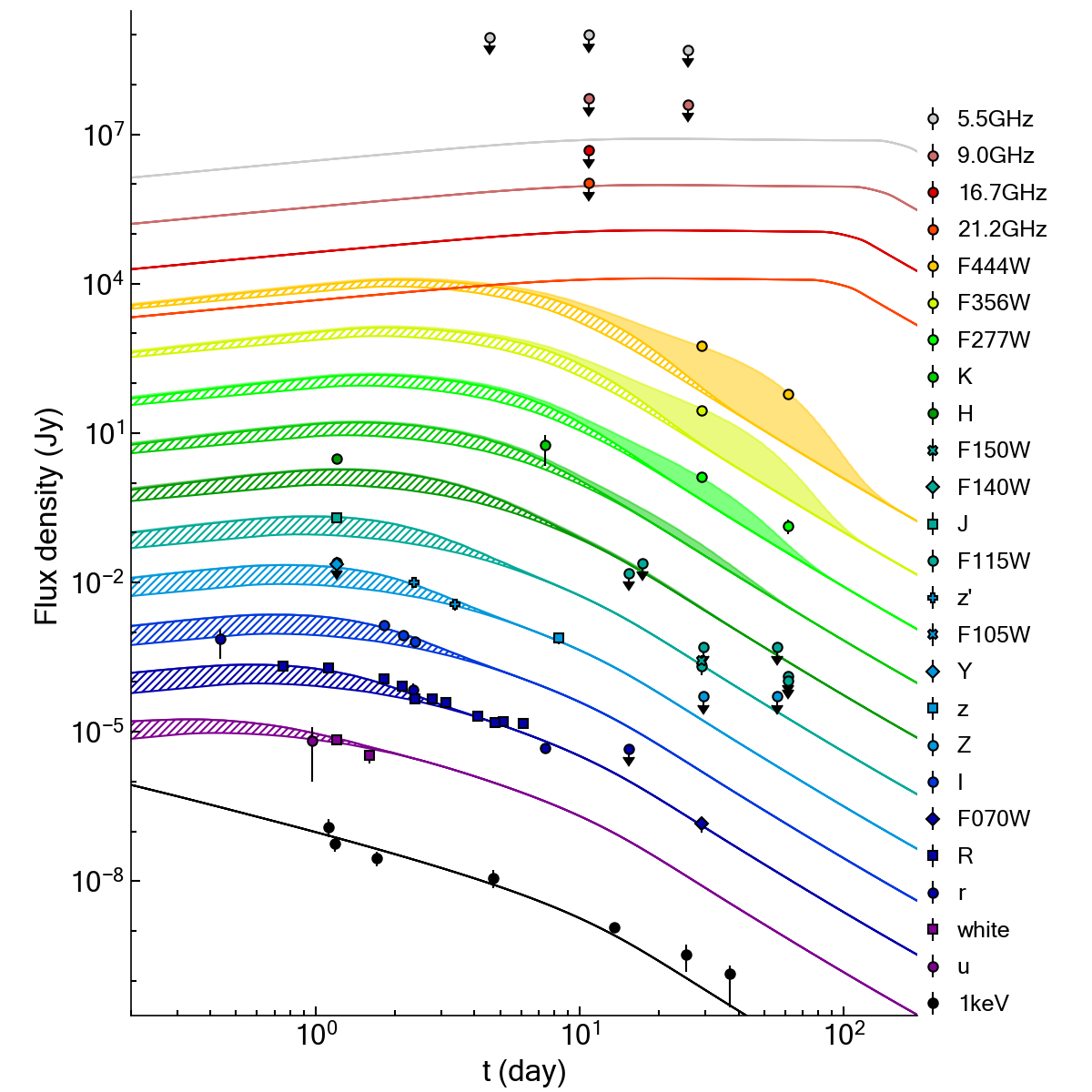
- Two-component kilonova modeling with varying ejecta masses, velocities, and opacities using kilonova/X-ray/IR light curves; comparison to single-component KN and afterglow models.
- Afterglow modeling with the external forward shock framework (afterglowpy) and kilonova light curves from gwemlightcurves to fit multi-wavelength data.
- Bayesian inference via MCMC/nested sampling (pymultinest) to derive best-fit parameters and evaluate model evidence (ΔBIC).
- bolometric luminosity, photospheric radius, and temperature evolution inferred from blackbody fits to track ejecta cooling and recombination.
- Assessment of host galaxy properties and redshift constraints from JWST/HST observations to inform distance scale and progenitor interpretation.
Experimental results
Research questions
- RQ1Does GRB 230307A host a kilonova powered by r-process–enhanced, lanthanide-rich ejecta?
- RQ2What are the masses, velocities, and opacities of the kilonova ejecta required to reproduce the observed light curves and spectra?
- RQ3Is a two-component kilonova necessary to explain the optical/NIR/IR evolution, and what does this imply about ejecta composition and ionization state?
- RQ4What does the event imply about the GRB progenitor (compact binary merger vs. massive-star collapse) given the host environment and prompt emission properties?
- RQ5How do late-time bolometric luminosity and photospheric evolution constrain energy deposition (e.g., absence of strong magnetar/fission signatures) and the presence of lanthanides?
Key findings
- The afterglow plus kilonova model provides a significantly better fit than an afterglow-only model (ΔBIC > 140).
- Two kilonova components are favored: a fast, low-opacity ejecta (v ~ 0.2c, M ≈ 0.03 M_sun, κ ≲ 3 cm^2 g^-1) dominating early emission, and a slower, high-opacity component (v ~ 0.03c, M ≈ 0.05 M_sun, κ ≳ 13 cm^2 g^-1) dominating late-time emission.
- The bolometric luminosity decays as L_bol ∝ t^-2.7 ± 0.4 from ~29 d to ~61 d, with temperatures dropping below ~2000 K, consistent with lanthanide-rich ejecta recombination and photospheric recession.
- The late-time COs/nIR evolution and high opacity imply production of r-process elements beyond the first peak (A ≳ 85), consistent with lanthanide synthesis in the merger ejecta.
- Host analysis supports a nearby (z ≈ 0.0647; D_L ≈ 291 Mpc) galaxy (G1) as the most likely host, with properties indicating a low-mass, low-SFR, relatively old stellar population; the environment is compatible with compact binary merger progenitors for long GRBs.
- Prompt emission properties and Amati relation positioning allow multiple redshift scenarios; the z < 3.3 constraint from SED, plus host association hints, favor a nearby origin over a very high-redshift GRB.
- The data favor a compact binary merger as the progenitor, with a kilonova signature similar in nature to those observed in other nearby GRBs (e.g., GRB 211211A) and consistent with lanthanide-rich ejecta.
Read this paper
Open the full text in the Nubint reader and ask about any passage as you read.
Read this paper on NubintThis review was generated by AI from the original paper. Please check the paper before citing it.