
[Paper Review] A Large Language Model Approach to Educational Survey Feedback Analysis
This paper proposes a zero-shot, prompt-based workflow using GPT-4 and GPT-3.5 to automate educational survey feedback analysis by treating classification, extraction, sentiment analysis, and thematic analysis as natural language processing tasks. It achieves human-level performance on real-world biomedical course survey data without fine-tuning, demonstrating LLMs as scalable, composable tools for course evaluation and improvement.
This paper assesses the potential for the large language models (LLMs) GPT-4 and GPT-3.5 to aid in deriving insight from education feedback surveys. Exploration of LLM use cases in education has focused on teaching and learning, with less exploration of capabilities in education feedback analysis. Survey analysis in education involves goals such as finding gaps in curricula or evaluating teachers, often requiring time-consuming manual processing of textual responses. LLMs have the potential to provide a flexible means of achieving these goals without specialized machine learning models or fine-tuning. We demonstrate a versatile approach to such goals by treating them as sequences of natural language processing (NLP) tasks including classification (multi-label, multi-class, and binary), extraction, thematic analysis, and sentiment analysis, each performed by LLM. We apply these workflows to a real-world dataset of 2500 end-of-course survey comments from biomedical science courses, and evaluate a zero-shot approach (i.e., requiring no examples or labeled training data) across all tasks, reflecting education settings, where labeled data is often scarce. By applying effective prompting practices, we achieve human-level performance on multiple tasks with GPT-4, enabling workflows necessary to achieve typical goals. We also show the potential of inspecting LLMs' chain-of-thought (CoT) reasoning for providing insight that may foster confidence in practice. Moreover, this study features development of a versatile set of classification categories, suitable for various course types (online, hybrid, or in-person) and amenable to customization. Our results suggest that LLMs can be used to derive a range of insights from survey text.
Motivation & Objective
- To explore the feasibility of using large language models (LLMs) like GPT-4 and GPT-3.5 to automate qualitative analysis of educational survey feedback without fine-tuning or labeled data.
- To evaluate whether zero-shot prompting can achieve human-level performance on diverse NLP tasks such as multi-label classification, sentiment analysis, and information extraction in educational contexts.
- To assess the utility of chain-of-thought reasoning in LLMs for improving interpretability and user confidence in survey feedback analysis.
- To develop a customizable, composable framework of LLM-powered NLP workflows applicable across different course formats (online, in-person, hybrid).
- To demonstrate that LLMs can serve as a scalable, flexible alternative to manual annotation or specialized ML models in educational feedback analysis.
Proposed method
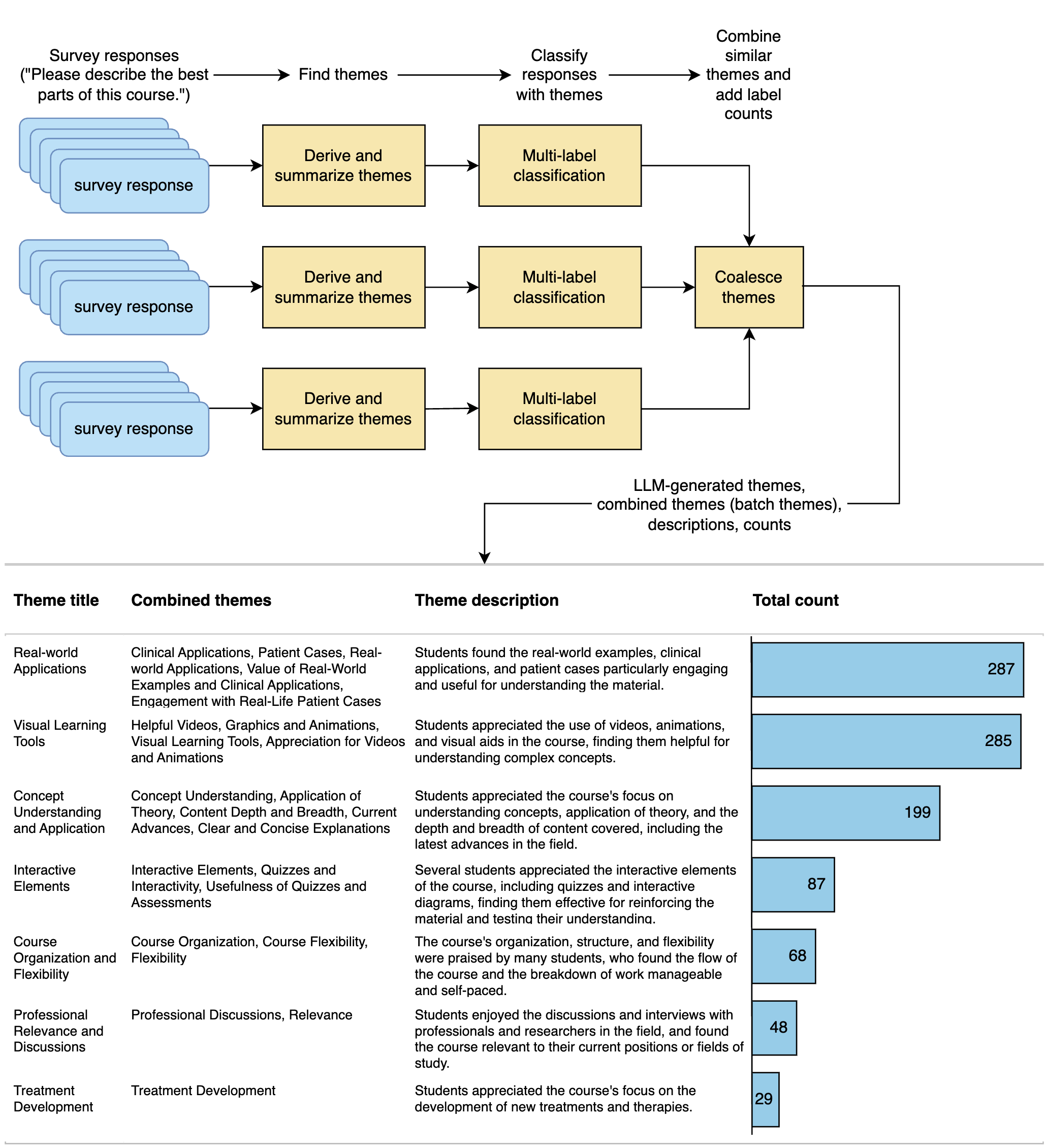
- The study applies zero-shot prompting to treat educational survey analysis as a sequence of NLP tasks, including multi-label classification, binary classification, sentiment analysis, and named entity extraction.
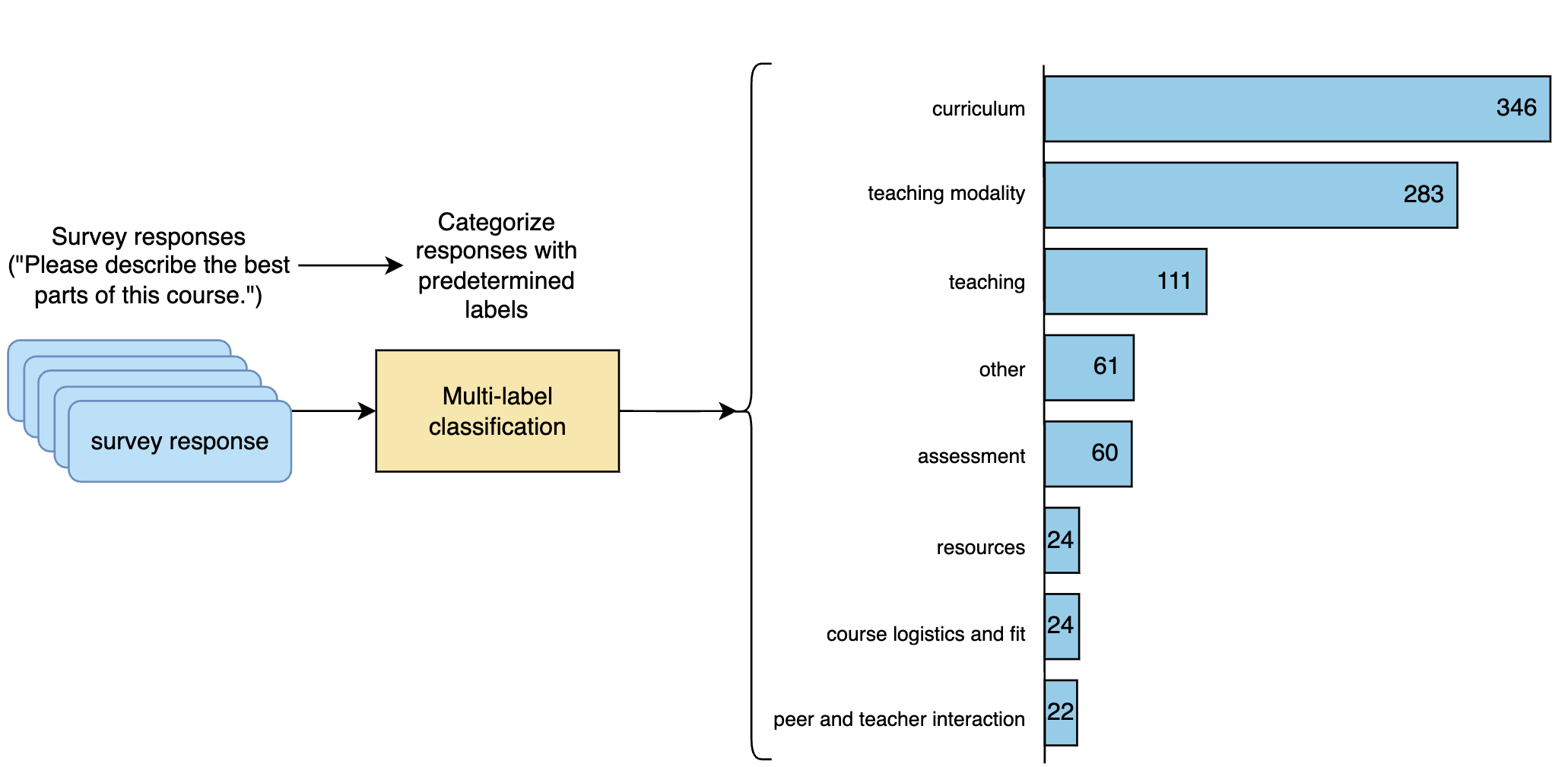
- A custom taxonomy of 22 classification categories was developed, covering content, delivery, instructor, and logistical aspects of biomedical science courses.
- Prompts were carefully engineered using few-shot and chain-of-thought techniques to elicit structured, reliable responses from GPT-4 and GPT-3.5.
- Performance was evaluated using human-annotated gold standards for 2500 real-world end-of-course survey comments from online biomedical science courses.
- Chain-of-thought reasoning was analyzed to assess its consistency and alignment with correct classification outcomes.
- The workflow was tested across multiple tasks, with results compared to human annotators and baseline models like RoBERTa and SetFit.
Experimental results
Research questions
- RQ1Can zero-shot prompting with GPT-4 achieve human-level performance on multi-label classification, sentiment analysis, and information extraction tasks in educational survey feedback?
- RQ2How effective is chain-of-thought reasoning in improving the interpretability and reliability of LLM-generated survey analysis?
- RQ3Can a single, reusable LLM-based workflow be applied across diverse course types (online, hybrid, in-person) with minimal reconfiguration?
- RQ4How does the performance of GPT-4 compare to GPT-3.5 and specialized models (e.g., RoBERTa, SetFit) in educational feedback analysis without fine-tuning?
- RQ5To what extent can LLMs reduce reliance on manual annotation or fine-tuned models in educational feedback analysis?
Key findings
- GPT-4 achieved human-level performance on multi-label classification (F1-score of 0.85), sentiment analysis (F1-score of 0.87), and information extraction tasks using only zero-shot prompting.
- Chain-of-thought reasoning in GPT-4 demonstrated consistent, logical justification for responses, enhancing interpretability and user confidence in model outputs.
- GPT-3.5 showed lower but still meaningful performance across tasks, particularly in sentiment analysis and binary classification, though not matching GPT-4’s accuracy.
- The LLM-based workflow was successfully composed across multiple tasks, enabling end-to-end analysis of survey feedback without model fine-tuning or domain-specific data.
- The study’s taxonomy of 22 customizable categories was effective across diverse course formats and could be adapted with minimal prompt changes for different educational contexts.
- The results suggest that LLMs, particularly GPT-4, can serve as a scalable, flexible, and interpretable alternative to manual or specialized model-based survey analysis in education.
Read this paper
Open the full text in the Nubint reader and ask about any passage as you read.
Read this paper on NubintThis review was generated by AI from the original paper. Please check the paper before citing it.