
[Paper Review] A Large-Scale Analysis on Self-Supervised Video Representation Learning
This paper introduces a large-scale benchmark for self-supervised video representation learning, enabling fair comparison across 7 methods and 7 architectures on 5 datasets. It reveals key insights—such as non-contrastive methods being more robust to noise, spatio-temporal pretext tasks generalizing well across data distributions, and knowledge distillation from diverse teachers improving performance—leading to a new method that outperforms SOTA using only 10% of the pretraining data.
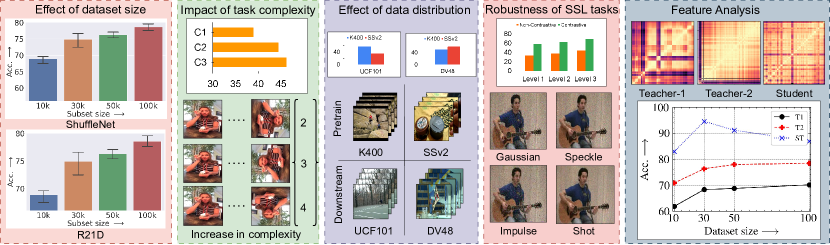
Self-supervised learning is an effective way for label-free model pre-training, especially in the video domain where labeling is expensive. Existing self-supervised works in the video domain use varying experimental setups to demonstrate their effectiveness and comparison across approaches becomes challenging with no standard benchmark. In this work, we first provide a benchmark that enables a comparison of existing approaches on the same ground. Next, we study five different aspects of self-supervised learning important for videos; 1) dataset size, 2) complexity, 3) data distribution, 4) data noise, and, 5)feature analysis. To facilitate this study, we focus on seven different methods along with seven different network architectures and perform an extensive set of experiments on 5 different datasets with an evaluation of two different downstream tasks. We present several interesting insights from this study which span across different properties of pretraining and target datasets, pretext-tasks, and model architectures among others. We further put some of these insights to the real test and propose an approach that requires a limited amount of training data and outperforms existing state-of-the-art approaches which use 10x pretraining data. We believe this work will pave the way for researchers to a better understanding of self-supervised pretext tasks in video representation learning.
Motivation & Objective
- To establish a standardized benchmark for fair comparison of self-supervised video representation learning methods.
- To analyze five critical factors affecting SSL in videos: dataset size, task complexity, distribution shift, data noise, and feature complementarity.
- To identify design principles for effective pretext tasks and model architectures in low-data regimes.
- To validate insights through a knowledge distillation-based approach that achieves SOTA performance with significantly reduced pretraining data.
Proposed method
- The benchmark standardizes pretraining hyperparameters, datasets, and evaluation protocols across 7 self-supervised methods and 7 network architectures.
- The study evaluates contrastive and non-contrastive learning objectives with three data transformation types: spatial, temporal, and spatio-temporal.
- Extensive experiments are conducted on five video action recognition datasets (UCF101, HMDB51, Kinetics400, SSv2, Something-Something V2) across two downstream tasks: action recognition and video retrieval.
- Knowledge distillation is applied using multiple teacher models trained on diverse pretext tasks and data distributions to distill complementary features.
- Robustness and generalization are evaluated under data noise and distribution shift, using controlled noise injection and cross-dataset evaluation.
- Performance is measured via top-1 and top-5 accuracy on action recognition and mean average precision on video retrieval.
Experimental results
Research questions
- RQ1How does pretraining dataset size affect downstream performance, and does diminishing returns occur beyond a certain threshold?
- RQ2How do different levels of pretext task complexity impact the learning of spatio-temporal representations?
- RQ3How robust are contrastive and non-contrastive self-supervised methods to data noise in real-world scenarios?
- RQ4To what extent do different data distributions in pretraining affect generalization to downstream tasks?
- RQ5Can features from diverse pretext tasks and architectures be combined to improve performance through knowledge distillation?
Key findings
- Contrastive self-supervised methods are faster learners but significantly less robust to data noise compared to non-contrastive methods.
- Increasing pretext task complexity does not guarantee better representation learning; performance gains are not monotonic with complexity.
- Temporal-based pretext tasks are more challenging to solve than spatial or spatio-temporal tasks, indicating higher representational demand.
- Spatio-temporal pretext tasks generalize well across data distribution shifts, maintaining strong performance even when source and target data differ.
- Knowledge distillation from multiple teachers—each specialized in different architectures, tasks, and data distributions—leads to substantial performance gains, especially in low-data regimes.
- The proposed method achieves state-of-the-art performance on video action recognition using only 10% of the pretraining data required by prior SOTA methods, demonstrating a 90% reduction in data and 80% improvement in resource efficiency.
Read this paper
Open the full text in the Nubint reader and ask about any passage as you read.
Read this paper on NubintThis review was generated by AI from the original paper. Please check the paper before citing it.