
[Paper Review] A massive, neutral gas reservoir permeating a galaxy proto-cluster after the reionization era
This study reports the first detection of a massive, spatially coherent reservoir of cold, neutral atomic hydrogen (H i) permeating a galaxy proto-cluster at z ≈ 5.4, one billion years after the Big Bang, using JWST/NIRSpec spectroscopy. The observation reveals H i column densities up to 10²³.⁵ cm⁻² across multiple background galaxies, indicating a dense, large-scale gas overdensity that challenges current cosmological simulations and has major implications for the topology of cosmic reionization.
Galaxy clusters are the most massive, gravitationally-bound structures in the Universe, emerging through hierarchical structure formation of large-scale dark matter and baryon overdensities. Early galaxy ``proto-clusters'' are believed to be important physical drivers of the overall cosmic star-formation rate density and serve as ``hotspots'' for the reionization of the intergalactic medium. Our understanding of the formation of these structures at the earliest cosmic epochs is, however, limited to sparse observations of their galaxy members, or based on phenomenological models and cosmological simulations. Here we report the detection of a massive neutral, atomic hydrogen (HI) gas reservoir permeating a galaxy proto-cluster at redshift $z=5.4$, observed one billion years after the Big Bang. The presence of this cold gas is revealed by strong damped Lyman-$α$ absorption features observed in several background galaxy spectra taken with JWST/NIRSpec in close on-sky projection. While overall the sightlines probe a large range in HI column densities, $N_{ m HI} = 10^{21.7}-10^{23.5}$ cm$^{-2}$, they are similar across nearby sightlines, demonstrating that they probe the same dense, neutral gas. This observation of a massive, large-scale overdensity of cold neutral gas challenges current large-scale cosmological simulations and has strong implications for the reionization topology of the Universe.
Motivation & Objective
- To characterize the baryonic content and distribution of cold, dense neutral gas in a rare, massive galaxy proto-cluster at z ≈ 5.4.
- To determine whether the strong damped Lyα absorption features observed in background galaxies arise from a common, large-scale H i reservoir or from individual host galaxies.
- To assess the implications of such a massive, coherent H i overdensity for the reionization topology of the early Universe.
- To test whether current cosmological simulations can reproduce the observed extreme gas overdensities and column density distributions.
- To quantify the covering fraction and spatial coherence of high-column-density H i gas in proto-cluster environments using statistical modeling and simulations.
Proposed method
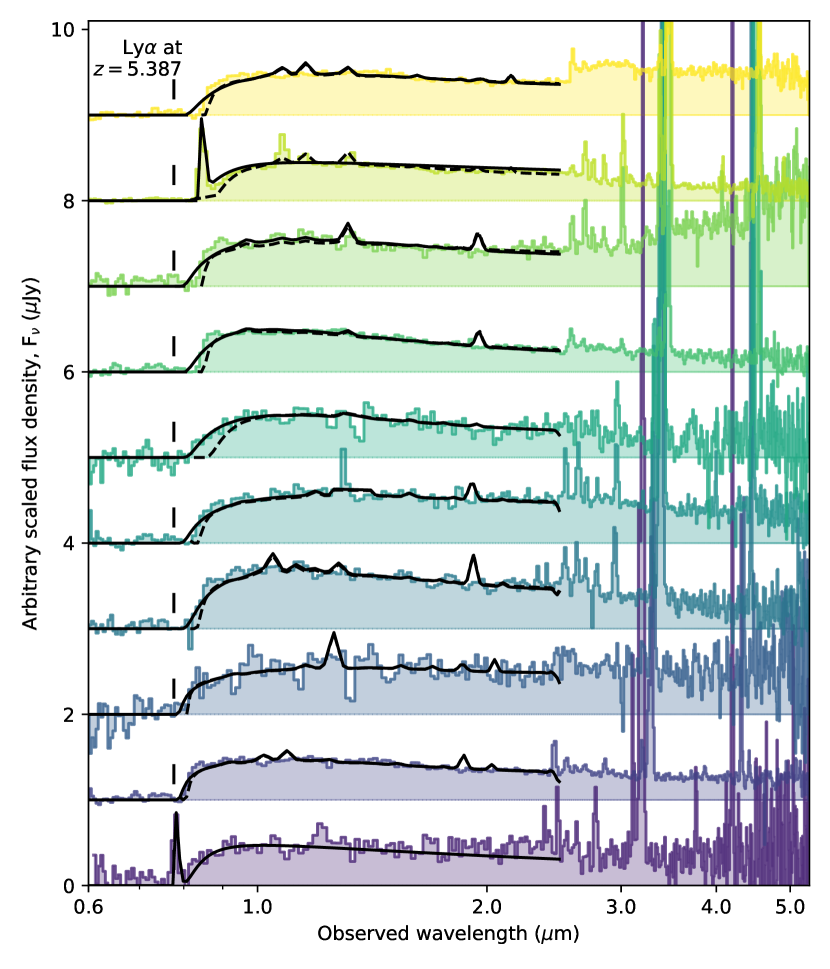
- Utilized JWST/NIRSpec Prism-mode spectroscopy to detect strong damped Lyα (DLA) absorption features in 10 background galaxies at z = 5.4–6.0.
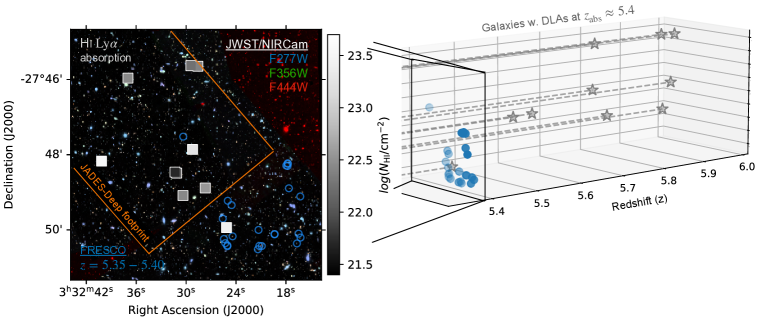
- Combined with JWST/NIRCam slitless grism observations from the FRESCO survey to identify and redshift the proto-cluster members at z ≈ 5.35–5.40.
- Applied photometric priors and required ≥5σ detections of H α and [N II] emission to confirm redshifts and select galaxy members.
- Modelled DLA absorption using free parameters for redshift and column density, excluding host-galaxy origins at >3σ confidence for most sightlines.
- Mapped the spatial distribution of H i column densities as a function of projected distance from the proto-cluster center, revealing similar values at small impact parameters.
- Compared observations with high-resolution cosmological simulations from the Manhattan Suite, analyzing covering fractions and overdensities at z = 5.4.
Experimental results
Research questions
- RQ1Is the strong damped Lyα absorption observed in multiple background galaxies due to a common, large-scale H i reservoir or individual galaxy contributions?
- RQ2What is the spatial coherence and overdensity of neutral gas in this proto-cluster, and how does it compare to predictions from cosmological simulations?
- RQ3To what extent do current simulations reproduce the observed column density distribution and covering fractions of H i at z ≈ 5.4?
- RQ4How does the presence of such a massive, cold H i reservoir affect the reionization topology and ionizing photon budget in early galaxy overdensities?
- RQ5What is the implied physical extent and mass of the neutral gas reservoir, and how does it relate to the halo mass and star formation history of the proto-cluster?
Key findings
- A massive, spatially coherent H i reservoir with column densities ranging from 10²¹.⁷ to 10²³.⁵ cm⁻² was detected across multiple background galaxies at z ≈ 5.4.
- Sightlines with small projected distances (<100 kpc) from the proto-cluster center show highly similar H i column densities, indicating a common, dense gas structure.
- The observed H i overdensity implies a neutral gas fraction f_HI(1+δ) ≈ 10³–10⁴, far exceeding typical values in current cosmological simulations at z ≈ 5.5.
- The covering fraction of H i at N_HI > 10²¹.⁷ cm⁻² reaches up to 15% in simulations, but such extreme, spatially coherent overdensities are not reproduced in the Manhattan Suite simulations.
- The proto-cluster has a total halo mass of log(M_halo/M☉) ≈ 12.6–12.8, consistent with future formation of a massive galaxy cluster (M₂₀₀,c ≈ 10¹⁵ M☉) at z = 0.
- The observed H i reservoir is inconsistent with models that do not include detailed galaxy formation physics, highlighting the need for improved simulations to capture dense, neutral gas in early structure formation.
Read this paper
Open the full text in the Nubint reader and ask about any passage as you read.
Read this paper on NubintThis review was generated by AI from the original paper. Please check the paper before citing it.