
[Paper Review] A new measurement of the expansion history of the Universe at z=1.26 with cosmic chronometers in VANDELS
This study presents a new cosmological measurement of the Hubble parameter at redshift z ≈ 1.26 using the cosmic chronometers method applied to 39 massive, passive galaxies from the VANDELS survey. By performing full-spectral fitting to derive robust stellar ages without cosmological priors, the authors obtain H(z=1.26) = 135 ± 65 km s⁻¹ Mpc⁻¹, demonstrating the viability of the cosmic chronometer approach up to z > 1 and highlighting its potential for future large surveys like Euclid.
We derive a new constraint on the expansion history of the Universe by applying the cosmic chronometers method, studying the age evolution of high-redshift galaxies with a full-spectral-fitting approach. We select a sample of 39 massive ($log(M/M_\odot)>10.8$) and passive ($log(sSFR/yr^{-1})<-11$) galaxies from the data release 4 of the VANDELS survey at $1=0.28\pm0.02$ Gyr), low dust extinction ($=0.43\pm0.02$ mag), and sub-solar metallicities ($=0.44\pm0.01$). The ages show a decreasing trend with redshift compatible with a standard cosmological model, even if no cosmological constraint is assumed in the fit, and a clear mass-downsizing pattern. Testing the impact of the star formation history on the results, we find only a maximum 2\% fluctuation in age and metallicity. By fitting the median age-redshift relation with a flat $Λ$CDM model and assuming a Gaussian prior on $Ω_{M,0}= 0.3\pm0.02$ from late-Universe probes, we obtain $H_0=67_{-15}^{+14}\:km\:s^{-1}\:Mpc^{-1}$. In the end, we derive a new estimate of the Hubble parameter with the cosmic chronometers method, $H(z=1.26)=135\pm65\:km\:s^{-1}\:Mpc^{-1}$ including statistical and systematic errors. While the error budget is currently dominated by the scarcity of the sample, this work proves the potential strength of the cosmic chronometers approach up to $z>1$, especially in view of incoming large spectroscopic surveys like Euclid. (abridged)
Motivation & Objective
- To measure the Hubble parameter at high redshift (z ≈ 1.26) using the cosmic chronometer method, independent of cosmological assumptions.
- To test the robustness of stellar age estimates derived from full-spectral fitting in high-redshift passive galaxies.
- To investigate the presence of mass-downsizing in massive, passive galaxies at z ≈ 1.26 using spectral features and physical parameter constraints.
- To assess the sensitivity of age and Hubble parameter estimates to different star formation history models and sample selection criteria.
- To demonstrate the feasibility of extending the cosmic chronometer method beyond z ≈ 1 using deep, high-quality spectroscopic data.
Proposed method
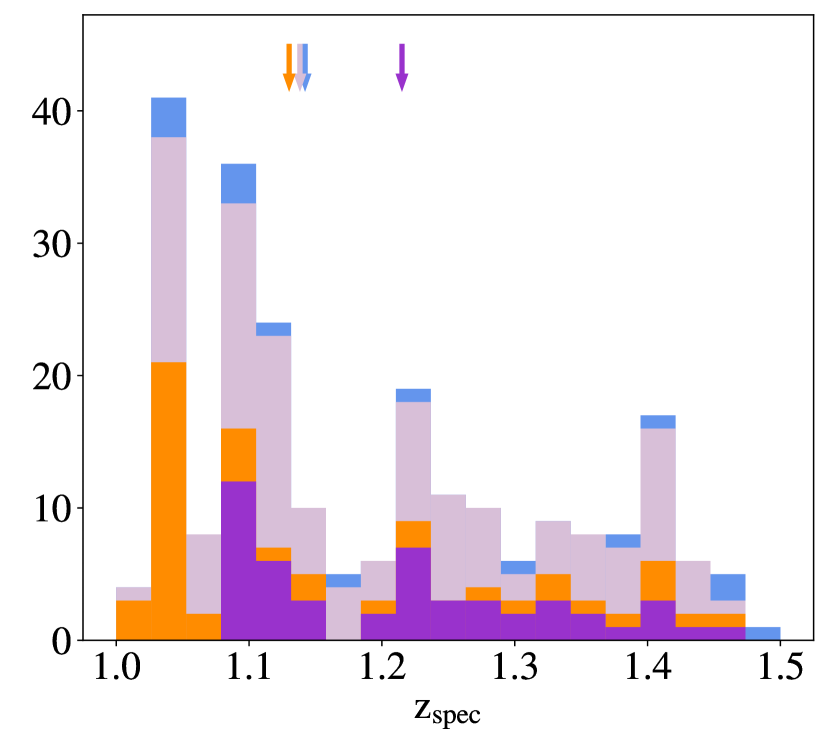
- The authors select 39 massive (log(M*/M☉) ≥ 10.8), passive (log(sSFR/yr⁻¹) ≤ -11) galaxies from the VANDELS survey in the redshift range 1 < z < 1.5 using combined photometric and spectroscopic criteria to minimize contamination by star-forming outliers.
- Stellar population properties—including age, metallicity, dust extinction, and star formation timescale—are derived via full-spectral fitting using the BAGPIPES code, jointly analyzing both spectra and photometry without imposing cosmological priors on age.
- The age-redshift relation is constructed by binning the sample into redshift and mass bins, computing median ages, and fitting this median relation to a flat ΛCDM model with a Gaussian prior on ΩM,0 = 0.30 ± 0.02 to break parameter degeneracies.
- The cosmic chronometer method is applied to the median age-redshift relation to directly estimate H(z) at z ≈ 1.26 using the differential age formula H(z) = -1/(1+z) × dz/dt.
- The robustness of results is tested by comparing age estimates from different star formation history models (delayed τ and double-power law), showing median differences of less than 2% in age and metallicity under physically reasonable constraints.
- Systematic uncertainties in H(z) are evaluated by varying the binning scheme and using more complex SFH models, with statistical errors dominating the final error budget.

Experimental results
Research questions
- RQ1Can the cosmic chronometer method reliably measure the Hubble parameter at z ≈ 1.26 using high-redshift passive galaxies?
- RQ2Do the derived stellar ages from full-spectral fitting show a consistent age evolution with redshift, independent of cosmological assumptions?
- RQ3Is there evidence of mass-downsizing in massive, passive galaxies at z ≈ 1.26, as indicated by differences in spectral features and age estimates?
- RQ4How sensitive are the Hubble parameter and age estimates to the choice of star formation history model?
- RQ5To what extent do systematic uncertainties from sample selection, binning, and SFH modeling affect the final H(z) measurement?
Key findings
- The sample of 39 massive, passive galaxies exhibits a clear age evolution with redshift, with stellar ages decreasing as cosmic time progresses, confirming the expected aging of the population.
- The median stellar age of the sample is 1.7⁺¹.⁵₋₀.⁹ Gyr, with a median star formation timescale of ⟨τ⟩ = 0.28 ± 0.02 Gyr, low dust extinction (⟨AV,dust⟩ = 0.43 ± 0.02 mag), and sub-solar metallicity (⟨Z/Z☉⟩ = 0.44 ± 0.01), consistent with other high-redshift passive galaxies.
- More massive galaxies (⟨log(M*/M☉)⟩ = 11.4) are older than less massive ones (⟨log(M*/M☉)⟩ = 11.15) by approximately 0.8 Gyr, providing strong evidence for mass-downsizing at z ≈ 1.26.
- Age estimates are robust to different star formation history models, with median differences in age and metallicity below 2% when comparing delayed τ and double-power law SFHs under physically constrained parameters.
- The Hubble parameter at z ≈ 1.26 is measured as H(z=1.26) = 135 ± 65 km s⁻¹ Mpc⁻¹, with statistical uncertainties dominating the error budget.
- The derived H₀ = 67⁺¹⁴₋₁⁵ km s⁻¹ Mpc⁻¹ from the median age-redshift fit is consistent with late-Universe probes and supports the potential of the cosmic chronometer method for future high-redshift cosmology.
Read this paper
Open the full text in the Nubint reader and ask about any passage as you read.
Read this paper on NubintThis review was generated by AI from the original paper. Please check the paper before citing it.