
[論文レビュー] A non-linear solution to the $S_8$ tension II: Analysis of DES Year 3 cosmic shear
本論文はDES Year 3の宇宙シアー観測データを用いて$S_8$の矛盾を調査し、波数$k \sim 0.2h\,{\rm Mpc}^{-1}$における非線形的物質パワー スペクトルの抑制が、弱引力レンズ測定とPlanckの$\Lambda{\rm CDM}$宇宙論の一致をもたらす可能性を提案している。必要な抑制は、以前のKiDSに基づく結果ほど極端ではないが、依然として流体力学的シミュレーションの予測を上回っており、修正されたダークマターまたは強化されたバリオン的フィードバックのような非標準的物理学の導入が求められる可能性を示唆している。
Weak galaxy lensing surveys have consistently reported low values of the $S_8$ parameter compared to the $ extit{Planck}\ Λ m{CDM}$ cosmology. Amon & Efstathiou (2022) used KiDS-1000 cosmic shear measurements to propose that this tension can be reconciled if the matter fluctuation spectrum is suppressed more strongly on non-linear scales than assumed in state-of-the-art hydrodynamical simulations. In this paper, we investigate cosmic shear data from the Dark Energy Survey (DES) Year 3. The non-linear suppression of the matter power spectrum required to resolve the $S_8$ tension between DES and the $ extit{Planck}\ Λ m{CDM}$ model is not as strong as inferred using KiDS data, but is still more extreme than predictions from recent numerical simulations. An alternative possibility is that non-standard dark matter contributes to the required suppression. We investigate the redshift and scale dependence of the suppression of the matter power spectrum. If our proposed explanation of the $S_8$ tension is correct, the required suppression must extend into the mildly non-linear regime to wavenumbers $k\sim 0.2 h { m Mpc}^{-1}$. In addition, all measures of $S_8$ using linear scales should agree with the $ extit{Planck}\ Λ m{CDM}$ cosmology, an expectation that will be testable to high precision in the near future.
研究の動機と目的
- DES Year 3の宇宙シアーとPlanckの$\Lambda{\rm CDM}$宇宙論の間の$S_8$の矛盾を解消するために、物質パワー スペクトルの非線形的抑制が有効かどうかを検証すること。
- 必要な抑制が、現在の流体力学的シミュレーションの予測と整合しているか、あるいは非標準的ダークマターのような新しい物理学を示唆するかを評価すること。
- 特に波数$k \sim 0.2h\,{\rm Mpc}^{-1}$までのやや非線形領域における抑制の赤方偏移およびスケール依存性を検討すること。
- 非線形的抑制仮説が正しい場合、すべての線形スケール$S_8$測定値がPlanckの$\Lambda{\rm CDM}$宇宙論と一致するかを評価すること。
- 検証可能な予測を提示する:今後の高精度の線形スケール測定(例:CMBレンズing-銀河相互相関)が$\Lambda{\rm CDM}$と一致するならば、提案された解決策が妥当であると結論づける。
提案手法
- 物質パワー スペクトルの現象論的モデルを用いる:$P_{\rm m}(k,z) = P^{\rm L}_{\rm m}(k,z) + A_{\rm mod}[P^{\rm NL}_{\rm m}(k,z) - P^{\rm L}_{\rm m}(k,z)]$。ここで$A_{\rm mod}$は非線形パワーの抑制を制御するパラメータである。
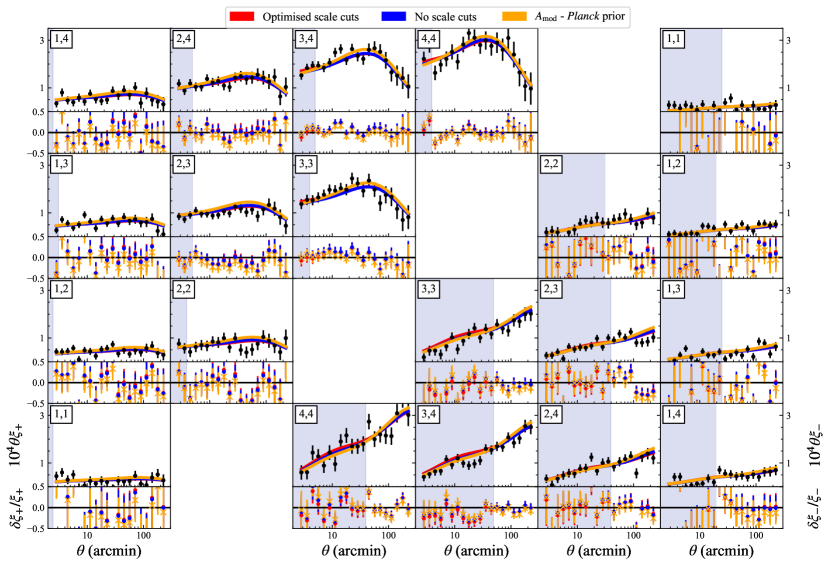
- DES Year 3データの宇宙シアー2点相関関数にこのモデルを適用し、$A_{\rm mod}$を最適化しながら宇宙論的パラメータを周辺化してフィッティングする。
- フィットの質と$S_8$の制約を、Planckの$\Lambda{\rm CDM}$モデルと比較し、$\chi^2$とベイズ的証拠を用いて矛盾の軽減を評価する。
- 抑制の赤方偏移および波数依存性を分析し、特に$k \sim 0.2h\,{\rm Mpc}^{-1}$までのやや非線形領域に注目する。
- CMBレンズing-銀河相互相関や赤方偏移空間歪みといった、独立した線形スケール$S_8$測定とモデルの整合性を評価する。
- 過去のKiDSベースの分析と比較することで、系誤差に対する結果の頑健性を評価し、今後の観測的制約を考慮する。
実験結果
リサーチクエスチョン
- RQ1物質パワー スペクトルの非線形的抑制は、DES Year 3の宇宙シアーデータにおける$S_8$の矛盾を解消できるか?
- RQ2最新の流体力学的シミュレーションの予測と比較して、必要な抑制の大きさ($A_{\rm mod}$)はどうなるか?
- RQ3抑制はスケールおよび赤方偏移に依存するか?また、$k \sim 0.2h\,{\rm Mpc}^{-1}$程度のやや非線形領域にまで及ぶか?
- RQ4非線形的抑制仮説が正しい場合、すべての線形スケール$S_8$測定値はPlanckの$\Lambda{\rm CDM}$宇宙論と一致するか?
- RQ5バリオン的フィードバックや非標準的ダークマターといった、必要な抑制を生じさせる物理的メカニズムは何か?
主な発見
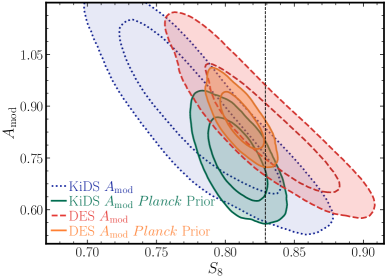
- DES Year 3データにおける$S_8$の矛盾を解消するための非線形的物質パワー スペクトルの抑制は、KiDS-1000の結果よりも控えめであり、$A_{\rm mod} \approx 0.75$(Paper Iの$\approx 0.69$と比較)である。
- 控えめではあるが、依然として最近の流体力学的シミュレーションの予測を上回っており、標準的バリオン的フィードバックを超える物理学的メカニズムの導入が求められる可能性を示唆している。
- 抑制はやや非線形領域にまで及んでいなければデータと整合しない。特に波数$k \sim 0.2h\,{\rm Mpc}^{-1}$まで顕著な影響を及ぼす必要がある。
- 非線形的抑制仮説が正しい場合、線形スケールに支配されるすべての$S_8$測定値(例:CMBレンズing-銀河相互相関、赤方偏移空間歪み)は、Planckの$\Lambda{\rm CDM}$モデルと一致しなければならない。
- この仮説が成立するためには、今後の高精度の線形スケール測定が$\Lambda{\rm CDM}$と整合することを確認する必要がある。もし乖離が見られれば、提案された解決策は否定される。
- DESの結果は、今後の弱引力レンズ調査がスケール全域にわたって物質パワー スペクトルを再構築し、非線形物理学とラテタイム$\Lambda{\rm CDM}$のずれを区別できるようにする必要性を強調している。
より良い研究を、今すぐ始めましょう
論文の読解から最終レビューまで、研究時間を劇的に削減しましょう。
クレジットカード登録不要
このレビューはAIが作成し、人間の編集者が確認しました。