
[Paper Review] A non-Newtonian approach in differential geometry of curves: multiplicative rectifying curves
This paper introduces a non-Newtonian differential geometry framework using multiplicative calculus to study rectifying curves in 3D multiplicative Euclidean space. By redefining vector operations and derivatives multiplicatively, the authors characterize multiplicative rectifying curves as those whose position vector lies in the rectifying plane, proving they are generated by scaling multiplicative spherical curves via a multiplicative secant function, thus enabling geometric analysis where standard calculus fails.
In this paper, we study the rectifying curves in multiplicative Euclidean space of dimension 3, i.e., those curves for which the position vector always lies in its rectifying plane. Since the definition of rectifying curve is affine and not metric, we are directly able to perform multiplicative differential-geometric concepts to investigate such curves. Having presented several characterizations, we completely classify the multiplicative rectifying curves by means of the multiplicative spherical curves.
Motivation & Objective
- To extend differential geometry to non-Newtonian frameworks using multiplicative calculus.
- To define and characterize rectifying curves in multiplicative Euclidean 3-space, where the position vector lies in the rectifying plane.
- To overcome limitations of standard calculus in analyzing certain curves by introducing a multiplicative differential-geometric approach.
- To demonstrate that multiplicative calculus provides geometric clarity for curves that are analytically intractable under Newtonian calculus.
- To establish a complete classification of multiplicative rectifying curves via multiplicative spherical curves.
Proposed method
- Define multiplicative Euclidean space ℝ³* with multiplicative vector addition and scalar multiplication.
- Introduce multiplicative inner product ⟨⋅,⋅⟩* and multiplicative norm ‖⋅‖* to replace standard Euclidean structure.
- Use multiplicative derivative x*(s) = lim_{h→0*} (x(s+h) ⊗ x(s)^{-1})^{1/h} to define curve evolution.
- Define multiplicative Frenet formulas and curvatures (multiplicative curvature and torsion) in terms of multiplicative derivatives.
- Characterize multiplicative rectifying curves as those satisfying x(s) = ρ(s) ⋅* y(s), where ρ(s) = a ⋅* sec*s(s) and y(s) is a multiplicative spherical curve with ‖y*(s)‖* = 1*.
- Prove that such curves lie entirely in their rectifying plane by showing the normal component x⊥*(s) has constant multiplicative norm a²*.
Experimental results
Research questions
- RQ1How can rectifying curves be redefined and characterized in a multiplicative differential geometry framework?
- RQ2What is the geometric structure of a multiplicative rectifying curve in ℝ³*?
- RQ3How does the multiplicative derivative enable the analysis of curves that are difficult to handle with standard calculus?
- RQ4Can multiplicative spherical curves serve as a generating mechanism for multiplicative rectifying curves?
- RQ5What is the necessary and sufficient condition for a curve to be a multiplicative rectifying curve in terms of its multiplicative curvature and parameterization?
Key findings
- A curve x(s) in multiplicative Euclidean 3-space is a multiplicative rectifying curve if and only if it is of the form x(s) = (a ⋅* sec*s(s)) ⋅* y(s), where y(s) is a multiplicative spherical curve with ‖y*(s)‖* = 1*.
- The multiplicative rectifying curve is completely classified by its associated multiplicative spherical curve and the multiplicative radius function ρ(s) = a ⋅* sec*s(s).
- The normal component x⊥*(s) of the position vector has constant multiplicative norm a²*, confirming the curve lies in its rectifying plane.
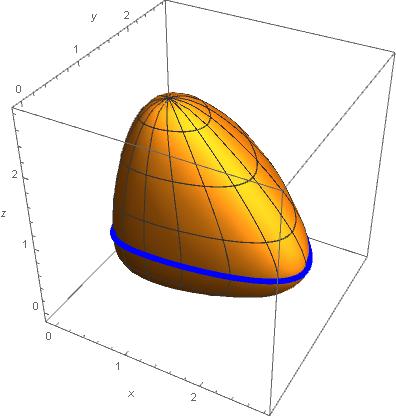
- The curve defined by x(t) = e^{sec(log t)/√2}, y(t) = e^{sec(log t)cos(log t^√2)/√2}, z(t) = e^{sec(log t)sin(log t^√2)/√2} is a multiplicative rectifying curve when parameterized by multiplicative arc length.
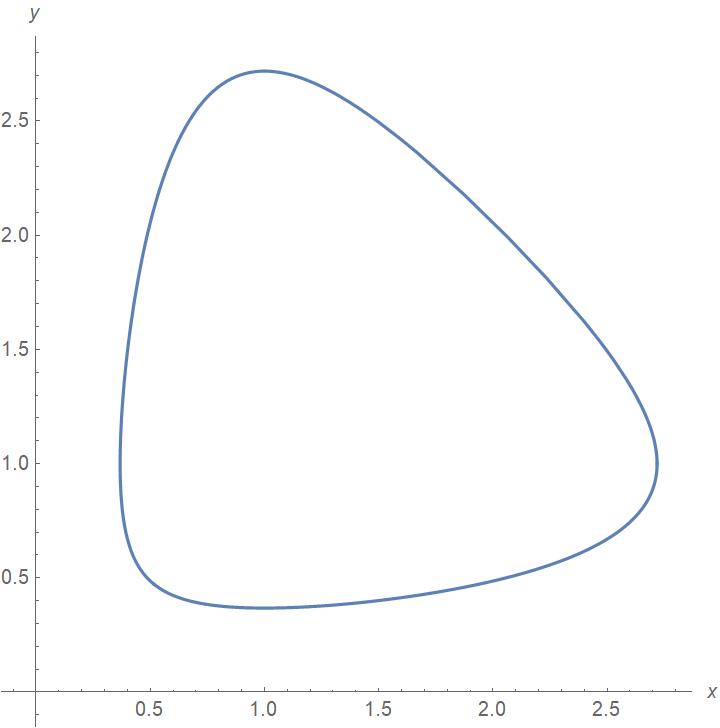
- The multiplicative circle defined by (log x)² + (log y)² = 1 in ℝ² is a simple example of a multiplicative spherical curve, and its multiplicative radius function is ρ(s) = e ⋅* sec*s(s).
- The multiplicative derivative satisfies standard derivative properties (e.g., chain rule, linearity) under the new multiplicative algebra, enabling consistent differential geometry.
Read this paper
Open the full text in the Nubint reader and ask about any passage as you read.
Read this paper on NubintThis review was generated by AI from the original paper. Please check the paper before citing it.