
[Paper Review] A Novel Approach to the Behavioral Aspects of Cybersecurity
This paper proposes a novel behavioral cybersecurity framework emphasizing situational support, self-efficacy, response efficacy, and behavioral comprehensiveness to enhance information security compliance. Using structural equation modeling and bootstrap analysis, it demonstrates that situational support significantly promotes cybersecurity habits through serial mediation by self-efficacy and behavioral comprehensiveness, offering actionable insights for organizational training and AI-based fatigue detection in high-risk contexts.
The Internet and cyberspace are inseparable aspects of everyone's life. Cyberspace is a concept that describes widespread, interconnected, and online digital technology. Cyberspace refers to the online world that is separate from everyday reality. Since the internet is a recent advance in human lives, there are many unknown and unpredictable aspects to it that sometimes can be catastrophic to users in financial aspects, high-tech industry, and healthcare. Cybersecurity failures are usually caused by human errors or their lack of knowledge. According to the International Business Machines Corporation (IBM) X-Force Threat Intelligence Index in 2020, around 8.5 billion records were compromised in 2019 due to failures of insiders, which is an increase of more than 200 percent compared to the compromised records in 2018. In another survey performed by the Ernst and Young Global Information Security during 2018-2019, it is reported that 34% of the organizations stated that employees who are inattentive or do not have the necessary knowledge are the principal vulnerabilities of cybersecurity, and 22% of the organizations indicated that phishing is the main threat to them. Inattentive users are one of the reasons for data breaches and cyberattacks. The National Cyber Security Centre (NCSC) in the United Kingdom observed that 23.2 million users who were victims of cybersecurity attacks used a carelessly selected password, which is 123456, as their account password. The Annual Cybersecurity Report published by Cisco in 2018 announced that phishing and spear phishing emails are the root causes of many cybersecurity attacks in recent years. Hence, enhancing the cybersecurity behaviors of both personal users and organizations can protect vulnerable users from cyber threats. Both human factors and technological aspects of cybersecurity should be addressed in organizations for a safer environment.
Motivation & Objective
- To address the persistent role of human error in cybersecurity breaches, particularly insider threats and phishing attacks.
- To investigate how psychological and environmental factors such as situational support, self-efficacy, and behavioral comprehensiveness influence information security compliance.
- To develop a validated behavioral model that integrates human factors into cybersecurity strategies for organizations.
- To propose practical interventions—like labeled external emails and AI-based fatigue detection—targeting cognitive vulnerabilities during peak attack times.
Proposed method
- Applied structural equation modeling (SEM) to test a theoretical framework linking situational support, self-efficacy, response efficacy, behavioral comprehensiveness, and cybersecurity habits.
- Used 26 validated items to measure organizational culture constructs: cooperativeness, innovation, consistency, and effectiveness.
- Measured self-efficacy (SE), response efficacy (RE), habit (HA), and behavioral comprehensiveness (BC) using established scales with Cronbach’s alpha >0.91.
- Conducted bootstrap analysis (5,000 resamples) to test serial multiple mediation effects of self-efficacy and behavioral comprehensiveness on the relationship between situational support and cybersecurity habits.
- Incorporated control variables such as gender, major, grade, and demographic factors in multivariate analysis to isolate behavioral effects.
- Proposed two practical interventions: email labeling for external messages and AI-driven fatigue detection using image/video processing for high-risk work hours.
Experimental results
Research questions
- RQ1How does situational support influence cybersecurity behavior through self-efficacy and behavioral comprehensiveness?
- RQ2To what extent do self-efficacy and response efficacy mediate the relationship between situational support and cybersecurity habits?
- RQ3How do organizational culture traits—cooperativeness, innovation, consistency, and effectiveness—impact information security compliance intentions?
- RQ4What role do psychological contracts and employee-specific factors (e.g., age, tenure, social status) play in compliance with information security policies?
- RQ5Can AI-based fatigue detection tools reduce human error in cybersecurity by identifying cognitive fatigue during high-risk periods?
Key findings
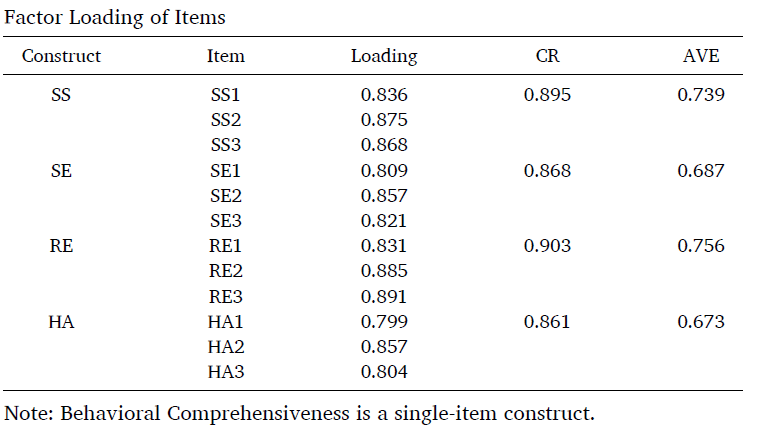
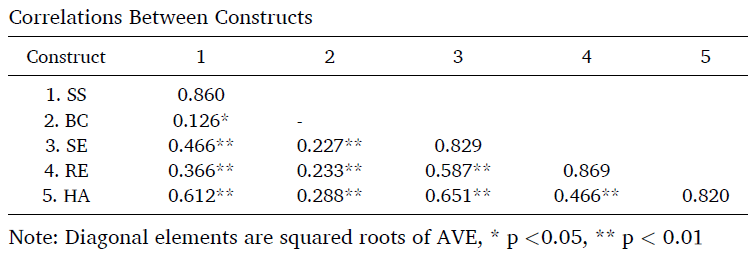
- Situational support has a significant positive impact on both self-efficacy and response efficacy, with a composite reliability (CR) above 0.7 and average variance extracted (AVE) above 0.5, indicating strong convergent validity.
- Self-efficacy and response efficacy jointly mediate the relationship between situational support and behavioral comprehensiveness, with a bootstrap 95% confidence interval for the indirect effect that excludes zero.
- The serial multiple mediation effect of self-efficacy and behavioral comprehensiveness fully explains the positive influence of situational support on cybersecurity habits.
- The habit factor (HA) demonstrated a Cronbach’s alpha of 0.925, indicating high internal consistency and reliability in measuring long-term cybersecurity behaviors.
- The study found that psychological contract fulfillment has a stronger effect on information security compliance intention among managers than among supervisees, highlighting role-specific behavioral dynamics.
- The proposed AI-based fatigue detection approach, using machine learning for video and image processing, shows potential for identifying cognitive fatigue during peak phishing attack times, though raises privacy concerns.
Read this paper
Open the full text in the Nubint reader and ask about any passage as you read.
Read this paper on NubintThis review was generated by AI from the original paper. Please check the paper before citing it.