
[Paper Review] A panorama of new-physics explanations to the MiniBooNE excess
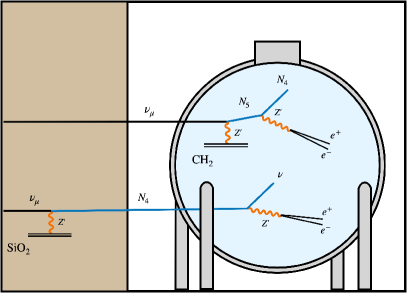
This paper presents a comprehensive analysis of dark neutrino models as a solution to the MiniBooNE low-energy excess, proposing that short-lived heavy neutral leptons (HNLs) produced in neutrino-nucleus scattering decay into e⁺e⁻ pairs inside the detector. The authors perform the first global fit of the MiniBooNE energy spectrum in the context of 3+1 and 3+2 HNL models, demonstrating that dark neutrino scenarios can explain the excess while being directly testable in future experiments.
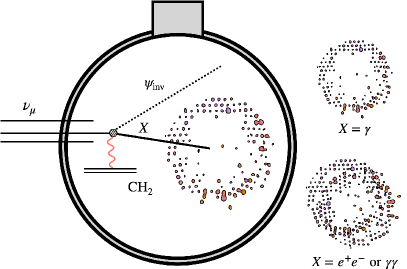
The MiniBooNE low-energy excess stands as an unexplained anomaly in short-baseline neutrino oscillation experiments. It has been shown that it can be explained in the context of dark sector models. Here, we provide an overview of the possible new-physics solutions based on electron, photon, and dilepton final states. We systematically discuss the various production mechanisms for dark particles in neutrino-nucleus scattering. Our main result is a comprehensive fit to the MiniBooNE energy spectrum in the parameter space of dark neutrino models, where short-lived heavy neutral leptons are produced in neutrino interactions and decay to $e^+e^-$ pairs inside the detector. For the first time, other experiments will be able to directly confirm or rule out dark neutrino interpretations of the MiniBooNE low-energy excess.
Motivation & Objective
- To investigate whether dark neutrino models with short-lived heavy neutral leptons (HNLs) can explain the unexplained MiniBooNE low-energy excess (LEE) in electron-like events between 200–600 MeV.
- To systematically evaluate various new-physics production mechanisms for dark particles in neutrino-nucleus scattering, including electron, photon, and dilepton final states.
- To perform a global fit of the MiniBooNE energy spectrum in the parameter space of 3+1 and 3+2 HNL models, accounting for kinematical and detector effects.
- To identify observable signatures—such as asymmetric e⁺e⁻ shower kinematics and angular distributions—that can be probed in upcoming short-baseline experiments.
- To provide a benchmark for future experimental confirmation or exclusion of dark neutrino interpretations of the LEE.
Proposed method
- Develop a phenomenological dark neutrino model where HNLs are produced via neutrino-nucleus neutral-current interactions and decay into e⁺e⁻ pairs inside the MiniBooNE detector.
- Use the DarkNews Monte Carlo simulation framework to model neutrino-nucleus scattering, HNL production, and subsequent decay into e⁺e⁻ final states with realistic detector response.
- Apply a statistical procedure based on a χ²-likelihood fit to compare simulated event spectra with the MiniBooNE data, including systematic uncertainties.
- Systematically vary HNL masses (m₄, m₅), mediator masses (m_Z′), mixing angles (|U_D4|), and coupling strengths (ε) to explore the full parameter space.
- Analyze kinematical distributions—such as shower angles, separation angles, energy asymmetry, and total energy—across the parameter space to identify distinctive signatures.
- Compare results with previous fits (e.g., Ref. [36]) to validate the methodology and ensure consistency in the 3+1 model with m_Z′ = 30 MeV.
Experimental results
Research questions
- RQ1Can dark neutrino models with HNLs decaying into e⁺e⁻ pairs explain the MiniBooNE low-energy excess without invoking sterile neutrino oscillations?
- RQ2What are the dominant production mechanisms for dark particles in neutrino-nucleus scattering that could lead to electron-like signatures in MiniBooNE?
- RQ3How do kinematical observables—such as shower angles, energy asymmetry, and total energy—differ between on-shell and off-shell HNL decays in the 3+1 and 3+2 models?
- RQ4Which regions of the HNL parameter space produce the most distinguishable signals in MiniBooNE, and how do they compare to existing global fits?
- RQ5Can the model’s predictions be directly tested in upcoming short-baseline experiments like the SBN program?
Key findings
- The 3+1 and 3+2 dark neutrino models provide a good fit to the MiniBooNE energy spectrum, with the 3+1 model showing good agreement with prior results when |U_D4| is set to 1.
- On-shell HNL decays produce more forward-moving e⁺e⁻ showers due to higher boost, while off-shell decays lead to broader angular distributions and larger separation angles.
- The highest shower separation angles occur around m₅ ≈ 700 MeV, where energy asymmetry is also maximized due to misreconstructed asymmetric events.
- Total shower energy is significantly enhanced near the on-shell region, particularly for heavier HNLs and larger mixing angles, with peak energies exceeding 500 MeV in favorable parameter regions.
- The on-shell region for m_Z′ ≈ 1.25 GeV in the 3+2 model shows a clear separation in kinematical behavior, with higher m₅ leading to more energetic and widely separated showers.
- The model predicts distinct, measurable kinematical patterns—especially in shower angular separation and energy asymmetry—that can be directly tested in future experiments such as the SBN program.
Read this paper
Open the full text in the Nubint reader and ask about any passage as you read.
Read this paper on NubintThis review was generated by AI from the original paper. Please check the paper before citing it.