
[Paper Review] A Score-based Nonlinear Filter for Data Assimilation
This paper proposes a score-based nonlinear filter that leverages diffusion models to overcome the instability and curse of dimensionality in traditional particle filters. By learning a score function to represent the filtering density and using reverse-time diffusion sampling, the method generates unlimited samples for accurate, non-Gaussian posterior estimation in high-dimensional stochastic dynamical systems.
We introduce a score-based generative sampling method for solving the nonlinear filtering problem with robust accuracy. A major drawback of existing nonlinear filtering methods, e.g., particle filters, is the low stability. To overcome this issue, we adopt the diffusion model framework to solve the nonlinear filtering problem. In stead of storing the information of the filtering density in finite number of Monte Carlo samples, in the score-based filter we store the information of the filtering density in the score model. Then, via the reverse-time diffusion sampler, we can generate unlimited samples to characterize the filtering density. Moreover, with the powerful expressive capabilities of deep neural networks, it has been demonstrated that a well trained score in diffusion model can produce samples from complex target distributions in very high dimensional spaces. Extensive numerical experiments show that our score-based filter could potentially address the curse of dimensionality in very high dimensional problems.
Motivation & Objective
- Address the instability and finite-sample limitations of particle filters in nonlinear filtering problems.
- Overcome the curse of dimensionality in high-dimensional state estimation by replacing particle-based representations with learned score models.
- Enable robust, high-fidelity approximation of non-Gaussian filtering densities using deep generative modeling.
- Leverage the expressive power of score-based generative models to represent complex filtering distributions without relying on Gaussian assumptions.
Proposed method
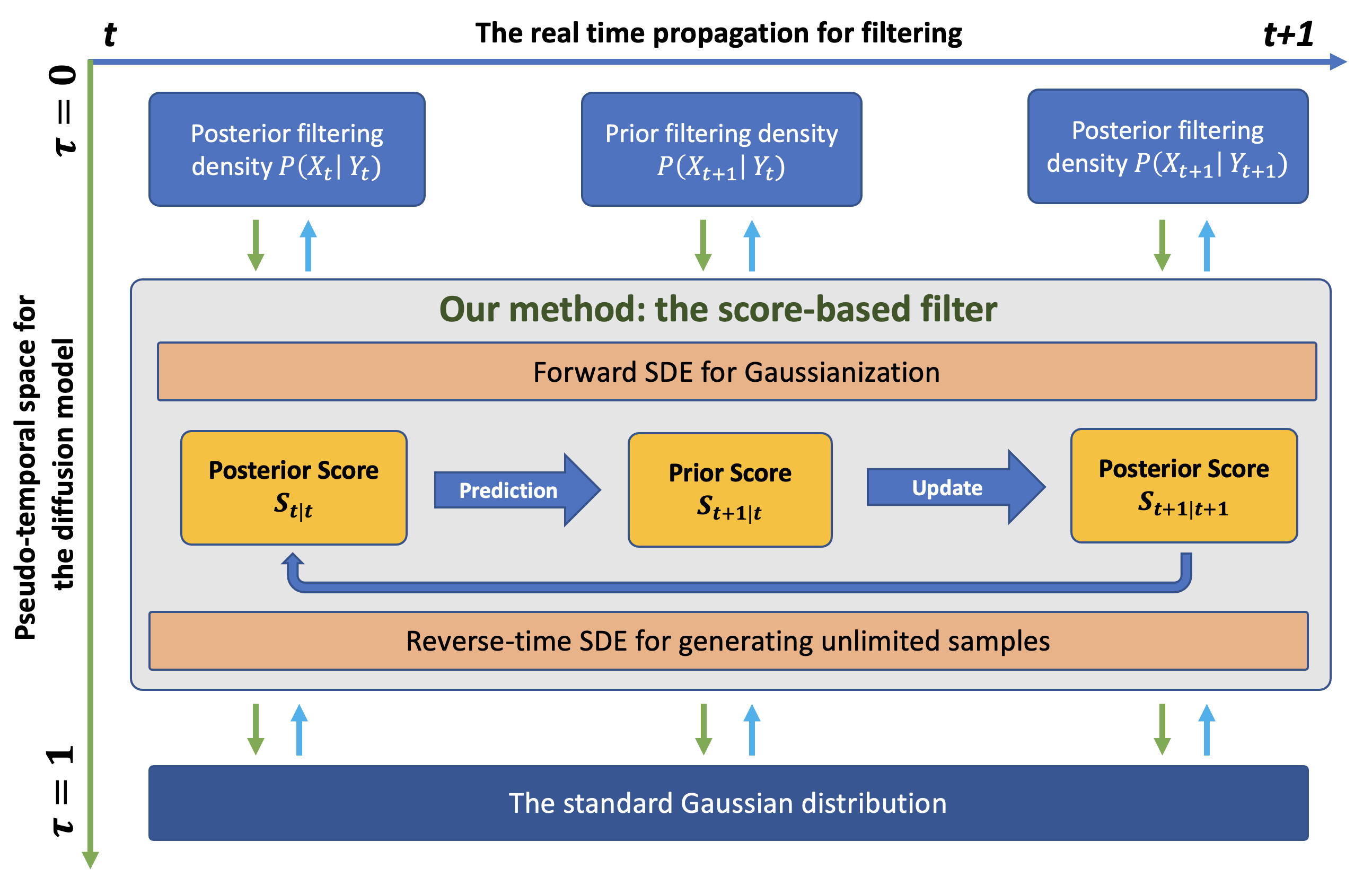
- Formulate the filtering problem within a diffusion model framework, where the filtering density is implicitly represented by a learned score function.
- Use a forward SDE to gradually corrupt the true state distribution into a standard Gaussian, enabling training of the score model.
- Train the score model via a denoising loss that minimizes the difference between the true score and the predicted score at each noise level.
- Apply reverse-time SDE sampling with the trained score model to generate unlimited samples from the filtering density.
- Use the Euler-Maruyama scheme to discretize the reverse-time SDE for practical implementation with adjustable time-step precision.
- Employ a weighting function λ(τ) and noise schedule βτ to balance training loss across the diffusion process.
Experimental results
Research questions
- RQ1Can a score-based generative model effectively represent complex, non-Gaussian filtering densities in high-dimensional nonlinear systems?
- RQ2Does the proposed score-based filter outperform traditional particle filters in terms of stability and accuracy under high-dimensional conditions?
- RQ3To what extent can the diffusion model framework mitigate the curse of dimensionality in data assimilation tasks?
- RQ4How well does the learned score model generalize across different nonlinear dynamical systems and observation models?
- RQ5Can the reverse-time diffusion sampling process reliably reconstruct the filtering density from a single set of initial Gaussian samples?
Key findings
- The score-based filter achieves robust performance in high-dimensional filtering problems where particle filters suffer from degeneracy and instability.
- The method successfully learns complex, non-Gaussian filtering densities through deep score models, enabling accurate posterior approximation without Gaussian assumptions.
- Extensive numerical experiments demonstrate the filter's ability to handle high-dimensional systems, suggesting potential mitigation of the curse of dimensionality.
- The use of a score model allows for unlimited sample generation, overcoming the finite-sample limitation inherent in particle filters.
- The training loss is computationally tractable due to the analytical form of the conditional score, enabling efficient optimization via Monte Carlo sampling.
- The reverse-time SDE sampling process produces samples that closely follow the true filtering density, as validated through empirical distribution matching.
Read this paper
Open the full text in the Nubint reader and ask about any passage as you read.
Read this paper on NubintThis review was generated by AI from the original paper. Please check the paper before citing it.