
[Paper Review] A Survey of Application of Machine Learning in Wireless Indoor Positioning Systems
This survey provides a comprehensive analysis of machine learning (ML)-based wireless indoor positioning systems, evaluating techniques using RSSI, TDOA, AoA, and CSI across fingerprinting, time-based, and angle-based methods. It identifies ML models like MLP, RBF, and RNN as effective for improving accuracy and robustness in non-line-of-sight and noisy environments, with CSI-based fingerprinting emerging as a superior alternative to RSSI due to higher resilience and performance.
Indoor human positioning has become increasingly important for applications such as health monitoring, breath monitoring, human identification, safety and rescue operations, and security surveillance. However, achieving robust indoor human positioning remains challenging due to various constraints. Numerous attempts have been made in the literature to develop efficient indoor positioning systems (IPSs), with a growing focus on machine learning (ML) based techniques. This paper aims to compare and analyze current ML-based wireless techniques and approaches for indoor positioning, providing a comprehensive review of enabling technologies for human detection, positioning, and activity recognition. The study explores different input measurement data, including RSSI, TDOA, etc., for various IPSs. Key positioning techniques such as RSSI-based fingerprinting, Angle-based, and Time-based approaches are examined in conjunction with various ML methods. The survey compares the positioning accuracy, scalability, and algorithm complexity, with the goal of determining the suitable technology in various services. Finally, the paper compares distinct datasets focused on indoor localization, which have been published using diverse technologies. Overall, the paper presents a comprehensive comparison of existing techniques and localization models.
Motivation & Objective
- To systematically review and compare machine learning-based approaches for wireless indoor positioning systems.
- To analyze the performance of various input signal types—RSSI, TDOA, AoA, CSI—across different ML models.
- To evaluate positioning accuracy, scalability, and algorithmic complexity of ML techniques in real-world indoor environments.
- To identify challenges such as device heterogeneity, NLoS conditions, and data scarcity, and assess ML’s role in mitigating them.
- To compile and compare publicly available datasets for indoor localization to support reproducible research and benchmarking.
Proposed method
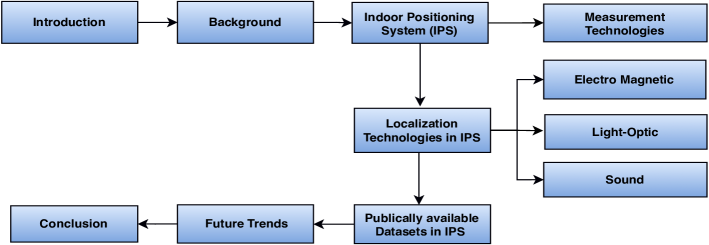
- Surveying peer-reviewed literature from 2010 to 2023 on ML applications in wireless indoor positioning.
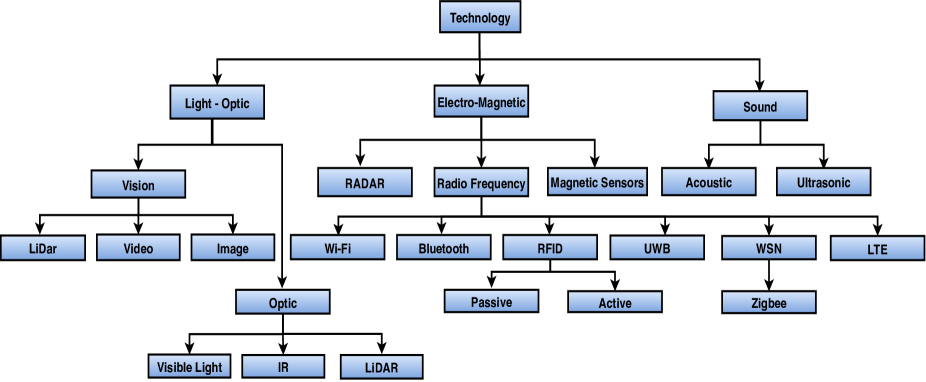
- Classifying indoor positioning techniques into RSSI-based fingerprinting, time-based (ToA/TDoA), and angle-based (AoA) methods.
- Evaluating ML models including multi-layer perceptron (MLP), radial basis function (RBF), k-nearest neighbors (k-NN), and recurrent neural networks (RNN) for localization tasks.
- Analyzing signal characteristics such as CSI, CIR, and signal eigenvectors for improved robustness over traditional RSSI.
- Comparing performance across datasets using metrics like RMSE, MAE, and localization accuracy in different environments.
- Integrating multi-sensor fusion approaches combining vision, sound, inertial sensors, and motion detection to enhance localization, especially for disabled users.
Experimental results
Research questions
- RQ1Which ML models deliver the highest accuracy in indoor positioning under non-line-of-sight (NLoS) and multipath conditions?
- RQ2How does CSI-based fingerprinting compare to RSSI-based fingerprinting in terms of robustness and localization accuracy?
- RQ3What are the key challenges in deploying ML-based indoor positioning systems at scale, and how can they be mitigated?
- RQ4How do hybrid systems combining wireless signals with vision or inertial sensing improve performance and accessibility?
- RQ5What are the most representative and publicly available datasets for indoor localization, and how do they differ in data type and application scope?
Key findings
- ML models such as RBF and RNN significantly improve localization accuracy by modeling non-linear signal distortions in complex indoor environments.
- CSI-based fingerprinting outperforms RSSI-based methods due to higher signal resolution and resilience to multipath fading and NLoS effects.
- Neural networks enable effective feature extraction from raw signal data, enhancing performance in 3D localization and floor detection tasks.
- Hybrid systems integrating vision, sound, and inertial sensors show promise in improving localization for physically disabled individuals and in low-signal environments.
- Despite hardware and data limitations, ML-based systems achieve sub-meter accuracy in controlled environments, with some studies reporting RMSE below 0.5 meters using CSI and deep learning.
- The integration of mmWave radar and IEEE 802.11ay for passive sensing offers potential for high-accuracy, privacy-preserving indoor localization in future systems.
Read this paper
Open the full text in the Nubint reader and ask about any passage as you read.
Read this paper on NubintThis review was generated by AI from the original paper. Please check the paper before citing it.