
[Paper Review] A survey of debris trails from short-period comets
This study uses Spitzer Space Telescope's 24 µm camera to survey 34 short-period comets, detecting debris trails—composed of mm-sized or larger particles—along 27 orbits, confirming debris trails as a generic feature of such comets. The median mass-loss rate in trail particles is 2 kg/s, with total input from Jupiter-family comets estimated at ~300 kg/s, significantly contributing to the interplanetary dust complex.
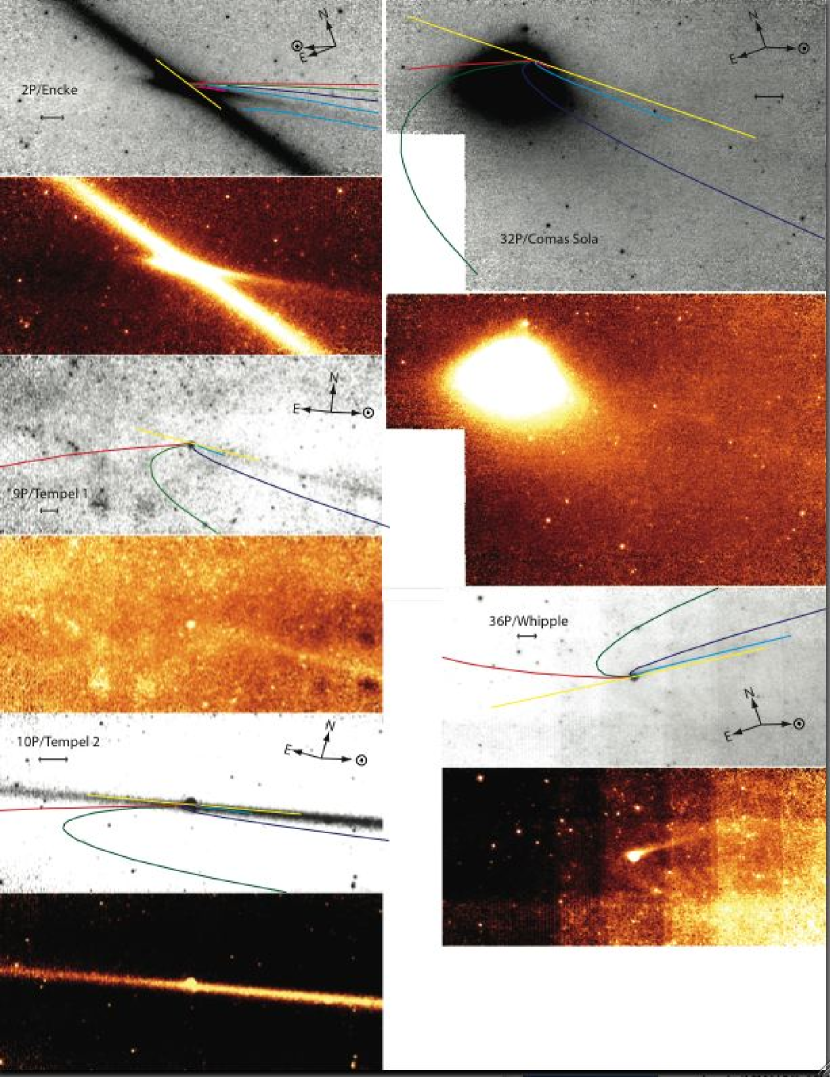
We observed 34 comets using the 24 micron camera on the Spitzer Space Telescope. Each image contains the nucleus and covers at least 10^6 km of each comet's orbit. Debris trails due to mm-sized or larger particles were found along the orbits of 27 comets; 4 comets had small-particle dust tails and a viewing geometry that made debris trails impossible to distinguish; and only 3 had no debris trail despite favorable observing conditions. There are now 30 Jupiter-family comets with known debris trails, of which 22 are reported in this paper for the first time. The detection rate is >80%, indicating that debris trails are a generic feature of short-period comets. By comparison to orbital calculations for particles of a range of sizes ejected over 2 yr prior to observation, we find that particles comprising 4 debris trails are typically mm-sized while the remainder of the debris trails require particles larger than this. The lower-limit masses of the debris trails are typically 10^11 g, and the median mass loss rate is 2 kg/s. The mass-loss rate in trail particles is comparable to that inferred from OH production rates and larger than that inferred from visible-light scattering in comae.
Motivation & Objective
- To determine the prevalence and characteristics of debris trails in short-period comets using infrared observations.
- To quantify the mass-loss rates of particles in debris trails and compare them with other cometary mass-loss indicators.
- To assess the contribution of short-period comets to the interplanetary dust complex and zodiacal light.
- To investigate the size distribution and orbital evolution of debris trail particles using Spitzer data and orbital modeling.
Proposed method
- Conducted deep, wide-area infrared surveys of 34 short-period comets using the Spitzer Space Telescope's 24 µm camera.
- Analyzed images to detect faint, extended debris trails along comet orbits, with sensitivity down to <1% of zodiacal light brightness.
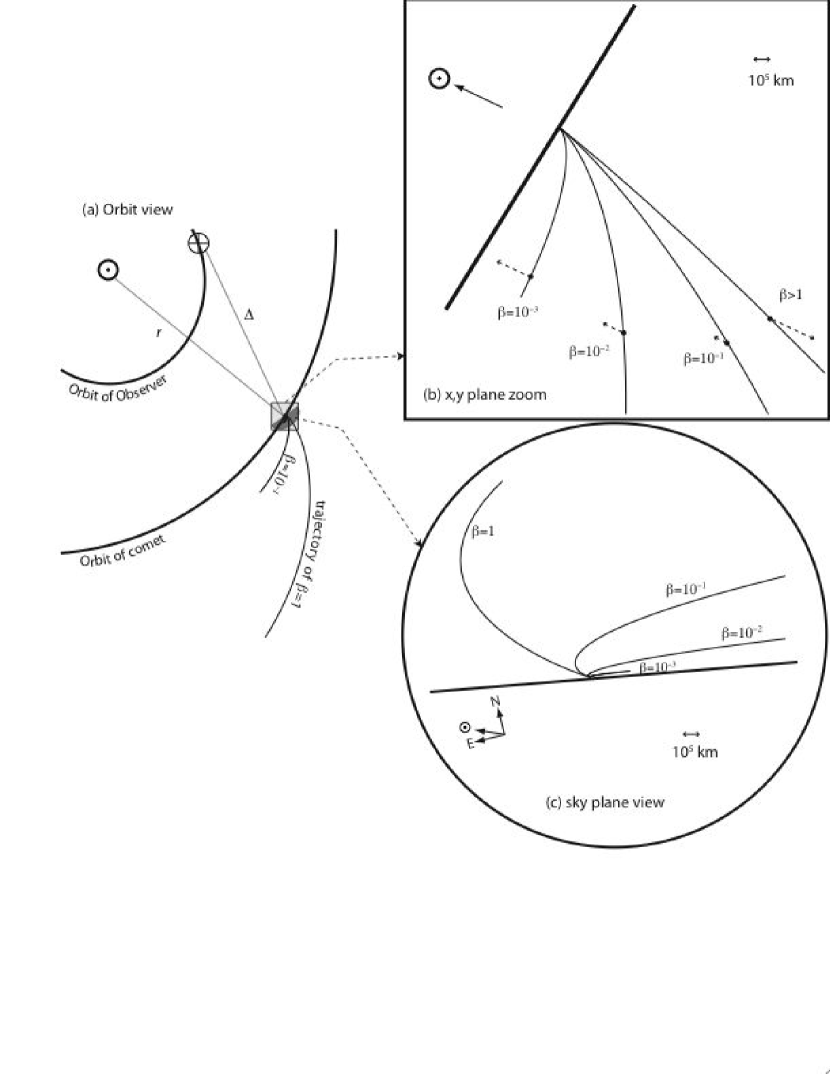
- Modeled particle orbits from 2 years prior to observation, assuming ejection velocities and sizes from 1 mm to larger particles.
- Calculated lower-limit masses of debris trails using observed surface brightness and spatial extent.
- Estimated mass-loss rates by comparing observed trail brightness with theoretical particle size distributions and albedos.
- Used orbital dynamics to assess how gravitational perturbations, Yarkovsky effect, and non-gravitational forces disperse trail particles over time.
Experimental results
Research questions
- RQ1What fraction of short-period comets exhibit detectable debris trails in the infrared?
- RQ2What particle sizes and masses are required to explain the observed debris trail morphology and brightness?
- RQ3How do the inferred mass-loss rates in debris trails compare to those derived from OH production and visible-light scattering?
- RQ4What is the total contribution of short-period comets to the interplanetary dust complex and zodiacal light?
- RQ5How do debris trails evolve into meteoroid streams and sporadic meteors over time?
Key findings
- Debris trails were detected along the orbits of 27 out of 34 observed short-period comets, indicating a detection rate exceeding 80%, confirming debris trails as a generic feature of such comets.
- Particles in 4 of the 27 detected trails are typically mm-sized, while the remaining trails require particles larger than mm in size.
- The lower-limit masses of debris trails are typically 10^11 g, with a median mass-loss rate of 2 kg/s per comet.
- The total mass input from short-period comets into the interplanetary dust complex is estimated at ~300 kg/s, assuming a representative sample and accounting for non-detection of ~20% of comets.
- The inferred mass-loss rate in trail particles is comparable to that from OH production and significantly higher than that inferred from visible-light scattering in comae.
- Debris trail particles, though initially on orbits similar to their parent comets, gradually disperse due to non-gravitational forces, Yarkovsky effect, and planetary perturbations, eventually contributing to the zodiacal dust cloud.
Read this paper
Open the full text in the Nubint reader and ask about any passage as you read.
Read this paper on NubintThis review was generated by AI from the original paper. Please check the paper before citing it.