
[Paper Review] A Survey of Safety and Trustworthiness of Large Language Models through the Lens of Verification and Validation
The paper reviews LLM safety and trustworthiness vulnerabilities and surveys how verification and validation (V&V) techniques can be adapted across the LLM lifecycle, proposing a framework with falsification, verification, runtime monitoring, and ethical/regulatory considerations.
Large Language Models (LLMs) have exploded a new heatwave of AI for their ability to engage end-users in human-level conversations with detailed and articulate answers across many knowledge domains. In response to their fast adoption in many industrial applications, this survey concerns their safety and trustworthiness. First, we review known vulnerabilities and limitations of the LLMs, categorising them into inherent issues, attacks, and unintended bugs. Then, we consider if and how the Verification and Validation (V&V) techniques, which have been widely developed for traditional software and deep learning models such as convolutional neural networks as independent processes to check the alignment of their implementations against the specifications, can be integrated and further extended throughout the lifecycle of the LLMs to provide rigorous analysis to the safety and trustworthiness of LLMs and their applications. Specifically, we consider four complementary techniques: falsification and evaluation, verification, runtime monitoring, and regulations and ethical use. In total, 370+ references are considered to support the quick understanding of the safety and trustworthiness issues from the perspective of V&V. While intensive research has been conducted to identify the safety and trustworthiness issues, rigorous yet practical methods are called for to ensure the alignment of LLMs with safety and trustworthiness requirements.
Motivation & Objective
- Identify and categorize safety and trustworthiness vulnerabilities in LLMs (inherent issues, attacks, unintended bugs).
- Explore how verification and validation techniques can be integrated into the LLM lifecycle for rigorous safety analysis.
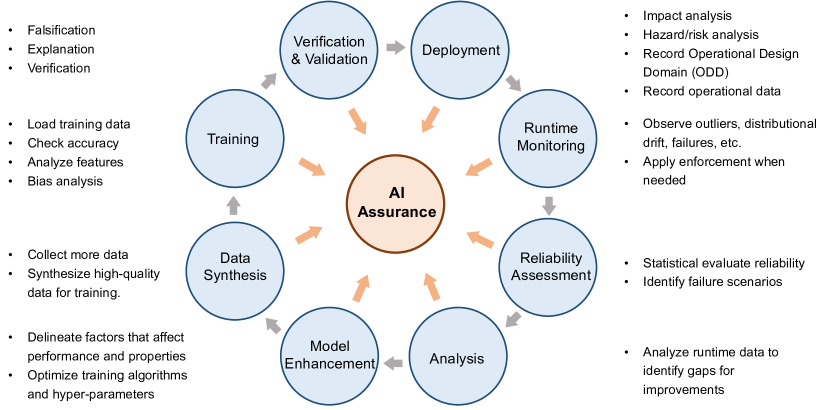
- Present a framework including falsification/evaluation, verification, runtime monitoring, and ethics/regulation to support AI assurance.
- Discuss RLHF and guardrails as core safety mechanisms in LLM development and deployment.
Proposed method
- Review and categorize known LLM vulnerabilities (inherent issues, attacks, unintended bugs).
- Analyze applicability of V&V techniques (falsification, verification, runtime monitoring) to LLMs across their lifecycle.
- Synthesize literature (370+ references) to map V&V techniques to safety and trustworthiness goals.
- Propose a complementary V&V framework tailored for LLMs and AI assurance.
Experimental results
Research questions
- RQ1What are the main safety and trustworthiness vulnerabilities of LLMs across their lifecycle?
- RQ2How can traditional V&V techniques be extended or adapted to verify and validate LLMs in practice?
- RQ3What roles do RLHF and guardrails play in aligning LLMs with safety requirements?
- RQ4What guidance do existing benchmarks, monitoring strategies, and regulatory considerations offer for LLM safety?
- RQ5What gaps remain between vulnerability identification and practical verification/evaluation methods?
Key findings
- LLMs exhibit inherent performance and sustainability issues that affect safety and trustworthiness.
- Attacks (privacy leakage, backdoors, poisoning, disinformation) and unintended bugs pose additional risks during deployment.
- Black-box V&V and runtime monitoring are essential given LLM non-determinism and scale, with a need for scalable, practical evaluation methods.
- RLHF and guardrails are central to current safety strategies, but they can introduce trade-offs between helpfulness and harmlessness.
- There is a strong need for rigorous yet practical V&V methods to ensure alignment with safety and trustworthiness requirements across lifecycle stages.
Read this paper
Open the full text in the Nubint reader and ask about any passage as you read.
Read this paper on NubintThis review was generated by AI from the original paper. Please check the paper before citing it.