
[Paper Review] A Security Risk Taxonomy for Prompt-Based Interaction With Large Language Models
This paper proposes a comprehensive security risk taxonomy for large language models (LLMs) focused on prompt-based interactions, categorizing attacks by target (user, model, third party) and the CIA triad (confidentiality, integrity, availability). It identifies real-world attack examples and provides a structured framework to guide future research and development of secure LLM applications.
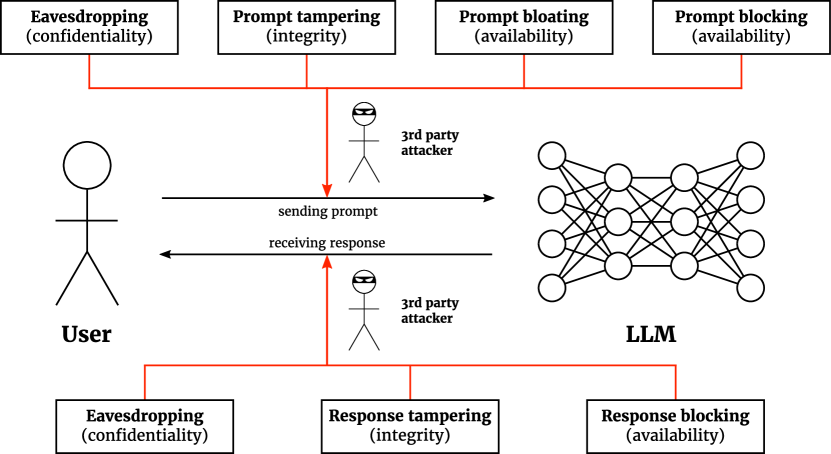
As large language models (LLMs) permeate more and more applications, an assessment of their associated security risks becomes increasingly necessary. The potential for exploitation by malicious actors, ranging from disinformation to data breaches and reputation damage, is substantial. This paper addresses a gap in current research by specifically focusing on security risks posed by LLMs within the prompt-based interaction scheme, which extends beyond the widely covered ethical and societal implications. Our work proposes a taxonomy of security risks along the user-model communication pipeline and categorizes the attacks by target and attack type alongside the commonly used confidentiality, integrity, and availability (CIA) triad. The taxonomy is reinforced with specific attack examples to showcase the real-world impact of these risks. Through this taxonomy, we aim to inform the development of robust and secure LLM applications, enhancing their safety and trustworthiness.
Motivation & Objective
- Address the gap in systematic research on LLM security risks, distinct from ethical and societal concerns.
- Develop a structured taxonomy of security threats in prompt-based LLM interactions to support robust system design.
- Classify attacks based on both target (user, model, third party) and CIA triad principles for comprehensive risk coverage.
- Illustrate real-world attack instances to demonstrate the tangible impact and feasibility of these threats.
- Provide a foundational framework for future research that integrates with existing cybersecurity models and standards.
Proposed method
- Propose a dual-axis taxonomy: one axis based on attack target (user, LLM, third party), the other on the CIA triad (confidentiality, integrity, availability).
- Categorize attacks into distinct types such as prompt injection, data exfiltration, and model manipulation based on target and CIA dimension.
- Use empirical examples from real-world LLM interactions to validate the relevance and feasibility of each attack category.
- Integrate the taxonomy with established cybersecurity frameworks to ensure compatibility with existing threat modeling practices.
- Structure the taxonomy to support both general system-level security (CIA) and actor-specific protection needs (user, stakeholder, third party).
- Ensure ethical boundaries by using only illustrative, anonymized, and non-malicious examples in all demonstrations.

Experimental results
Research questions
- RQ1What are the primary security risks associated with prompt-based interactions in large language models?
- RQ2How can LLM security threats be systematically classified based on their targets and impact on confidentiality, integrity, and availability?
- RQ3What real-world attack examples demonstrate the feasibility and impact of these security risks?
- RQ4How does this taxonomy support the development of more secure and trustworthy LLM applications?
- RQ5In what ways can this taxonomy be integrated into existing cybersecurity and risk assessment frameworks?
Key findings
- The proposed taxonomy systematically classifies LLM security risks into three attack targets—users, the LLM itself, and third parties—enabling targeted defense strategies.
- Attack types such as prompt injection, data exfiltration, and model manipulation are shown to be feasible and impactful in real-world scenarios, including financial fraud and information theft.
- The integration of the CIA triad (confidentiality, integrity, availability) with attack targets provides a robust, scalable framework for threat modeling in LLM systems.
- Empirical examples demonstrate that LLMs can be exploited to generate malicious content, impersonate users, or leak sensitive data, even without violating ToS or legal boundaries.
- The taxonomy serves as a foundational reference for future research, enabling consistent identification and mitigation of emerging threats in LLM security.
- The study highlights that LLMs are vulnerable to both novel and classic cyberattacks, emphasizing the need for enhanced security mechanisms beyond current safety and fairness measures.
Read this paper
Open the full text in the Nubint reader and ask about any passage as you read.
Read this paper on NubintThis review was generated by AI from the original paper. Please check the paper before citing it.