
[Paper Review] A Unified Cryptoprocessor for Lattice-based Signature and Key-exchange
This paper presents a unified, compact, and programmable cryptoprocessor architecture for lattice-based post-quantum cryptography, integrating CRYSTALS-Dilithium (digital signature) and Saber (key encapsulation mechanism). By exploiting shared algorithmic components—especially a unified NTT-based polynomial multiplier and a reconfigurable Keccak core—the design achieves high performance with minimal area overhead, demonstrating 200 MHz operation on FPGA and sub-100 μs execution times for critical operations across both schemes.
We propose design methodologies for building a compact, unified and programmable cryptoprocessor architecture that computes post-quantum key agreement and digital signature. Synergies in the two types of cryptographic primitives are used to make the cryptoprocessor compact. As a case study, the cryptoprocessor architecture has been optimized targeting the signature scheme 'CRYSTALS-Dilithium' and the key encapsulation mechanism (KEM) 'Saber', both finalists in the NIST's post-quantum cryptography standardization project. The programmable cryptoprocessor executes key generations, encapsulations, decapsulations, signature generations, and signature verifications for all the security levels of Dilithium and Saber. On a Xilinx Ultrascale+ FPGA, the proposed cryptoprocessor consumes 18,406 LUTs, 9,323 FFs, 4 DSPs, and 24 BRAMs. It achieves 200 MHz clock frequency and finishes CCA-secure key-generation/encapsulation/decapsulation operations for LightSaber in 29.6/40.4/58.3$μ$s; for Saber in 54.9/69.7/94.9$μ$s; and for FireSaber in 87.6/108.0/139.4$μ$s, respectively. It finishes key-generation/sign/verify operations for Dilithium-2 in 70.9/151.6/75.2$μ$s; for Dilithium-3 in 114.7/237/127.6$μ$s; and for Dilithium-5 in 194.2/342.1/228.9$μ$s, respectively, for the best-case scenario. On UMC 65nm library for ASIC the latency is improved by a factor of two due to a 2x increase in clock frequency.
Motivation & Objective
- To design a compact, unified, and programmable cryptoprocessor that supports both post-quantum key encapsulation (Saber) and digital signature (Dilithium) schemes.
- To exploit algorithmic and structural synergies between NTT-friendly (Dilithium) and NTT-unfriendly (Saber) lattice-based schemes to minimize hardware overhead.
- To achieve high performance and low area consumption for real-world deployment in resource-constrained environments such as TLS-enabled systems.
- To enable extensibility for future lattice-based schemes like CRYSTALS-Kyber through a modular instruction-set architecture.
- To provide a foundation for secure, side-channel resilient implementations via integrated masking strategies for shared components.
Proposed method
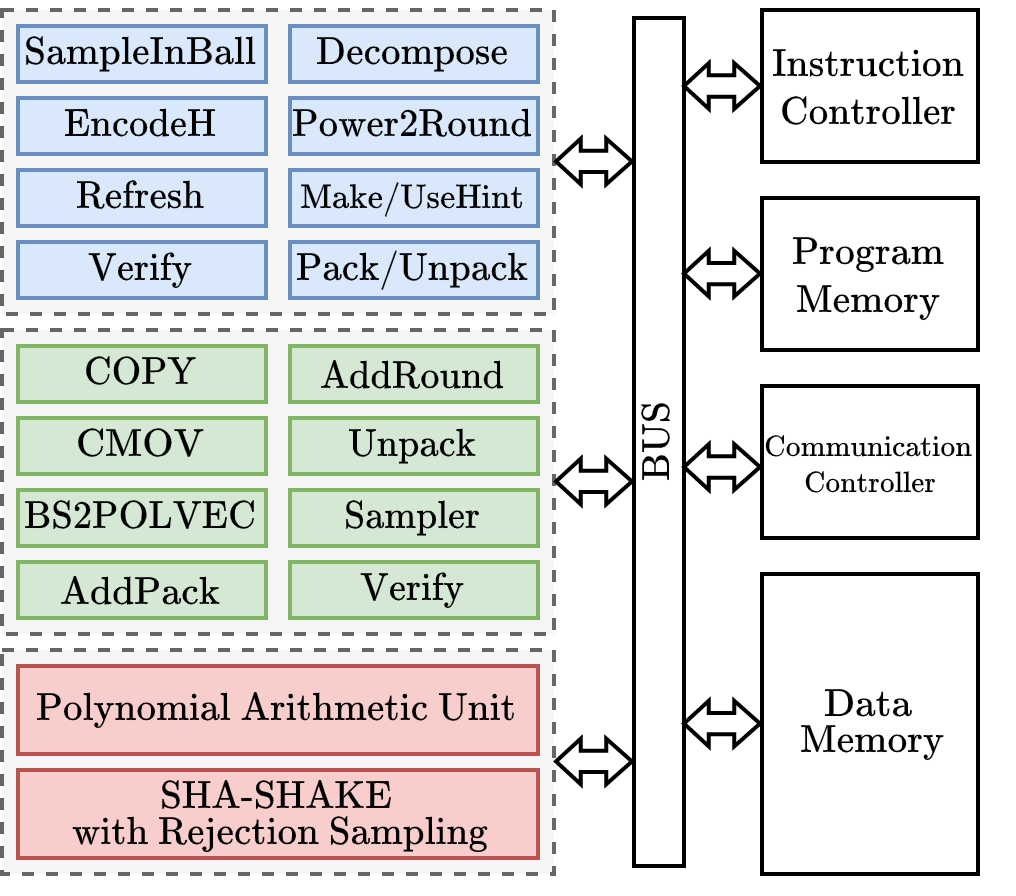
- Design a unified instruction-set architecture that supports both Dilithium and Saber operations using shared hardware units.
- Implement a single NTT-based polynomial multiplier that supports both NTT-friendly (Dilithium) and optimized NTT-unfriendly (Saber) arithmetic via a special prime modulus.
- Develop a reconfigurable Keccak core wrapper to efficiently handle on-the-fly input preprocessing and output postprocessing for SHA3 and SHAKE operations used in both schemes.
- Optimize memory access patterns by reducing redundant read/write cycles through pipelined dataflow and buffering strategies.
- Integrate a dual-mode arithmetic unit for polynomial multiplication and modular reduction, sharing logic across both schemes.
- Use a hardware-software co-design approach to enable runtime reconfiguration and support for multiple security levels.
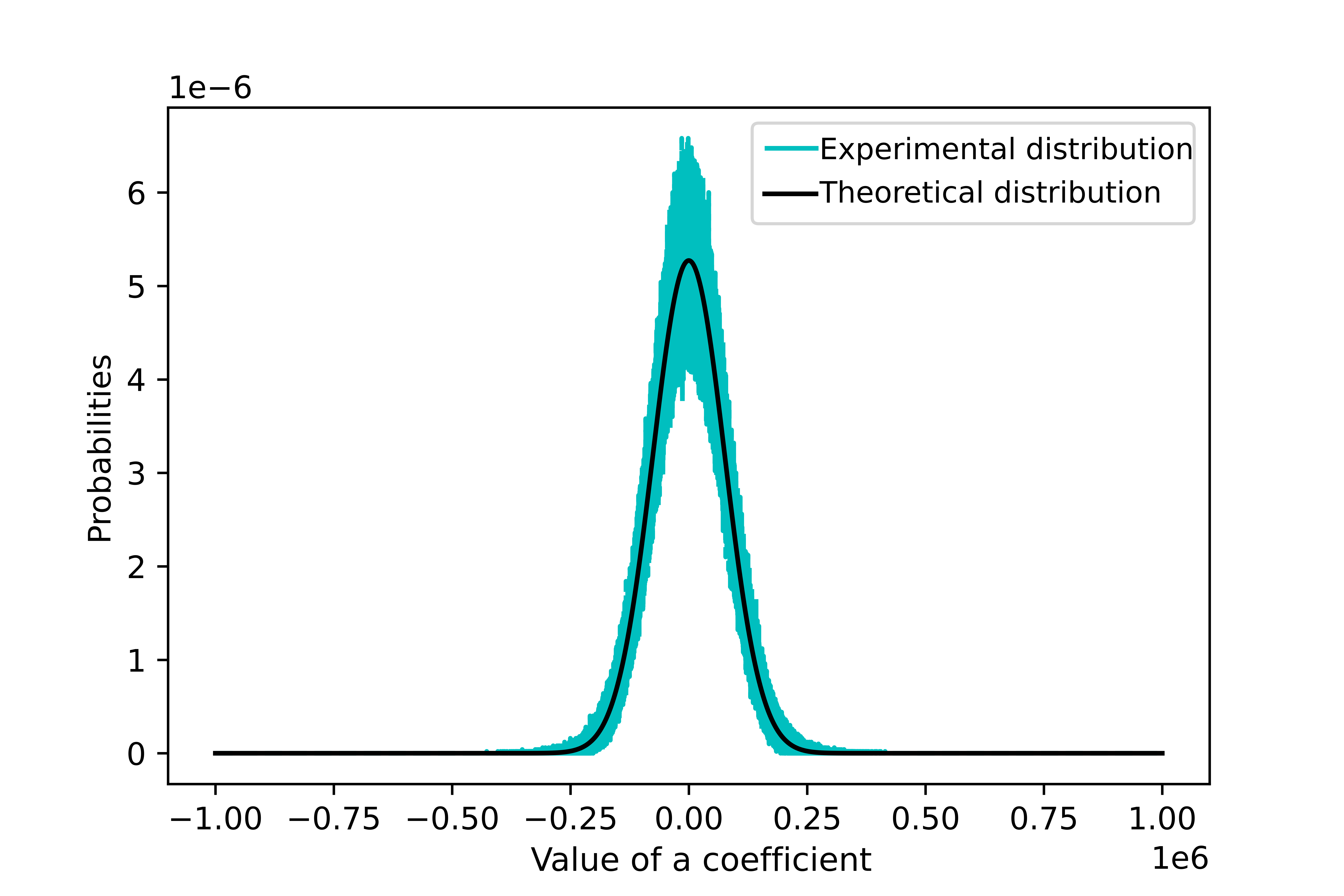
Experimental results
Research questions
- RQ1Can a single cryptoprocessor efficiently and compactly support both lattice-based key encapsulation (Saber) and digital signature (Dilithium) schemes despite their differing algorithmic structures?
- RQ2What architectural synergies exist between NTT-friendly and NTT-unfriendly lattice schemes that can be exploited to minimize area overhead?
- RQ3How can a unified hardware design reduce resource consumption while maintaining high throughput for critical operations like key generation and signature verification?
- RQ4To what extent can shared building blocks—such as NTT and Keccak cores—be reused across different post-quantum schemes without sacrificing performance?
- RQ5Can the proposed cryptoprocessor be extended to support additional lattice-based schemes like CRYSTALS-Kyber with minimal modifications?
Key findings
- The cryptoprocessor achieves 200 MHz clock frequency on a Xilinx Ultrascale+ FPGA, consuming 18,406 LUTs, 9,323 FFs, 4 DSPs, and 24 BRAMs.
- For LightSaber, key generation, encapsulation, and decapsulation complete in 29.6, 40.4, and 58.3 μs, respectively.
- For Saber, the same operations take 54.9, 69.7, and 94.9 μs, respectively, with Dilithium-3 signing and verification completing in 237 and 127.6 μs in the best-case scenario.
- On a 65nm ASIC, the performance improves by a factor of two due to a 2× increase in clock frequency, with estimated latency of 27.5, 34.9, and 47.5 μs for Saber operations.
- The unified NTT multiplier reduces area overhead compared to a Dilithium-only design, especially by leveraging a special prime modulus for Saber's NTT computation.
- The optimized Keccak wrapper reduces unnecessary memory accesses, improving throughput and reducing power consumption for hash-based operations.
Read this paper
Open the full text in the Nubint reader and ask about any passage as you read.
Read this paper on NubintThis review was generated by AI from the original paper. Please check the paper before citing it.