
[Paper Review] A Unified Hardware Architecture for Convolutions and Deconvolutions in CNN
This paper proposes a unified FPGA-based hardware accelerator that shares the same process element array for both convolution and deconvolution operations in CNNs, eliminating the need for separate hardware. By reusing on-chip memory and optimizing data flow, it achieves 151.5 GOPS for convolution and 94.3 GOPS for deconvolution on a Xilinx ZC706 FPGA, outperforming existing designs while maintaining balanced resource efficiency for both operations.
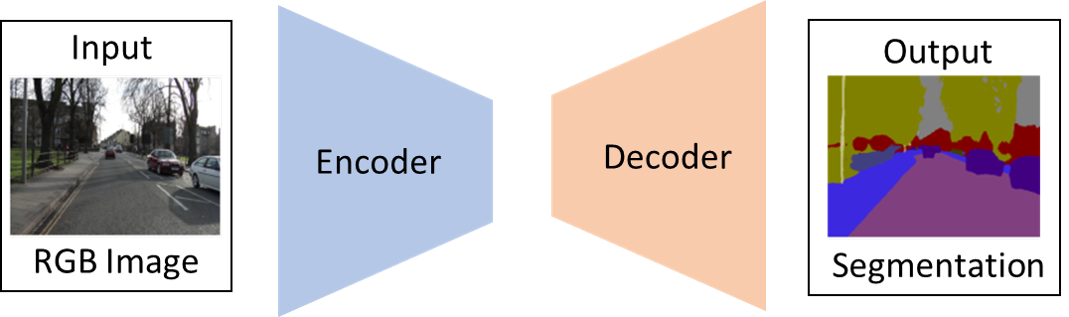
In this paper, a scalable neural network hardware architecture for image segmentation is proposed. By sharing the same computing resources, both convolution and deconvolution operations are handled by the same process element array. In addition, access to on-chip and off-chip memories is optimized to alleviate the burden introduced by partial sum. As an example, SegNet-Basic has been implemented using the proposed unified architecture by targeting on Xilinx ZC706 FPGA, which achieves the performance of 151.5 GOPS and 94.3 GOPS for convolution and deconvolution respectively. This unified convolution/deconvolution design is applicable to other CNNs with deconvolution.
Motivation & Objective
- Address the performance bottleneck caused by unaccelerated deconvolution in CNNs, especially in semantic segmentation.
- Reduce hardware redundancy by enabling a single architecture to handle both convolution and deconvolution operations.
- Optimize memory access patterns to minimize off-chip bandwidth and intermediate storage overhead.
- Achieve high performance and scalability on FPGAs while maintaining resource efficiency for both operations.
- Demonstrate the design’s effectiveness by implementing SegNet-Basic on a Xilinx ZC706 FPGA.
Proposed method
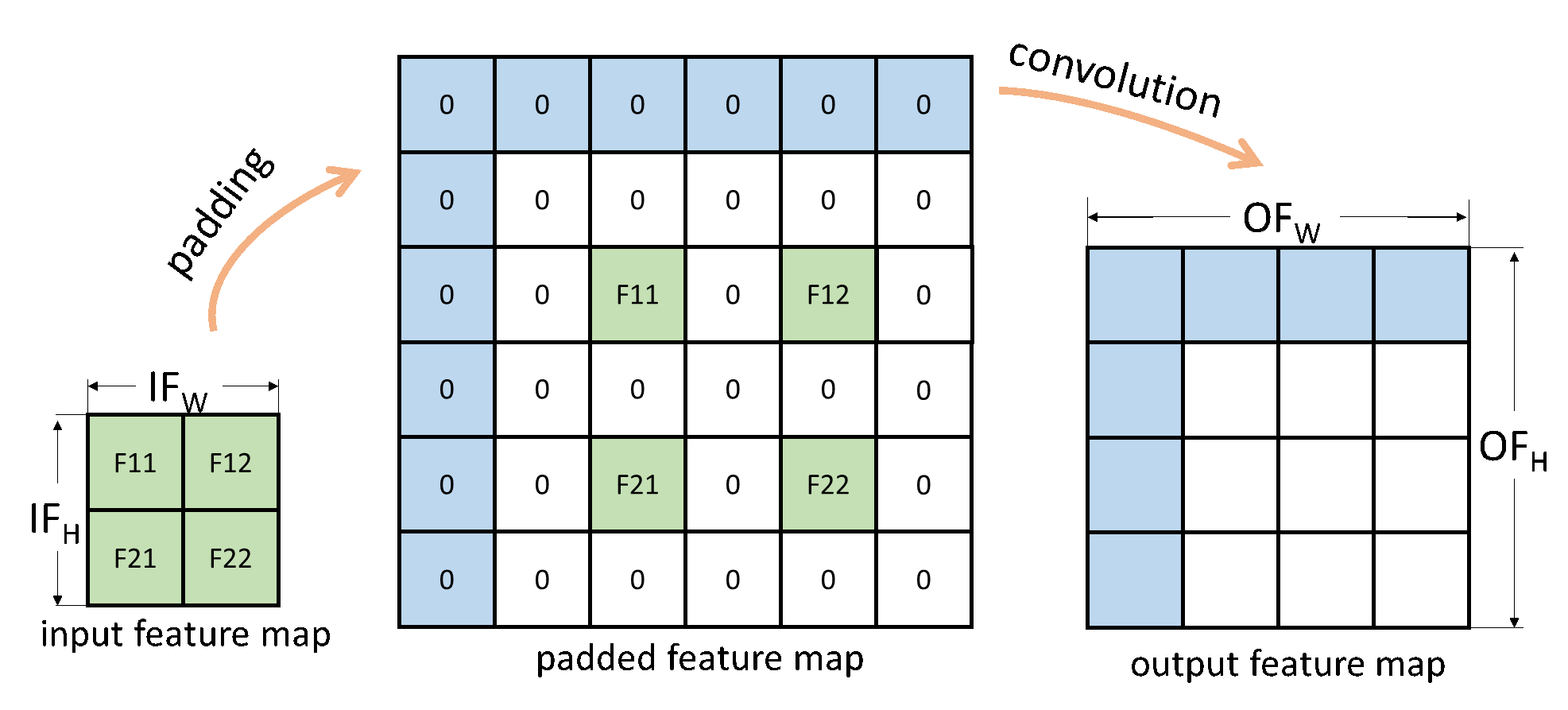
- Propose a unified process element array that supports both convolution and deconvolution through configurable data flow and computation scheduling.
- Use loop unrolling, loop tiling, and loop interchange to optimize data reuse and reduce memory bandwidth.
- Implement a hybrid memory access strategy with line buffers and shift registers to manage feature map streaming and reduce off-chip memory access.
- Integrate system controller as a finite state machine (FSM) to manage data flow, padding modes, and bypassing of activation/pooling units.
- Utilize double buffering to hide data transfer latency and balance computation and memory access.
- Implement batch normalization and activation (ReLU/LeakyReLU) directly within the process element to reduce external data movement.
Experimental results
Research questions
- RQ1Can a single hardware architecture efficiently support both convolution and deconvolution operations in CNNs without dedicated hardware?
- RQ2How can memory access patterns be optimized to reduce off-chip bandwidth and intermediate storage in deconvolution?
- RQ3What performance and resource efficiency gains can be achieved by sharing on-chip resources between convolution and deconvolution?
- RQ4How does the unified design compare to existing FPGA accelerators in terms of throughput and latency for deconvolution-heavy networks?
- RQ5To what extent can the architecture be scaled for higher performance by increasing the number of process element arrays?
Key findings
- The proposed unified architecture achieves 151.5 GOPS for convolution and 94.3 GOPS for deconvolution on a Xilinx ZC706 FPGA, outperforming most existing FPGA-based CNN accelerators.
- The deconvolution operation is completed in a single step without storing intermediate partial sums, reducing memory pressure and latency.
- The design uses only 8% of LUTs, 6% of registers, 99% of BRAMs, and 64% of DSPs on the ZC706 FPGA, indicating high resource efficiency.
- The system controller FSM enables dynamic configuration of data flow and processing modes, supporting on-the-fly reconfiguration.
- Deconvolution processing time is reduced by approximately 3.2% compared to convolution plus max pooling and ReLU due to optimized buffering and data flow.
- The architecture demonstrates scalability, as performance can be increased by adding more process element arrays to handle higher data bandwidth.
Read this paper
Open the full text in the Nubint reader and ask about any passage as you read.
Read this paper on NubintThis review was generated by AI from the original paper. Please check the paper before citing it.