
[Paper Review] A Unified Picture of Short and Long Gamma-ray Bursts from Compact Binary Mergers
This paper proposes a unified framework linking short and long gamma-ray bursts (GRBs) to compact binary mergers, showing that massive accretion disks around black holes from high-mass binaries (M_tot ≳ 2.8 M☉) power long-duration GRBs like GRB 211211A and GRB 230307A, while hypermassive neutron stars (HMNSs) from low-mass binaries (M_tot ≲ 2.8 M☉) produce short GRBs via magnetized outflows, reconciling diverse GRB durations with binary merger physics.
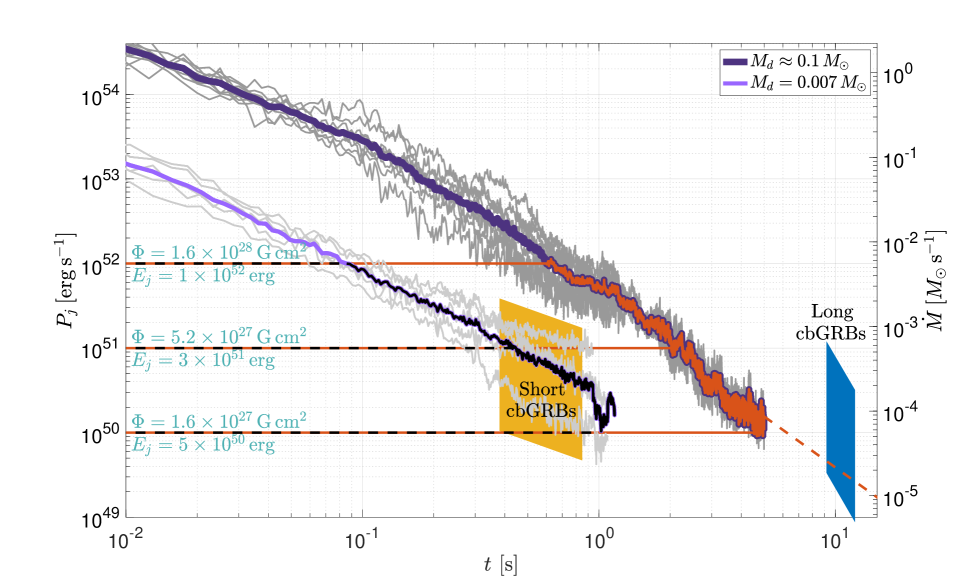
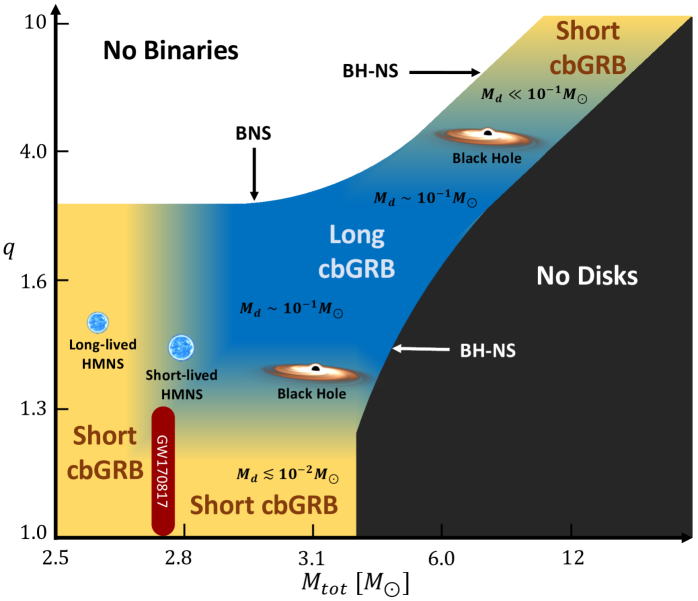
The recent detections of the $\sim10$-s long $γ$-ray bursts (GRBs) 211211A and 230307A followed by softer temporally extended emission (EE) and kilonovae, point to a new GRB class. Using state-of-the-art first-principles simulations, we introduce a unifying theoretical framework that connects binary neutron star (BNS) and black hole-NS (BH-NS) merger populations with the fundamental physics governing compact-binary GRBs (cbGRBs). For binaries with large total masses $M_{ m tot}\gtrsim2.8\,M_\odot$, the compact remnant created by the merger promptly collapses into a BH, surrounded by an accretion disk. The duration of the pre-magnetically arrested disk (MAD) phase sets the duration of the roughly constant power cbGRB and could be influenced by the disk mass, $M_d$. We show that massive disks ($M_d\gtrsim0.1\,M_\odot$), which form for large binary mass ratio $q\gtrsim1.2$ in BNS or $q\lesssim3$ in BH-NS mergers, inevitably produce 211211A-like long cbGRBs. Once the disk becomes MAD, the jet power drops with the mass accretion rate as $\dot{M}\sim t^{-2}$, naturally establishing the EE decay. Two scenarios are plausible for short cbGRBs. They can be powered by BHs with less massive disks, which form for other $q$ values. Alternatively, for binaries with $M_{ m tot}\lesssim2.8\,M_\odot$, mergers should go through a hypermassive NS (HMNS) phase, as inferred for GW170817. Magnetized outflows from such HMNSs, which typically live for $\lesssim1\,{ m s}$, offer an alternative progenitor for short cbGRBs. The first scenario is challenged by the bimodal GRB duration distribution and the fact that the Galactic BNS population peaks at sufficiently low masses that most mergers should go through a HMNS phase.
Motivation & Objective
- To resolve the longstanding puzzle of long-duration gamma-ray bursts (GRBs) not associated with collapsars, particularly following the detection of 10-s GRBs with kilonovae.
- To unify the origin of short and long GRBs within a single theoretical framework based on compact binary mergers.
- To determine whether black hole accretion disks or hypermassive neutron stars (HMNSs) are the dominant progenitors of short GRBs, given conflicting observational constraints.
- To explain the observed temporal structure of GRB light curves, including prompt emission, quiescent phases, and extended emission (EE), via distinct physical mechanisms.
- To reconcile the bimodal duration distribution of GRBs with the underlying physics of binary mass ratios and remnant evolution.
Proposed method
- Performing first-principles, magnetohydrodynamic (MHD) simulations of compact binary mergers, including black hole–neutron star (BH–NS) and binary neutron star (BNS) systems.
- Modeling the formation and evolution of post-merger accretion disks, focusing on disk mass (M_d) and magnetic field structure, particularly the magnetically arrested disk (MAD) phase.
- Analyzing jet power evolution as a function of mass accretion rate, with jet power scaling as Ṁ ∼ t⁻² during the MAD phase, driving the decay of extended emission.
- Using binary mass ratio (q) and total mass (M_tot) as key parameters to classify merger outcomes: prompt black hole formation (M_tot ≳ 2.8 M☉) vs. hypermassive neutron star (HMNS) formation (M_tot ≲ 2.8 M☉).
- Comparing theoretical light curves from BH-disk and HMNS-jet models with observed GRB 211211A and GRB 230307A light curves, including precursor flares and quiescent intervals.
- Assessing the viability of different progenitor scenarios using constraints from kilonova observations, radio afterglows, and the Galactic BNS population's mass distribution.
Experimental results
Research questions
- RQ1What physical mechanism in compact binary mergers can produce long-duration GRBs (T90 ≈ 10 s) with extended emission and kilonova counterparts?
- RQ2Why do some compact binary mergers produce short GRBs (T90 ≲ 1 s) while others produce long GRBs, despite both originating from binary mergers?
- RQ3Can the observed bimodal duration distribution of GRBs be explained by distinct progenitor channels—specifically, BH-disk systems versus HMNSs?
- RQ4How do the mass ratio (q) and total mass (M_tot) of binary systems determine the formation of massive disks or hypermassive neutron stars?
- RQ5What explains the quiescent time between prompt emission and extended emission in GRB 211211A and GRB 230307A, and how does it relate to progenitor evolution?
Key findings
- Massive disks (M_d ≳ 0.1 M☉) formed in high-mass binary mergers (M_tot ≳ 2.8 M☉, q ≳ 1.2 in BNS or q ≲ 3 in BH–NS) inevitably produce long-duration GRBs like GRB 211211A and GRB 230307A.
- The extended emission (EE) decay in long GRBs follows a t⁻² power law due to the mass accretion rate in the magnetically arrested disk (MAD) phase, consistent with observations.
- Short GRBs are likely powered by magnetized outflows from hypermassive neutron stars (HMNSs), which live for ≲1 s and can explain the short duration and quiescent phase between prompt and extended emission.
- BH-disk systems with low disk masses (M_d ≲ 10⁻² M☉) can produce typical short GRBs, but this scenario is challenged by the bimodal duration distribution and the Galactic BNS population’s mass distribution.
- The Galactic BNS population peaks at M_tot ≲ 2.75 M☉, implying that most BNS mergers should form HMNSs rather than prompt black holes, favoring HMNSs as the dominant progenitor of short GRBs.
- The absence of two distinct sub-classes among short GRBs suggests that either HMNS-powered jets and BH-powered jets are physically indistinguishable, or one channel dominates—with current evidence favoring HMNSs as the primary progenitor of short GRBs.
Read this paper
Open the full text in the Nubint reader and ask about any passage as you read.
Read this paper on NubintThis review was generated by AI from the original paper. Please check the paper before citing it.