
[Paper Review] A velocity-space adaptive unified gas kinetic scheme for continuum and rarefied flows
This paper proposes a velocity-space adaptive unified gas kinetic scheme (AUGKS) that dynamically switches between continuous and discrete velocity spaces based on non-equilibrium effects, enabling accurate and efficient simulation of multiscale flows from continuum to rarefied regimes. The method achieves higher computational efficiency and reduced memory usage than traditional UGKS while maintaining accuracy across Knudsen number regimes without buffer zones.
In this paper, a unified gas kinetic scheme with adaptive velocity space (AUGKS) for multiscale flow transport will be developed. In near-equilibrium flow regions, particle distribution function is close to the Chapman-Enskog expansion and can be formulated with a continuous velocity space, where only macroscopic conservative variables are updated. With the emerging of non-equilibrium effects, the AUGKS automatically switches to a discrete velocity space to follow the evolution of particle distribution function. Based on the Chapman-Enskog expansion, a criterion is proposed in this paper to quantify the intensity of non-equilibrium effects and is used for the continuous-discrete velocity space transformation. Following the scale-dependent local evolution solution, the AUGKS presents the discretized gas dynamic equations directly on the cell size and time step scales, i.e., the so-called direct modeling method. As a result, the scheme is able to capture the cross-scale flow physics from particle transport to hydrodynamic wave propagation, and provides a continuous variation of solutions from the Boltzmann to the Navier-Stokes. Under the unified framework, different from conventional DSMC-NS hybrid method, the AUGKS does not need a buffer zone to match up kinetic and hydrodynamic solutions. Instead, a continuous and discrete particle velocity space is naturally connected, which is feasible for the numerical simulations with unsteadiness or complex geometries. Compared with the asymptotic preserving (AP) methods which solves kinetic equations uniformly over the entire flow field with discretized velocity space, the current velocity-space adaptive unified scheme speeds up the computation and reduces the memory requirement in multiscale flow problems, and maintains the equivalent accuracy. The AUGKS provides an effective tool for non-equilibrium flow simulations.
Motivation & Objective
- Address the challenge of simulating multiscale gas flows with large variations in density and characteristic length scales, especially in hypersonic and reentry conditions.
- Overcome the limitations of conventional hybrid methods that require buffer zones to interface kinetic and hydrodynamic solvers.
- Develop a unified numerical framework that naturally transitions between continuum and kinetic descriptions without artificial interfaces.
- Reduce computational cost and memory usage in multiscale simulations compared to uniform discrete velocity space methods like UGKS.
- Enable accurate simulation of unsteady and complex-geometry flows with inherent non-equilibrium effects using a single, adaptive algorithm.
Proposed method
- Proposes a switching criterion based on the Chapman-Enskog expansion to quantify non-equilibrium intensity and trigger velocity-space adaptation.
- Uses a scale-dependent, local evolution solution of the Boltzmann model equation to derive discrete gas dynamic equations on cell and time step scales.
- Employs continuous velocity space in near-equilibrium regions to update only macroscopic conservative variables, reducing computational cost.
- Switches to discrete velocity space in non-equilibrium regions to directly evolve the particle distribution function, capturing kinetic effects.
- Integrates the unified gas kinetic scheme (UGKS) framework with adaptive velocity space, eliminating the need for buffer zones between continuum and kinetic solvers.
- Applies the direct modeling method to ensure consistency across scales, enabling seamless transition from Boltzmann to Navier-Stokes behavior.
Experimental results
Research questions
- RQ1How can a single numerical scheme accurately capture flow physics across the entire range of Knudsen numbers, from continuum to free molecular regimes?
- RQ2What criterion can dynamically and accurately identify when to switch from continuous to discrete velocity space based on non-equilibrium intensity?
- RQ3Can a velocity-space adaptive scheme eliminate the need for buffer zones in hybrid continuum-kinetic simulations while maintaining accuracy?
- RQ4To what extent does the adaptive velocity-space approach reduce computational cost and memory usage compared to uniform discrete velocity space schemes?
- RQ5How does the scheme perform in capturing complex non-equilibrium structures such as shocks and wakes in rarefied flows?
Key findings
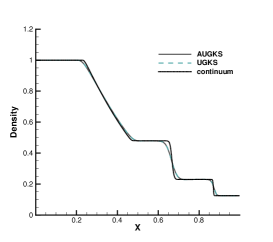
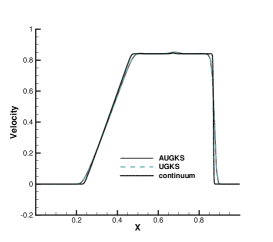
- The AUGKS reduces CPU time by approximately 3.3 times and memory usage by 47% at Kn = 0.001 and 67% at Kn = 0.01 compared to the original UGKS in circular cylinder flow simulations.
- At Kn = 0.001, the GKS is about 30 times faster than UGKS, but AUGKS achieves 3.3× speedup over UGKS while maintaining accuracy.
- The scheme captures the correct shock structure and wake dynamics at Kn = 0.01, where the continuous GKS fails due to non-equilibrium effects, while AUGKS matches UGKS solutions.
- The velocity-space adaptation is triggered by high gradients in flow variables and increasing collision time, particularly behind the cylinder in low-density wake regions.
- The switching criterion based on Chapman-Enskog expansion effectively identifies non-equilibrium regions, enabling accurate and efficient simulation without artificial interfaces.
- The AUGKS provides a continuous transition from Navier-Stokes to Boltzmann solutions, avoiding the discontinuities and inefficiencies of traditional hybrid methods.
Read this paper
Open the full text in the Nubint reader and ask about any passage as you read.
Read this paper on NubintThis review was generated by AI from the original paper. Please check the paper before citing it.