
[Paper Review] Abstractors and relational cross-attention: An inductive bias for explicit relational reasoning in Transformers
This paper introduces the Abstractor, a novel Transformer module that enables explicit relational reasoning through relational cross-attention, disentangling relational information from object-level features. The method achieves significant sample efficiency gains on relational sequence-to-sequence tasks and modest but consistent improvements in performance and sample efficiency on mathematical problem-solving benchmarks compared to standard Transformers.
An extension of Transformers is proposed that enables explicit relational reasoning through a novel module called the Abstractor. At the core of the Abstractor is a variant of attention called relational cross-attention. The approach is motivated by an architectural inductive bias for relational learning that disentangles relational information from object-level features. This enables explicit relational reasoning, supporting abstraction and generalization from limited data. The Abstractor is first evaluated on simple discriminative relational tasks and compared to existing relational architectures. Next, the Abstractor is evaluated on purely relational sequence-to-sequence tasks, where dramatic improvements are seen in sample efficiency compared to standard Transformers. Finally, Abstractors are evaluated on a collection of tasks based on mathematical problem solving, where consistent improvements in performance and sample efficiency are observed.
Motivation & Objective
- To address the limitation of standard Transformers in supporting explicit relational reasoning due to entangled object and relational representations.
- To develop an architectural inductive bias—'relational bottleneck'—that separates relational information from extraneous object-level features.
- To evaluate whether the Abstractor improves sample efficiency and performance on purely relational sequence-to-sequence tasks and real-world mathematical reasoning tasks.
- To demonstrate that architectural modifications enabling explicit relational processing yield gains beyond increased parameter count.
Proposed method
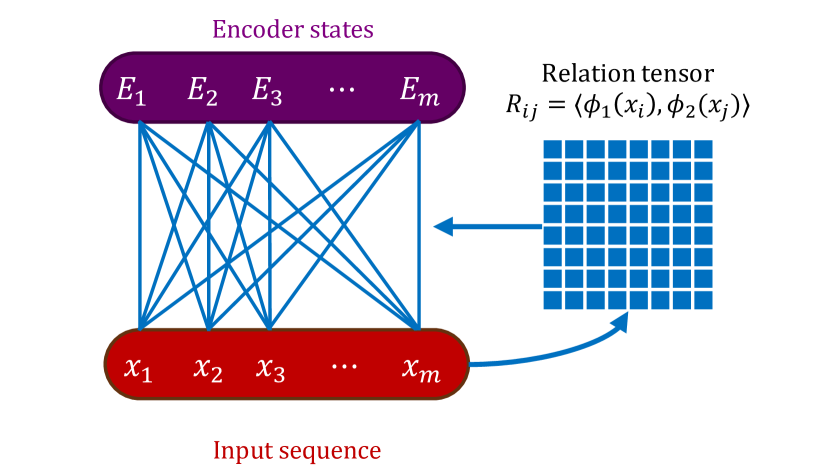
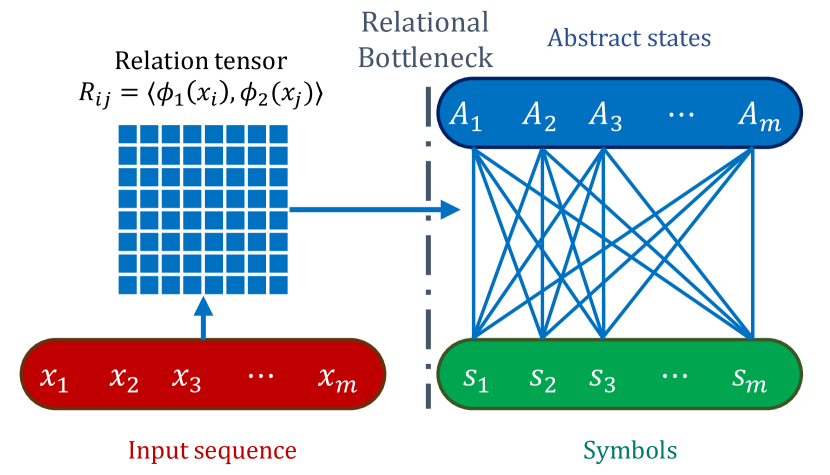
- The Abstractor introduces a novel attention mechanism called relational cross-attention, which computes relations between object representations in a disentangled manner.
- The method enforces a 'relational bottleneck' by learning low-dimensional, abstract representations of relations independent of object-specific features.
- The Abstractor is integrated into the Transformer architecture as an additional module between the encoder and decoder, enabling specialized relational processing.
- The framework supports multiple architectural variants, including partially-relational configurations, to explore trade-offs in representational capacity.
- Experiments use character-level tokenization and teacher-forcing accuracy to evaluate performance on synthetic and mathematical reasoning tasks.
- Model comparisons control for parameter count by including both standard and wider-width Transformers as baselines.
Experimental results
Research questions
- RQ1Can a modular extension to Transformers enable explicit relational reasoning by disentangling relational information from object-level features?
- RQ2Does the Abstractor improve sample efficiency on purely relational sequence-to-sequence tasks compared to standard Transformers?
- RQ3Can the Abstractor-based architecture achieve consistent performance gains on realistic mathematical problem-solving tasks?
- RQ4Is the performance improvement due to architectural inductive bias rather than increased model capacity?
Key findings
- On purely relational sequence-to-sequence tasks, the Abstractor-based model achieves dramatic improvements in sample efficiency compared to standard Transformers.
- On mathematical problem-solving tasks, the Abstractor-based model shows modest but consistent improvements in both accuracy and sample efficiency over both standard and wider-width Transformers.
- The Abstractor-based model consistently outperforms both the standard Transformer and the larger 'Transformer+' model across all five mathematical tasks, indicating the gain is due to architectural design, not parameter count.
- The results suggest that the Abstractor enables a partially-relational processing pathway, where the encoder handles general input processing and the Abstractor specializes in relational reasoning.
- The framework demonstrates that explicit relational inductive bias enhances generalization, particularly in low-data regimes.
- The code and experimental logs are publicly available for reproducibility.
Read this paper
Open the full text in the Nubint reader and ask about any passage as you read.
Read this paper on NubintThis review was generated by AI from the original paper. Please check the paper before citing it.