
[Paper Review] Accelerated Formation of Ultra-Massive Galaxies in the First Billion Years
This study presents 36 spectroscopically confirmed optically dark/faint galaxies at zspec 5–9 from JWST FRESCO, including three ultra-massive systems at z~5.5 with M* > 10^11 Msun, implying unusually high star-formation efficiencies in the early universe.
Recent JWST observations have revealed an unexpected abundance of massive galaxy candidates in the early Universe, extending further in redshift and to lower luminosity than what had previously been found by sub-millimeter surveys. These JWST candidates have been interpreted as challenging the $Λ$CDM cosmology, but, so far, they have mostly relied only on rest-frame ultraviolet data and lacked spectroscopic confirmation of their redshifts. Here we report a systematic study of 36 massive dust-obscured galaxies with spectroscopic redshifts between $z_{ m spec}=5-9$ from the JWST FRESCO survey. We find no tension with the $Λ$CDM model in our sample. However, three ultra-massive galaxies (log$M_{\star}/M_{\odot}$ $\gtrsim11.0$) require an exceptional fraction of 50% of baryons converted into stars -- two to three times higher than even the most efficient galaxies at later epochs. The contribution from an active nucleus is unlikely because of their extended emission. Ultra-massive galaxies account for as much as 17% of the total cosmic star formation rate density at $z\sim5-6$.
Motivation & Objective
- Demonstrate the existence of a population of dusty, high-mass galaxies at z > 5 using robust spectroscopic redshifts from JWST FRESCO.
- Quantify the stellar masses, star-formation rates, and dust properties of optically dark/faint galaxies to assess their role in early cosmic star formation.
- Assess whether ultra-massive galaxies at high redshift can be accommodated within or challenge current galaxy formation models and halo-baryon conversion efficiencies.
Proposed method
- Use JWST FRESCO NIRCam imaging and grism spectroscopy to identify optically dark/faint galaxies via red colors and strong emission lines.
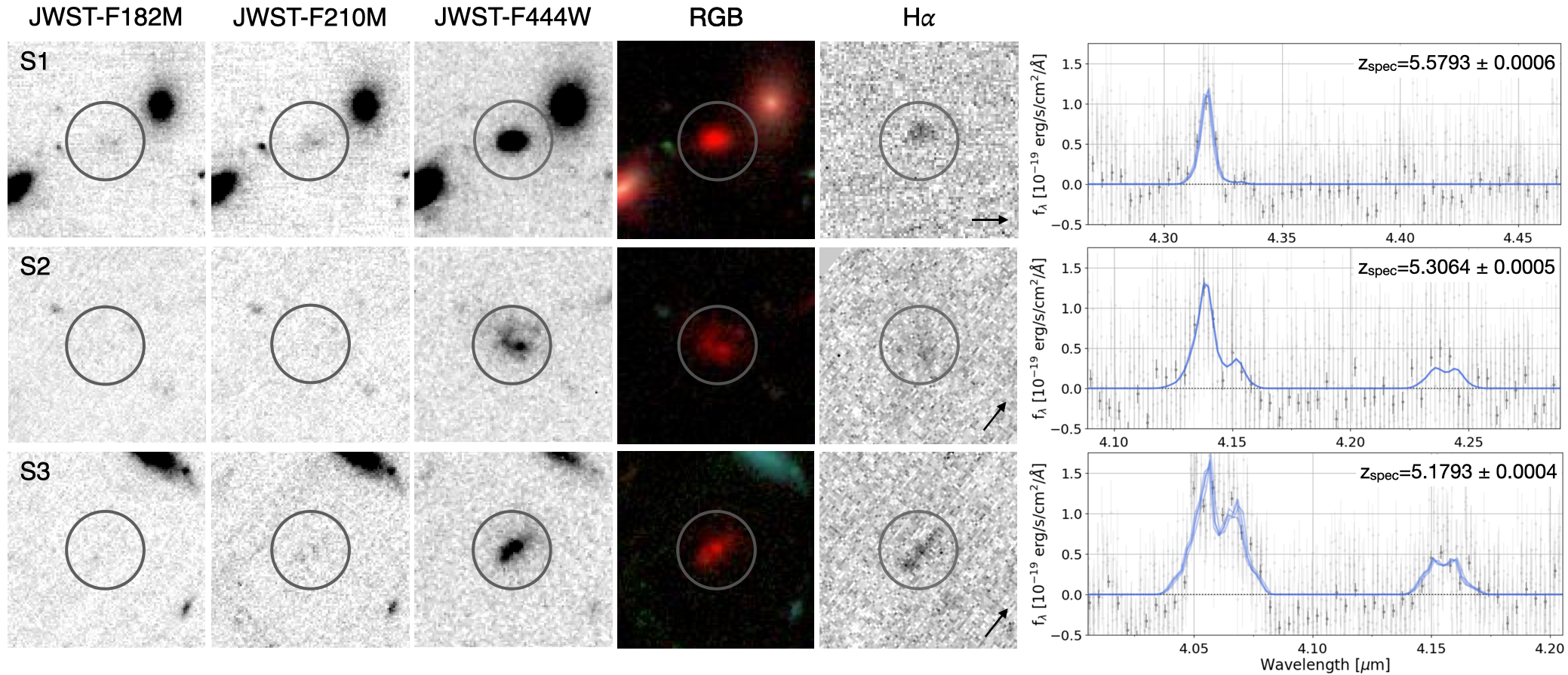
- Obtain zspec from H-alpha + NII + SII or OIII + H-beta lines in the F444W grism data (zspec ~ 4.9–9.0).
- Perform SED fitting of UV-to-NIR photometry with emission-line subtraction using BAGPIPES and CIGALE at fixed zspec to derive M* and SFR.
- Correct F444W photometry for emission-line contamination to recover the stellar continuum.
- Cross-match with ancillary HST/JWST imaging and far-infrared/mm data (ALMA GOODS-ALMA) to constrain dust and star-formation properties where available.
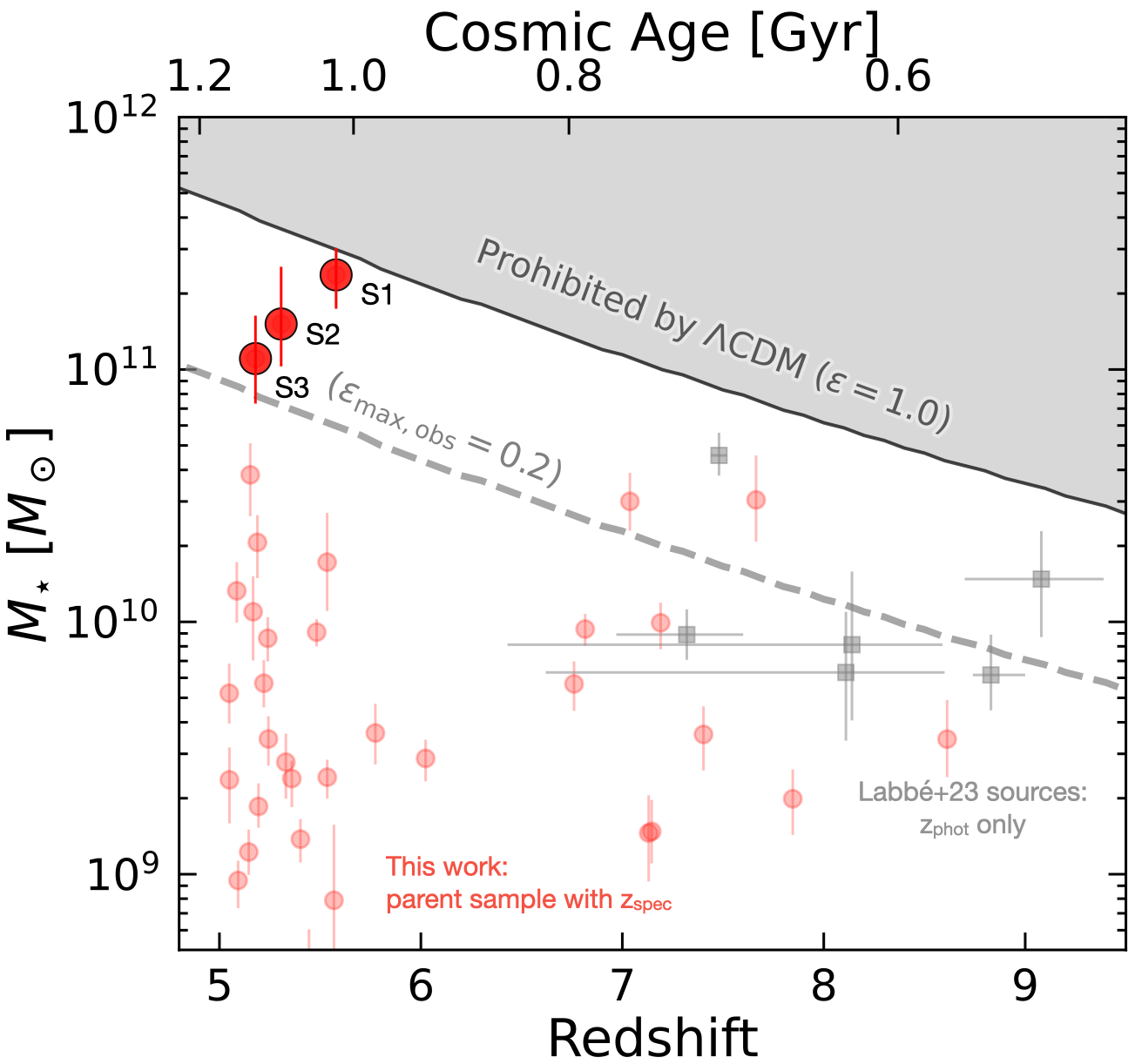
- Compare observed ultra-massive systems to halo mass function predictions to infer baryon-to-star conversion efficiencies.
Experimental results
Research questions
- RQ1What is the redshift distribution and mass range of optically dark/faint galaxies uncovered by JWST in the FRESCO survey?
- RQ2Do ultra-massive galaxies with M* > 10^11 Msun exist at z ~ 5–6, and what baryon-to-star conversion efficiencies do they imply?
- RQ3How do the dust and star-formation properties of these galaxies inform their formation mechanisms and potential AGN contributions?
- RQ4Are such ultra-massive systems compatible with standard Lambda-CDM halo mass functions and observed maximum star-formation efficiencies?
- RQ5What is the contribution of optically dark/faint galaxies to the cosmic star-formation-rate density at high redshift?
Key findings
- Detected 36 spectroscopically confirmed optically dark/faint galaxies at zspec 5–9 with stellar masses spanning log(M*/Msun) = 8.3–11.4.
- Three ultra-massive galaxies at zspec ~ 5.5 have log(M*/Msun) > 11.0, implying ~0.5 baryons converted to stars on average, two–three times higher than the highest efficiencies at lower redshift.
- Two additional ultra-massive systems at zspec ~ 7.5 suggest similarly high efficiencies (ε > 0.2), though their masses are less robustly constrained.
- The three ultra-massive z ~ 5.5 galaxies are extremely dust-obscured (AV > 3 mag) with SFR_IR values of 625–1137 Msun/yr, and show extended dust emission relative to the stellar component.
- The observed ultra-massive galaxies contribute up to ~20% of the total cosmic star-formation-rate density at z ~ 5–6 when considering ε > 0.2, indicating efficient early star formation.
- The observed systems challenge standard galaxy-formation models, suggesting the need for higher early baryon-to-star conversion efficiencies or alternative formation channels (e.g., top-heavy IMF or feedback-free bursts).
Read this paper
Open the full text in the Nubint reader and ask about any passage as you read.
Read this paper on NubintThis review was generated by AI from the original paper. Please check the paper before citing it.