
[Paper Review] Accessing GPT-4 level Mathematical Olympiad Solutions via Monte Carlo Tree Self-refine with LLaMa-3 8B
Introduces MCT Self-Refine (MCTSr), an LLM+MCTS framework that iteratively self-refines and evaluates mathematical solutions, achieving GPT-4 level performance on several Olympiad-style benchmarks with increased rollouts.
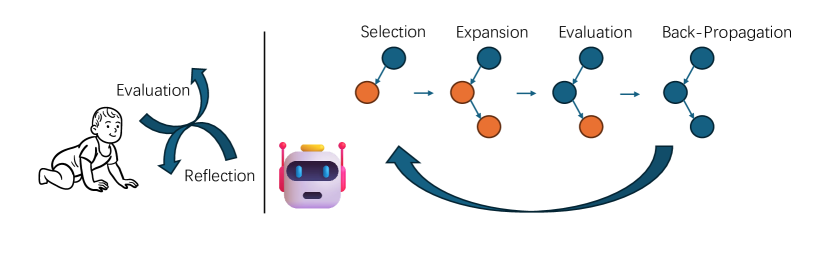
This paper introduces the MCT Self-Refine (MCTSr) algorithm, an innovative integration of Large Language Models (LLMs) with Monte Carlo Tree Search (MCTS), designed to enhance performance in complex mathematical reasoning tasks. Addressing the challenges of accuracy and reliability in LLMs, particularly in strategic and mathematical reasoning, MCTSr leverages systematic exploration and heuristic self-refine mechanisms to improve decision-making frameworks within LLMs. The algorithm constructs a Monte Carlo search tree through iterative processes of Selection, self-refine, self-evaluation, and Backpropagation, utilizing an improved Upper Confidence Bound (UCB) formula to optimize the exploration-exploitation balance. Extensive experiments demonstrate MCTSr's efficacy in solving Olympiad-level mathematical problems, significantly improving success rates across multiple datasets, including GSM8K, GSM Hard, MATH, and Olympiad-level benchmarks, including Math Odyssey, AIME, and OlympiadBench. The study advances the application of LLMs in complex reasoning tasks and sets a foundation for future AI integration, enhancing decision-making accuracy and reliability in LLM-driven applications.
Motivation & Objective
- Motivate improving the accuracy and reliability of LLM-driven mathematical reasoning, particularly for strategic and multi-step problems.
- Propose a unified framework that combines Monte Carlo Tree Search with self-refinement and self-evaluation for LLMs.
- Demonstrate effectiveness on standard math benchmarks including GSM8K, GSM Hard, MATH, and Olympiad-level datasets.
Proposed method
- Build a Monte Carlo Tree Search (MCTS) with a novel self-refine loop where nodes represent different answer versions.
- Use an improved UCT-based selection to balance exploration and exploitation within LLM-driven refinements.
- Define a Q-value for each answer from aggregated self-reward samples and backpropagate to refine the tree.
- Employ a dynamic pruning strategy with an enhanced UCB formula to determine full expansion and guide search.
- Self-refinement: generate reflective feedback, then produce improved answers via multi-turn prompts.
- Self-evaluation: sample rewards with constraints (prompt constraint, full-score suppression, repeated sampling) to compute Q(a) as the half-sum of the min and mean rewards.
Experimental results
Research questions
- RQ1Can MCTS guided self-refinement improve the correctness and reliability of LLM-generated mathematical solutions?
- RQ2How do rollouts (4 vs 8) affect success rates across different difficulty levels and datasets?
- RQ3To what extent can a smaller open-model (LLaMA-3 8B) approach GPT-4 level performance on Olympiad-style problems?
- RQ4What are the practical limits of MCTSr on highly challenging Olympiad benchmarks?
Key findings
- MCTSr improves success rates on GSM8K and GSM Hard as rollouts increase, with larger gains on simpler GSM8K.
- On MATH, 8-rollouts MCTSr achieves 58.24% overall across five levels (vs 24.36% for zero-shot CoT).
- Olympiad benchmarks show substantial gains with more rollouts: AIME from 2.36% to 11.79%, Math Odyssey from 17.22% to 49.36%, OlympiadBench from 1.25% to 7.76%.
- Compared to some closed-source SOTA models, MCTSr-enabled LLaMA-3-8B approaches GPT-4 level performance on the tested datasets.
- The study confirms a scalable pathway to enhance open-model mathematical reasoning via iterative self-refinement within an MCTS framework.
Read this paper
Open the full text in the Nubint reader and ask about any passage as you read.
Read this paper on NubintThis review was generated by AI from the original paper. Please check the paper before citing it.