
[Paper Review] Active and reactive behaviour in human mobility: the influence of attraction points on pedestrians
This study proposes a Langevin dynamics-based model to disentangle active (intrinsic) and reactive (context-dependent) components in human mobility at a public fair. Using GPS-tracked pedestrians and simulated attraction points, it demonstrates that reactive forces from visible stands significantly shape movement patterns, while active persistence and memory contribute to trajectory complexity, offering a scalable framework for urban planning and event design.
Human mobility is becoming an accessible field of study thanks to the progress and availability of tracking technologies as a common feature of smart phones. We describe an example of a scalable experiment exploiting these circumstances at a public, outdoor fair in Barcelona (Spain). Participants were tracked while wandering through an open space with activity stands attracting their attention. We develop a general modeling framework based on Langevin Dynamics, which allows us to test the influence of two distinct types of ingredients on mobility: reactive or context-dependent factors, modelled by means of a force field generated by attraction points in a given spatial configuration, and active or inherent factors, modelled from intrinsic movement patterns of the subjects. The additive and constructive framework model accounts for the observed features. Starting with the simplest model (purely random walkers) as a reference, we progressively introduce different ingredients such as persistence, memory, and perceptual landscape, aiming to untangle active and reactive contributions and quantify their respective relevance. The proposed approach may help in anticipating the spatial distribution of citizens in alternative scenarios and in improving the design of public events based on a facts-based approach.
Motivation & Objective
- To develop a scalable, open-access experimental framework for studying human mobility using citizen science and GPS tracking.
- To quantify the relative contributions of active (intrinsic) and reactive (context-driven) behaviors in pedestrian movement within urban-like environments.
- To create a general modeling framework based on Langevin dynamics that integrates persistence, memory, and perceptual landscapes.
- To test the model's ability to reproduce real-world mobility patterns observed at a public science fair in Barcelona.
- To provide a data-driven approach for anticipating crowd distribution and improving public space design in urban settings.
Proposed method
- Conducted a large-scale citizen science experiment at a public fair in Barcelona, tracking 50+ participants using GPS-enabled smartphones.
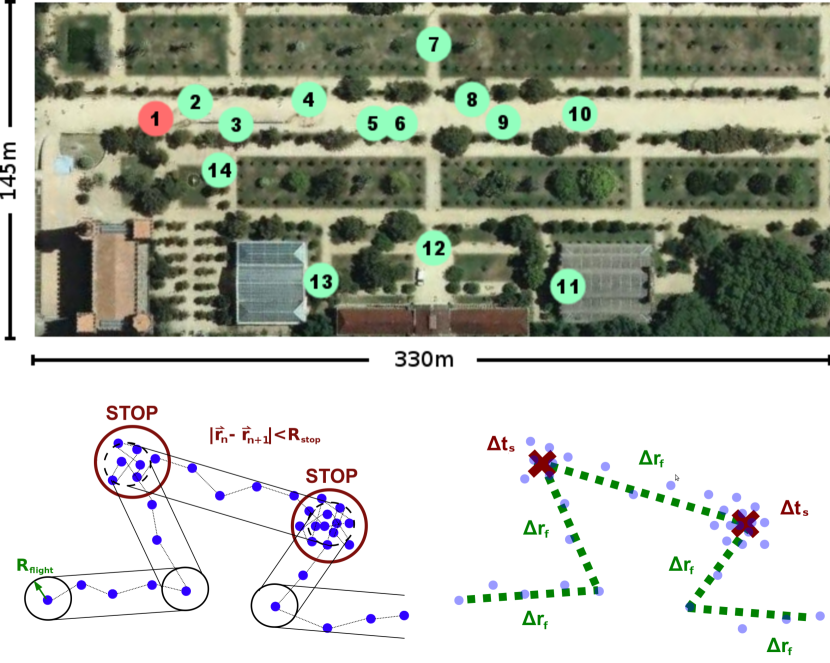
- Collected real-world GPS data with a mean location error of 4.071 meters and a 15-second sampling interval to simulate real data collection.
- Developed a Langevin dynamics model with additive components: a stochastic term for random motion, a persistence term (via Von Mises distribution), and a force field from attraction points (potential wells) representing stands.
- Simulated 20,000 seconds of movement (5.5 hours) in a 330m × 145m area with identical stand configurations to the real fair.
- Used dBBMM (dynamic Brownian bridge movement model) and GIS tools (ArcGIS, Geospatial Modelling Environment) to compute home ranges and trajectory variance.
- Applied a sliding window of 11 points to compute trajectory variance and assess movement complexity over time.
Experimental results
Research questions
- RQ1How do reactive forces from visible attraction points influence pedestrian movement patterns in open urban-like spaces?
- RQ2To what extent do intrinsic movement properties such as persistence and memory shape human mobility trajectories?
- RQ3Can a unified Langevin-based model effectively reproduce real-world pedestrian dynamics by combining active and reactive components?
- RQ4How does the interplay between perceptual landscape and individual movement patterns affect spatial distribution and home range estimation?
- RQ5What is the relative contribution of active versus reactive behaviors in shaping collective mobility at public events?
Key findings
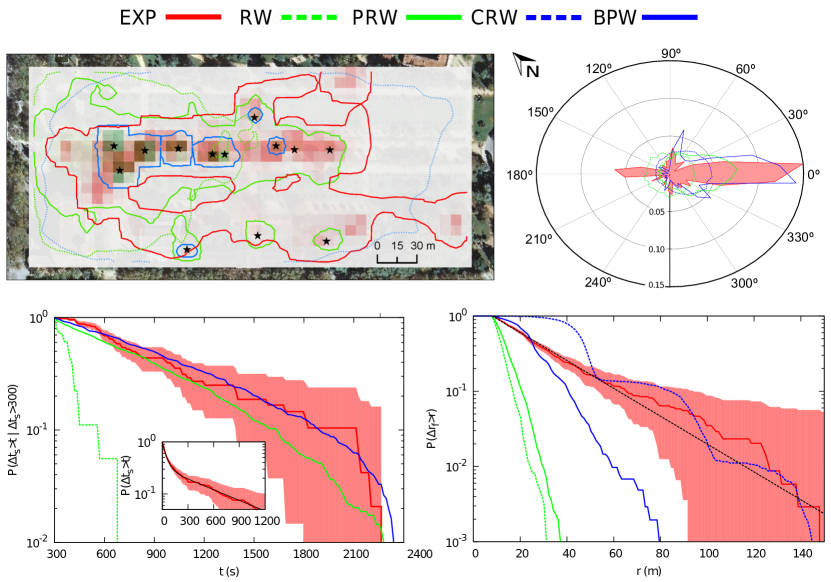
- The inclusion of attraction points (potential wells) in the Langevin model significantly improved the fit to real GPS trajectories, indicating strong reactive influence from visible stands.
- Trajectory variance analysis showed that movement complexity increased in proximity to attraction points, confirming context-dependent behavioral shifts.
- The dBBMM analysis revealed that the 95% home range of participants was consistently larger in simulations including reactive forces compared to purely active models.
- The model with both persistence and memory components better reproduced the observed movement patterns than models with only one or none of these features.
- The simulated trajectories closely matched real data in terms of spatial distribution and movement intensity, validating the model’s predictive power.
- The study demonstrated that reactive behavior—driven by visible attraction points—was the dominant factor in shaping pedestrian flows, especially in high-traffic zones near stands.
Read this paper
Open the full text in the Nubint reader and ask about any passage as you read.
Read this paper on NubintThis review was generated by AI from the original paper. Please check the paper before citing it.