
[Paper Review] ADMET property prediction through combinations of molecular fingerprints
This paper proposes a machine learning model that combines extended-connectivity fingerprints (ECFP), Avalon, ErG, and 200 molecular properties with CatBoost regression to predict ADMET properties. The model achieves top-1 performance in 6 out of 22 Therapeutics Data Commons benchmarks and top-3 in 16, demonstrating that enriched molecular representations significantly improve predictive accuracy over deep learning models.
While investigating methods to predict small molecule potencies, we found random forests or support vector machines paired with extended-connectivity fingerprints (ECFP) consistently outperformed recently developed methods. A detailed investigation into regression algorithms and molecular fingerprints revealed gradient-boosted decision trees, particularly CatBoost, in conjunction with a combination of ECFP, Avalon, and ErG fingerprints, as well as 200 molecular properties, to be most effective. Incorporating a graph neural network fingerprint further enhanced performance. We successfully validated our model across 22 Therapeutics Data Commons ADMET benchmarks. Our findings underscore the significance of richer molecular representations for accurate property prediction.
Motivation & Objective
- To develop a robust, generalizable model for predicting ADMET properties of small molecules without relying on deep neural networks.
- To investigate whether traditional machine learning with combined molecular fingerprints outperforms state-of-the-art deep learning models in ADMET prediction.
- To evaluate the impact of combining multiple fingerprint types and molecular descriptors on predictive performance.
- To validate the model’s generalization across diverse ADMET tasks using standardized benchmarks.
- To explore whether graph neural network fingerprints further enhance performance in a unified feature representation framework.
Proposed method
- The model uses CatBoost regression with a combined molecular representation consisting of ECFP, Avalon, ErG fingerprints, and 200 molecular properties.
- Feature engineering includes concatenation of multiple fingerprint types and numerical molecular descriptors such as molecular weight and ring count.
- A time-split validation strategy was applied to ensure generalization, with molecules profiled after a certain date reserved as a final test set.
- Hyperparameter optimization was performed using Optuna, with LightGBM used for practical tuning due to ease of integration.
- A graph isomorphism network (GIN) with supervised masking was added to the feature set to explore neural fingerprint enhancement.
- Model performance was evaluated on 22 ADMET benchmarks from the Therapeutics Data Commons using mean absolute error and rank-based comparison.
Experimental results
Research questions
- RQ1Can a traditional machine learning model with combined molecular fingerprints outperform deep learning models in ADMET property prediction?
- RQ2How does the integration of multiple fingerprint types (ECFP, Avalon, ErG) affect predictive accuracy compared to individual fingerprints?
- RQ3To what extent do molecular properties enhance model performance when combined with fingerprints?
- RQ4Does adding a graph neural network fingerprint further improve performance across diverse ADMET tasks?
- RQ5Can a single, unified model generalize across 22 different ADMET prediction benchmarks without task-specific fine-tuning?
Key findings
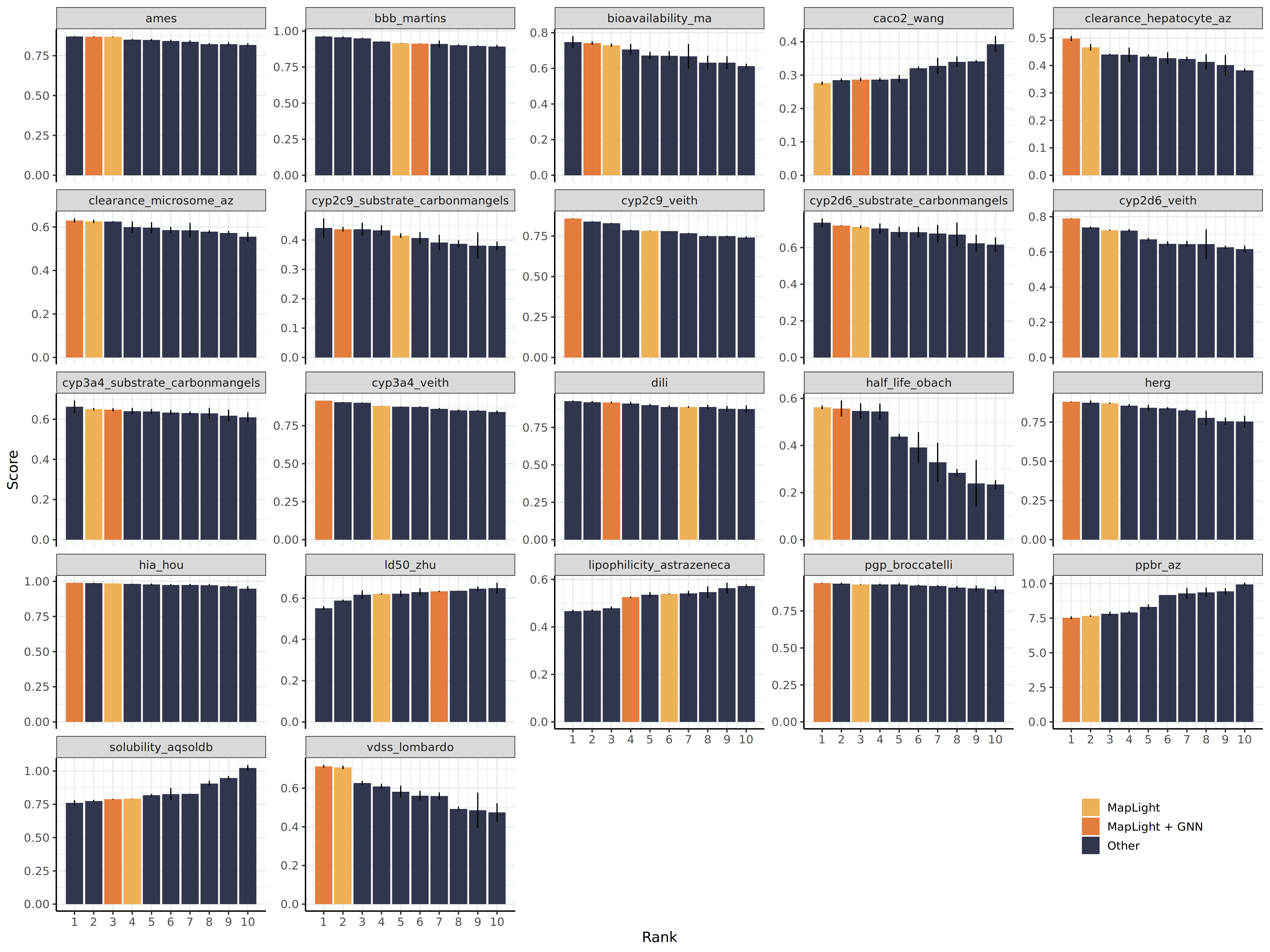
- The CatBoost model with combined ECFP, Avalon, ErG fingerprints, and 200 molecular properties achieved top-1 performance in 6 out of 22 Therapeutics Data Commons ADMET benchmarks.
- The same model achieved top-3 performance in 16 out of 22 benchmarks, demonstrating strong generalization across diverse ADMET tasks.
- Adding a GIN (graph isomorphism network) fingerprint improved performance, resulting in top-1 performance in 11 out of 22 benchmarks and top-3 in 19.
- Despite extensive hyperparameter tuning, no significant improvement was found over default LightGBM or CatBoost settings, except for adjusting CatBoost’s random strength.
- The model’s performance was consistent across time-split validation, indicating robustness to temporal data drift and low risk of overfitting.
- Traditional fingerprint-based models outperformed deep learning models like Chemprop, ChemBERTa, and Grover, even when pre-trained on large datasets.
Read this paper
Open the full text in the Nubint reader and ask about any passage as you read.
Read this paper on NubintThis review was generated by AI from the original paper. Please check the paper before citing it.