
[Paper Review] AEGIS: Online Adaptive AI Content Safety Moderation with Ensemble of LLM Experts
This paper introduces Aegis, an online adaptive AI content safety system that uses an ensemble of fine-tuned LLM experts to dynamically moderate harmful content. It proposes a comprehensive 13-category safety taxonomy, curates the AegisSafetyDataset (26,541 human-annotated interactions), and demonstrates state-of-the-art robustness against jailbreak attacks while preserving model helpfulness on standard benchmarks.
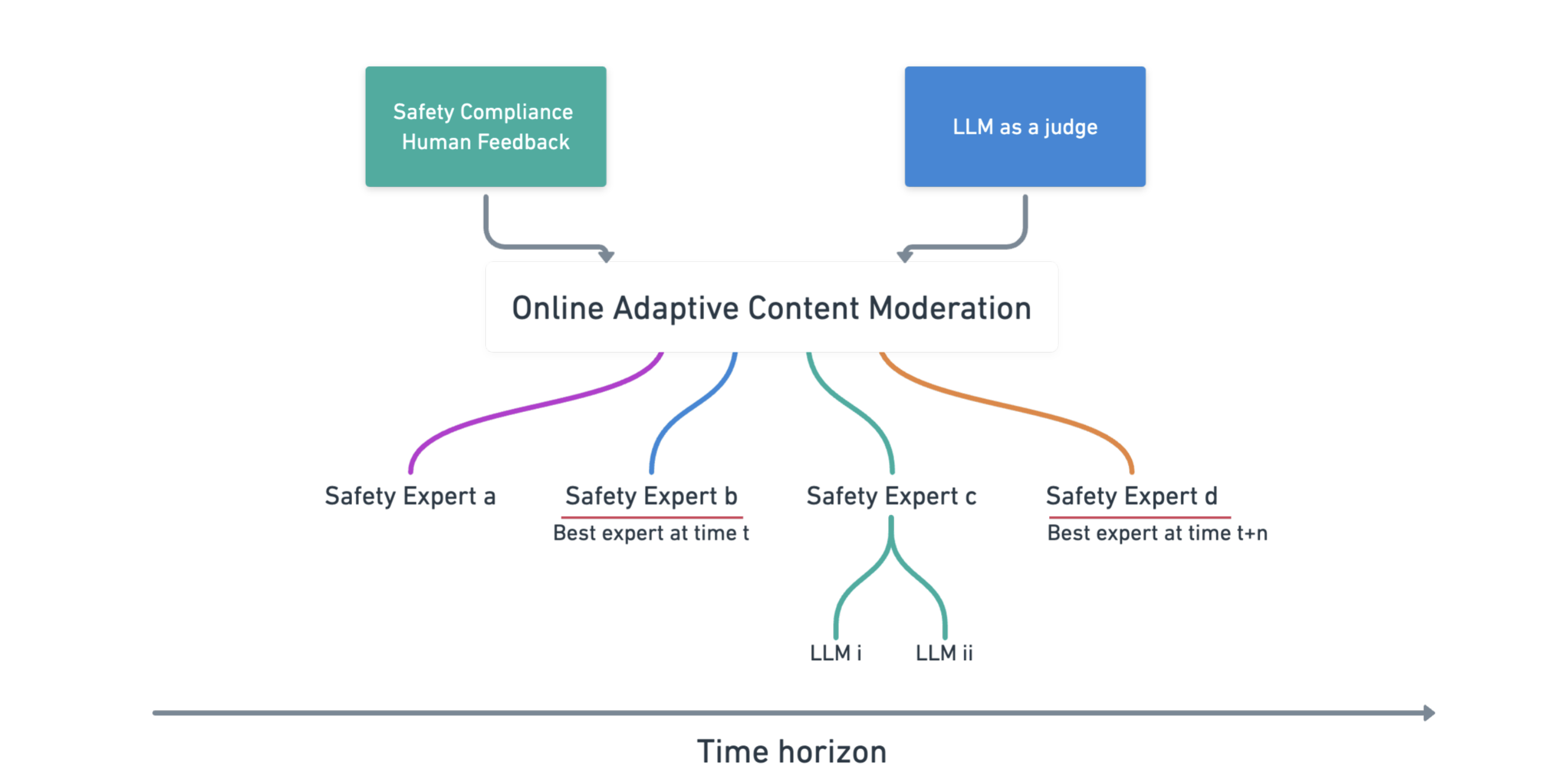
As Large Language Models (LLMs) and generative AI become more widespread, the content safety risks associated with their use also increase. We find a notable deficiency in high-quality content safety datasets and benchmarks that comprehensively cover a wide range of critical safety areas. To address this, we define a broad content safety risk taxonomy, comprising 13 critical risk and 9 sparse risk categories. Additionally, we curate AEGISSAFETYDATASET, a new dataset of approximately 26, 000 human-LLM interaction instances, complete with human annotations adhering to the taxonomy. We plan to release this dataset to the community to further research and to help benchmark LLM models for safety. To demonstrate the effectiveness of the dataset, we instruction-tune multiple LLM-based safety models. We show that our models (named AEGISSAFETYEXPERTS), not only surpass or perform competitively with the state-of-the-art LLM-based safety models and general purpose LLMs, but also exhibit robustness across multiple jail-break attack categories. We also show how using AEGISSAFETYDATASET during the LLM alignment phase does not negatively impact the performance of the aligned models on MT Bench scores. Furthermore, we propose AEGIS, a novel application of a no-regret online adaptation framework with strong theoretical guarantees, to perform content moderation with an ensemble of LLM content safety experts in deployment
Motivation & Objective
- To address the lack of comprehensive, high-quality content safety datasets covering critical and sparse safety risks in LLM interactions.
- To develop a robust, adaptive content moderation system that can respond to evolving safety policies and emerging adversarial attacks.
- To ensure that safety alignment does not degrade model performance on helpfulness benchmarks like MT-Bench.
- To create a theoretically grounded, no-regret online learning framework for dynamic expert selection in content moderation.
Proposed method
- Design a 13-category content safety taxonomy with 9 sparse risk subcategories to comprehensively cover critical safety risks in human-LLM interactions.
- Curate AegisSafetyDataset with 26,541 human-annotated LLM interaction instances using 12 annotators to ensure alignment with human values.
- Fine-tune diverse strong LLMs on the dataset to create AegisSafetyExperts—specialized safety models with enhanced robustness.
- Implement Aegis, a no-regret online adaptation framework that dynamically weights expert predictions based on context and feedback.
- Use online learning theory (Cesa-Bianchi & Lugosi, 2006) to ensure theoretical guarantees on performance and adaptability.
- Integrate human compliance team feedback into the meta-algorithm to enable continuous improvement over time.
Experimental results
Research questions
- RQ1Can a comprehensive, human-validated safety taxonomy improve the detection of both common and rare harmful content in LLM interactions?
- RQ2How does an ensemble of instruction-tuned LLM experts compare to state-of-the-art safety models in robustness against jailbreak attacks?
- RQ3To what extent does training safety models on the AegisSafetyDataset affect their performance on general helpfulness benchmarks like MT-Bench?
- RQ4Can a no-regret online learning framework effectively adapt expert weighting in real-time to changing safety policies and attack patterns?
- RQ5Does integrating human feedback into the meta-algorithm improve long-term moderation accuracy and adaptability?
Key findings
- The AegisSafetyDataset contains 26,541 human-annotated LLM interaction instances across 13 core and 9 sparse safety categories, with ongoing annotation.
- The AegisSafetyExperts models outperform or match state-of-the-art LLM-based safety models in robustness across multiple jailbreak attack categories, including TAP and GCG.
- Training on AegisSafetyDataset does not degrade model performance on MT-Bench, maintaining high helpfulness scores.
- The Aegis meta-algorithm achieves strong theoretical guarantees via no-regret online learning, enabling dynamic adaptation to shifting data distributions and safety policies.
- The system demonstrates resilience to adversarial attacks without requiring task-specific retraining, thanks to its ensemble-based, context-aware expert selection.
- The authors plan to release both the dataset and fine-tuned models to support community research and benchmarking.
Read this paper
Open the full text in the Nubint reader and ask about any passage as you read.
Read this paper on NubintThis review was generated by AI from the original paper. Please check the paper before citing it.