
[論文レビュー] Age of Information for Multiple-Source Multiple-Server Networks
本稿では、リアルタイム監視システムにおける情報の古さ(Age of Information: AoI)を最適化する複数ソース・複数サーバーのネットワークモデルを提案する。指数分布に従うサービス時間とポアソン分布に従う更新を伴う最後に来たものが先に処理される(LCFS)キューイングポリシーを用い、均一なネットワークでは平均AoIの閉形式表現を導出し、非均一なケースには再帰的アルゴリズムを構築する。これにより、複数のソースとサーバー間でデータの新鮮さが著しく向上する。
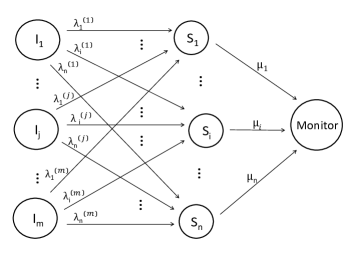
Having timely and fresh knowledge about the current state of information sources is critical in a variety of applications. In particular, a status update may arrive at the destination later than its generation time due to processing and communication delays. The freshness of the status update at the destination is captured by the notion of age of information. In this study, we analyze a multiple sensing network with multiple sources, multiple servers, and a monitor (destination). Each source corresponds to an independent piece of information and its age is measured individually. Given a particular source, the servers independently sense the source of information and send the status update to the monitor. We assume that updates arrive at the servers according to Poisson random processes. Each server sends its updates to the monitor through a direct link, which is modeled as a queue. The service time to transmit an update is considered to be an exponential random variable. We examine both homogeneous and heterogeneous service and arrival rates for the single-source case, and only homogeneous arrival and service rates for the multiple-source case. We derive a closed-form expression for the average age of information under a last-come-first-serve (LCFS) queue for a single source and arbitrary number of homogeneous servers. Using a recursive method, we derive the explicit average age of information for any number of sources and homogeneous servers. We also investigate heterogeneous servers and a single source, and present algorithms for finding the average age of information.
研究の動機と目的
- 各ソースが複数のサーバーによって独立に測定されるマルチソース・マルチサーバーネットワークにおける情報の古さ(AoI)をモデル化・分析すること。
- 単一サーバー構成と比較して、各ソースに複数のサーバーを用いることでAoIがどの程度改善されるかを定量化すること。
- 任意の数のソースとサーバーを有する均一なネットワークにおいて、前払いを伴うLCFSポリシー下での平均AoIの閉形式表現を導出すること。
- 単一ソースを有する非均一サーバーネットワークにおけるAoIの再帰的アルゴリズムと解析的表現を構築すること。
- さまざまなキューイングモデルとネットワーク構成において、シミュレーションを通じて解析結果の妥当性を検証すること。
提案手法
- 各サーバーをポアソン分布に従う更新の到着と指数分布に従うサービス時間を有する独立したM/M/1キューとしてモデル化する。
- 新規更新が進行中の伝送を即座に置き換える前払いを伴う最後に来たものが先に処理される(LCFS)ポリシーを適用する。
- 確率的ハイブリッドシステム(SHS)を用いて平均AoIを導出し、状態空間方程式の再帰的分解を活用する。
- 再帰的アルゴリズム(アルゴリズム2)を構築し、係数行列がT₀の形を取る基本アルゴリズム(アルゴリズム3)を用いて、方程式系をより小さな部分問題に分解する。
- 階層的消去プロセスを用いて、高次方程式から順に基本ケースへと順次解を求める。これにより、非負の解が保証される。
- 帰納法を用いた非負性の証明により、すべての導出変数が非負であることを示し、解の物理的整合性を裏付ける。
実験結果
リサーチクエスチョン
- RQ1前払いを伴うLCFSキューイングポリシー下で、単一ソース・複数均一サーバーのネットワークにおける平均情報の古さ(AoI)は何か?
- RQ2均一なマルチソース・マルチサーバーネットワークにおいて、平均AoIはソース数およびサーバー数の増加に伴いどのように変化するか?
- RQ3任意のサービス速度および到着レートを有する単一ソース・複数非均一サーバーのネットワークにおける平均AoIの解析的表現は何か?
- RQ4複数ソース・複数サーバーのネットワークにおいて、均一なサーバーを有する場合に平均AoIを効率的に計算できる再帰的アルゴリズムを構築できるか?
- RQ5マルチソース・マルチサーバーシステムにおいて、さまざまなキューイングポリシーとネットワーク構成におけるAoI性能はどのように比較されるか?
主な発見
- 前払いを伴うLCFSポリシー下で、任意の数のサーバーを有する単一ソース・複数均一サーバーのネットワークにおいて、平均AoIの閉形式表現が導出された。
- 複数ソースを有する均一なネットワークでは、サーバー数が2または3の場合に、平均AoIの明示的な閉形式表現が得られた。
- 任意の数のソースと均一なサーバーを有する場合に平均AoIを計算できる再帰的アルゴリズムが開発され、スケーラブルな解析が可能になった。
- 単一ソースを有する非均一サーバーのネットワークでは、2および3台のサーバーに対する解析的表現が提示され、任意の数のサーバーをカバーする汎用アルゴリズムが開発された。
- 導出されたすべての変数の非負性が厳密に証明され、解析的解の妥当性と物理的整合性が保証された。
- シミュレーションにより、さまざまなキューイングモデルとネットワーク設定において解析結果の正確性が確認され、理論的枠組みの妥当性が検証された。
より良い研究を、今すぐ始めましょう
論文の読解から最終レビューまで、研究時間を劇的に削減しましょう。
クレジットカード登録不要
このレビューはAIが作成し、人間の編集者が確認しました。