
[Paper Review] Agent AI: Surveying the Horizons of Multimodal Interaction
A comprehensive survey proposing Agent AI—multimodal, embodied agents built from large foundation models (LLMs/VLMs) that perceive, reason, and act across physical and virtual environments, with discussion of learning paradigms, ethics, and applications.
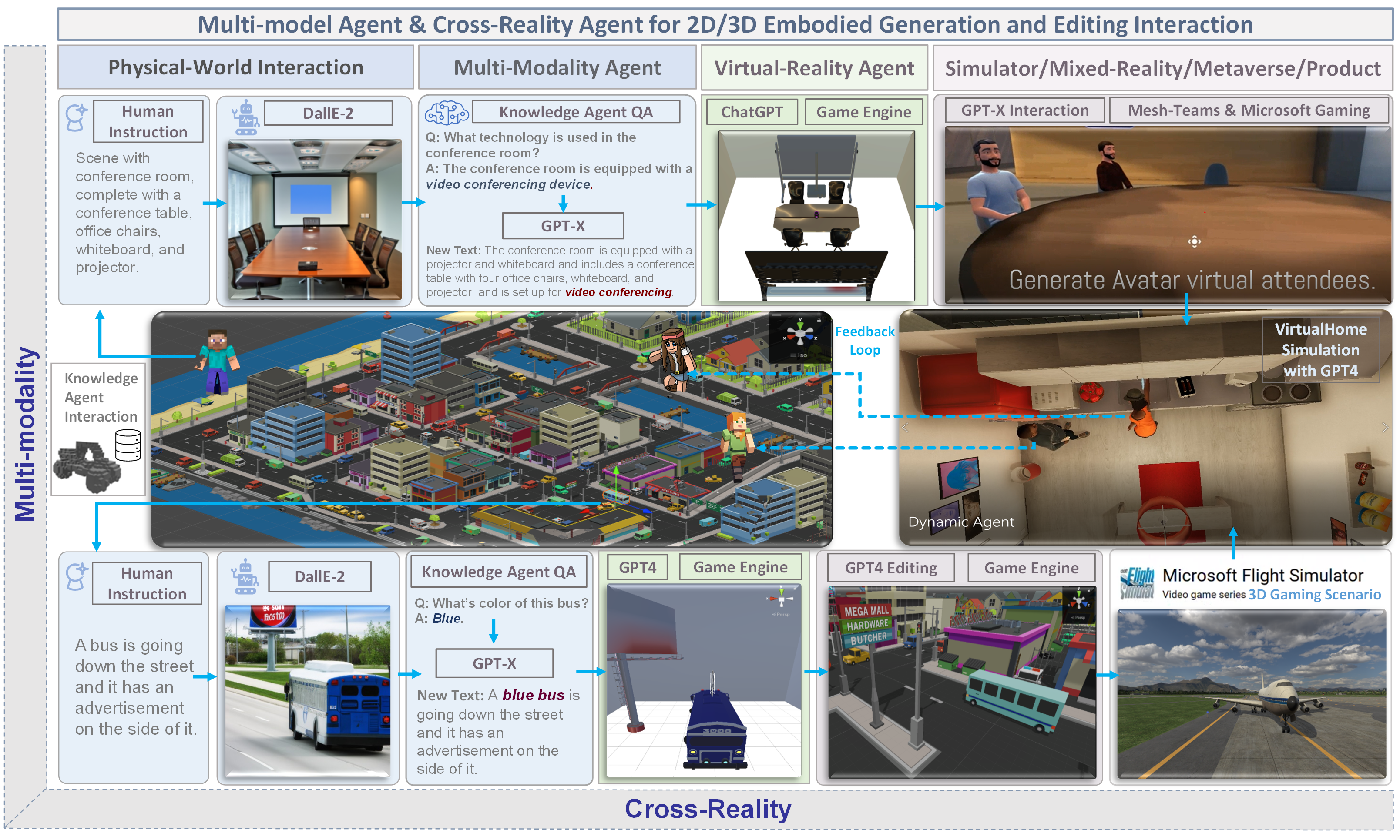
Multi-modal AI systems will likely become a ubiquitous presence in our everyday lives. A promising approach to making these systems more interactive is to embody them as agents within physical and virtual environments. At present, systems leverage existing foundation models as the basic building blocks for the creation of embodied agents. Embedding agents within such environments facilitates the ability of models to process and interpret visual and contextual data, which is critical for the creation of more sophisticated and context-aware AI systems. For example, a system that can perceive user actions, human behavior, environmental objects, audio expressions, and the collective sentiment of a scene can be used to inform and direct agent responses within the given environment. To accelerate research on agent-based multimodal intelligence, we define "Agent AI" as a class of interactive systems that can perceive visual stimuli, language inputs, and other environmentally-grounded data, and can produce meaningful embodied actions. In particular, we explore systems that aim to improve agents based on next-embodied action prediction by incorporating external knowledge, multi-sensory inputs, and human feedback. We argue that by developing agentic AI systems in grounded environments, one can also mitigate the hallucinations of large foundation models and their tendency to generate environmentally incorrect outputs. The emerging field of Agent AI subsumes the broader embodied and agentic aspects of multimodal interactions. Beyond agents acting and interacting in the physical world, we envision a future where people can easily create any virtual reality or simulated scene and interact with agents embodied within the virtual environment.
Motivation & Objective
- Define Agent AI as a class of interactive systems that perceive visual, linguistic, and environmental data and produce embodied actions.
- Survey integration of large foundation models (LLMs and VLMs) with agentic capabilities to operate in cross-reality environments.
- Categorize agent types and applications across domains like gaming, robotics, and healthcare.
- Discuss learning strategies (RL, imitation learning, in-context learning) and agent infrastructure for zero/few-shot scenarios.
- Address ethical, privacy, bias, interpretability, and governance considerations for agent-based AI.
Proposed method
- Propose a framework for training and evaluating Agent AI systems that integrate LLMs/VLMs with embodied action.
- Analyze challenges of hallucinations and biases in foundation-model-driven agents and discuss grounding and retrieval-augmented methods.
- Outline an Agent Transformer paradigm and construction process for multi-domain agents.
- Describe learning strategies (RL, IL, in-context learning) and how they enable zero-shot and few-shot generalization across tasks.
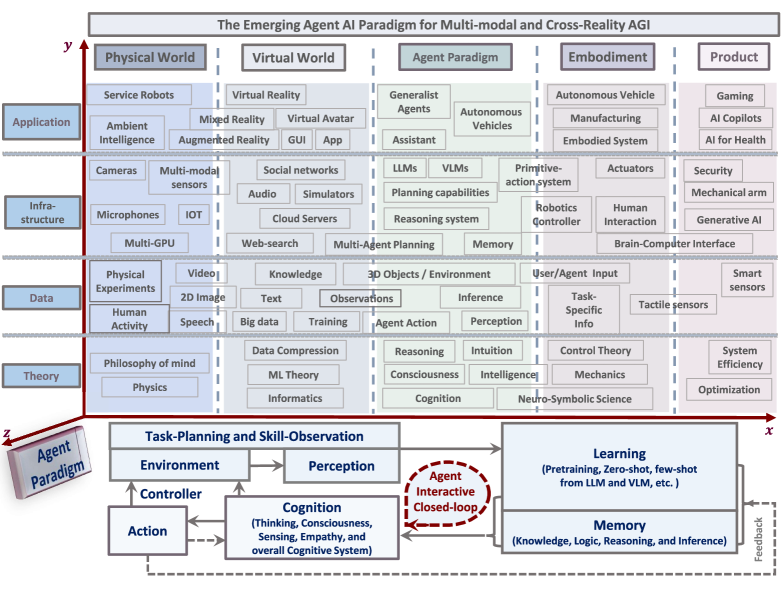
- Present an organizing taxonomy of agent types, modalities, and real/virtual environments, plus evaluation benchmarks and datasets.
Experimental results
Research questions
- RQ1How can LLMs and VLMs be leveraged to create embodied, multimodal agents that operate effectively in both physical and virtual settings?
- RQ2What learning paradigms and architectures best support generalization, grounding, and robustness of Agent AI across domains?
- RQ3How should Agent AI be categorized by capabilities, modalities, and environments to guide research and evaluation?
- RQ4What ethical, privacy, and inclusivity considerations arise for agent-based systems and how can they be mitigated?
- RQ5What datasets and benchmarks are needed to advance multimodal Agent AI research?
Key findings
- Agent AI is framed as a pathway toward more interactive, embodied multimodal intelligence that spans physical and virtual realities.
- A comprehensive taxonomy of Agent AI categories and applications is provided, including generalist, embodied, simulation, generative, knowledge, and neuro-symbolic agents.
- Discussion of integration with foundation models highlights benefits and risks, including hallucinations, biases, data privacy, and interpretability considerations.
- The paper outlines learning strategies (RL, IL, in-context learning) and agent infrastructures for zero-shot and few-shot generalization.
- Ethical, societal, and governance aspects are analyzed, along with datasets and leadership boards proposed for benchmarking Agent AI progress.
Read this paper
Open the full text in the Nubint reader and ask about any passage as you read.
Read this paper on NubintThis review was generated by AI from the original paper. Please check the paper before citing it.