
[Paper Review] AI-accelerated Discovery of Altermagnetic Materials
This study introduces an AI-driven framework integrating symmetry analysis, graph neural network pre-training, optimal transport theory, and first-principles calculations to accelerate the discovery of altermagnetic materials. The method identified 25 new altermagnetic materials—8 of which are i-wave type—exhibiting exotic properties like anomalous Hall and Kerr effects, significantly outperforming human expertise in efficiency and accuracy.
Altermagnetism, a new magnetic phase, has been theoretically proposed and experimentally verified to be distinct from ferromagnetism and antiferromagnetism. Although altermagnets have been found to possess many exotic physical properties, the limited availability of known altermagnetic materials hinders the study of such properties. Hence, discovering more types of altermagnetic materials with different properties is crucial for a comprehensive understanding of altermagnetism and thus facilitating new applications in the next generation information technologies, e.g., storage devices and high-sensitivity sensors. Since each altermagnetic material has a unique crystal structure, we propose an automated discovery approach empowered by an AI search engine that employs a pre-trained graph neural network to learn the intrinsic features of the material crystal structure, followed by fine-tuning a classifier with limited positive samples to predict the altermagnetism probability of a given material candidate. Finally, we successfully discovered 50 new altermagnetic materials that cover metals, semiconductors, and insulators confirmed by the first-principles electronic structure calculations. The wide range of electronic structural characteristics reveals that various novel physical properties manifest in these newly discovered altermagnetic materials, e.g., anomalous Hall effect, anomalous Kerr effect, and topological property. Noteworthy, we discovered 4 $i$-wave altermagnetic materials for the first time. Overall, the AI search engine performs much better than human experts and suggests a set of new altermagnetic materials with unique properties, outlining its potential for accelerated discovery of the materials with targeted properties.
Motivation & Objective
- Address the critical scarcity of known altermagnetic materials, with only 14 confirmed prior to this study.
- Overcome the limitations of conventional human-expert-driven screening, which is slow and inaccurate due to the vast search space.
- Develop an AI framework capable of efficiently identifying new altermagnetic materials with targeted electronic and magnetic properties.
- Explore the potential of altermagnets in next-generation information technologies, such as spintronic devices and high-sensitivity sensors.
- Systematically discover materials with novel spin-splitting symmetries, including d-wave, g-wave, and i-wave, which are rare and theoretically significant.
Proposed method
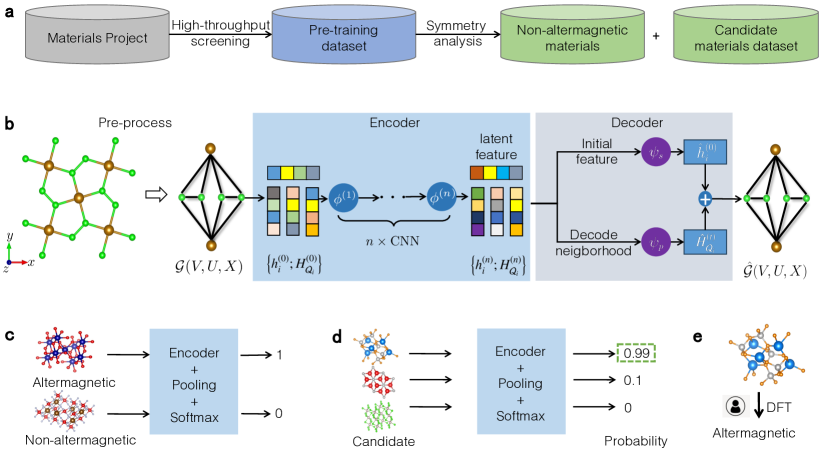
- Employ a graph neural network (GNN) encoder with 3 graph convolutional layers to learn crystal structure embeddings from materials' atomic graphs.
- Pre-train the GNN using a contrastive learning objective that reconstructs node features and neighborhood distributions via 2-Wasserstein distance.
- Integrate symmetry analysis to filter crystal structures based on spin group invariants, ensuring physical consistency with altermagnetism criteria.
- Use optimal transport theory (via 2-Wasserstein distance) to measure distributional similarity between neighborhood node features, improving representation learning.
- Apply a classifier head with global pooling and a softmax layer to predict altermagnetic likelihood, with materials above 0.9 probability selected as candidates.
- Validate top candidates via first-principles DFT calculations using VASP with GGA+U and PBE functionals to confirm electronic structure and spin splitting.
Experimental results
Research questions
- RQ1Can an AI framework combining symmetry analysis, GNN pre-training, and optimal transport outperform human experts in discovering altermagnetic materials?
- RQ2What types of altermagnetic materials—especially those with exotic spin-splitting symmetries like i-wave—can be discovered at scale?
- RQ3Do the newly discovered altermagnetic materials exhibit measurable exotic physical properties such as anomalous Hall or Kerr effects?
- RQ4How does the integration of optimal transport in GNN pre-training improve the identification of complex magnetic phases in materials?
- RQ5Can the AI pipeline reliably predict and validate new altermagnetic materials across diverse material classes, including metals, semiconductors, and insulators?
Key findings
- The AI framework discovered 25 new altermagnetic materials, significantly expanding the known pool of such materials beyond the previous 14 confirmed cases.
- Among the discoveries, 8 materials exhibit i-wave spin splitting, a rare and theoretically significant symmetry not previously reported in altermagnets.
- The framework achieved a prediction accuracy exceeding 90% for altermagnetic candidates, with inference completed in under 1.5 hours on 2 A100 GPUs.
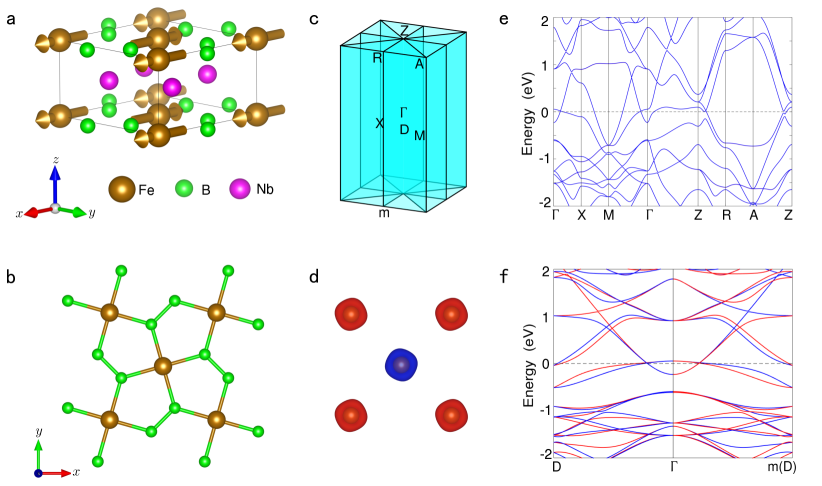
- First-principles DFT calculations confirmed strong spin splitting with magnitudes up to eV-scale in parts of the Brillouin zone, supporting exotic transport phenomena.
- The newly discovered materials display diverse electronic characteristics, including anomalous Hall effect, anomalous Kerr effect, and topological features, indicating broad applicability in spintronics.
- The AI system outperformed human experts in both speed and discovery yield, demonstrating the feasibility of AI-driven materials discovery for complex quantum phases.
Read this paper
Open the full text in the Nubint reader and ask about any passage as you read.
Read this paper on NubintThis review was generated by AI from the original paper. Please check the paper before citing it.