
[論文レビュー] AI-coupled HPC Workflow Applications, Middleware and Performance
A survey that classifies AI–HPC workflows into six execution motifs, analyzes coupling modes, frameworks, performance challenges, and open research issues for AI-driven HPC systems.
AI integration is revolutionizing the landscape of HPC simulations, enhancing the importance, use, and performance of AI-driven HPC workflows. This paper surveys the diverse and rapidly evolving field of AI-driven HPC and provides a common conceptual basis for understanding AI-driven HPC workflows. Specifically, we use insights from different modes of coupling AI into HPC workflows to propose six execution motifs most commonly found in scientific applications. The proposed set of execution motifs is by definition incomplete and evolving. However, they allow us to analyze the primary performance challenges underpinning AI-driven HPC workflows. We close with a listing of open challenges, research issues, and suggested areas of investigation including the the need for specific benchmarks that will help evaluate and improve the execution of AI-driven HPC workflows.
研究の動機と目的
- Establish a common conceptual basis for understanding AI-driven HPC workflows.
- Identify and characterize common execution motifs that describe AI–HPC interaction patterns.
- Survey existing frameworks and libraries that support AI–HPC coupling.
- Analyze performance and systems challenges in AI-driven HPC workflows.
- Outline open challenges and research directions to advance AI–HPC workflows.
提案手法
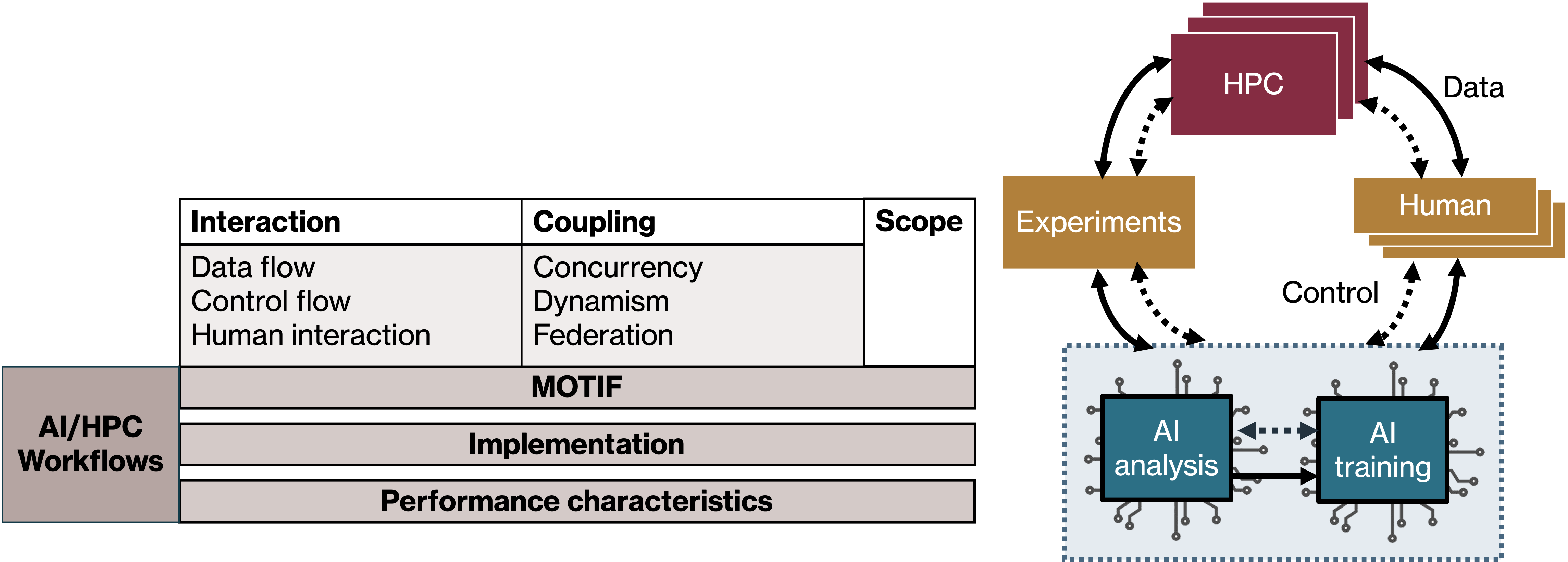
- Define AI–HPC coupling modes (AI-in-HPC, AI-out-HPC, AI-about-HPC) and propose six execution motifs.
- Describe characteristics of each motif focusing on interaction, coupling, concurrency, dynamism, and federation.
- Summarize representative frameworks and libraries that support AI–HPC integration and map them to motifs.
- Discuss performance bottlenecks and system challenges organized by motif (load balancing, dataflow, etc.).
- Present open issues and suggested research areas, including the need for benchmarks for AI-driven HPC workflows.
実験結果
リサーチクエスチョン
- RQ1What are the recurring interaction and coupling patterns in AI-driven HPC workflows?
- RQ2How can we categorize AI–HPC workflows into a finite set of motifs to analyze performance bottlenecks?
- RQ3What frameworks exist to support AI–HPC integration and how do they map to the motifs?
- RQ4What are the primary performance and systems challenges in AI-coupled HPC workflows, and how can they be addressed?
- RQ5What open research directions and benchmarks are needed to advance AI-driven HPC workflows?
主な発見
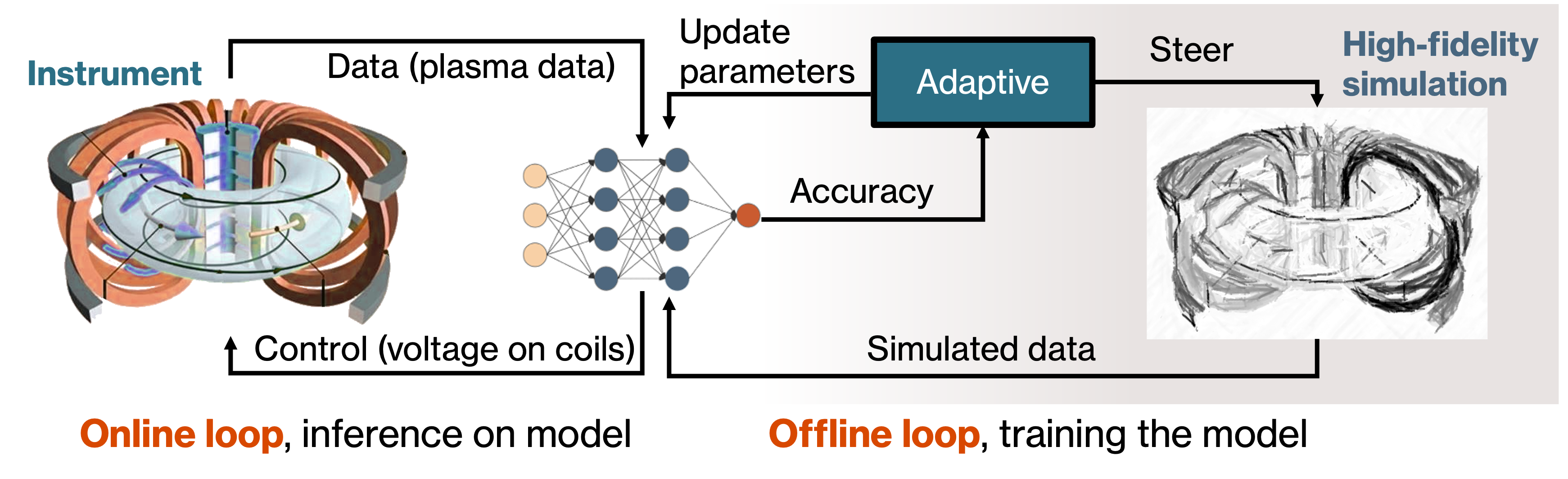
- Six execution motifs capture the main AI–HPC interaction patterns (Steering, Multistage Pipeline, Inverse Design, Digital Replica, Distributed Models, Adaptive Training).
- AI–HPC coupling occurs in three modes (AI-in-HPC, AI-out-HPC, AI-about-HPC) and can be combined across motifs.
- AI-driven steering and multistage pipelines can dramatically improve efficiency and enable near-real-time decision-making in HPC workflows.
- Digital replicas (digital twins) integrate AI with HPC and experiments to monitor, predict, and steer simulations.
- Distributed models and dynamic data address edge-to-cloud and WAN-distributed resources with near-real-time adaptations.
- Adaptive training focuses on training large AI models using data generated by HPC simulations, potentially in conjunction with simulations
より良い研究を、今すぐ始めましょう
論文設計から論文執筆まで、研究時間を劇的に削減しましょう。
クレジットカード登録不要
このレビューはAIが作成し、人間の編集者が確認しました。