
[Paper Review] AI in Software Engineering: A Survey on Project Management Applications
This survey investigates AI and machine learning applications in software engineering project management, analyzing 11 studies from 1992 to 2022. It identifies AI’s potential to improve risk mitigation, cost estimation, and requirement allocation through automated analytics, while highlighting challenges in model training, data quality, and ethical integration.
Artificial Intelligence (AI) refers to the intelligence demonstrated by machines, and within the realm of AI, Machine Learning (ML) stands as a notable subset. ML employs algorithms that undergo training on data sets, enabling them to carry out specific tasks autonomously. Notably, AI holds immense potential in the field of software engineering, particularly in project management and planning. In this literature survey, we explore the use of AI in Software Engineering and summarize previous works in this area. We first review eleven different publications related to this subject, then compare the surveyed works. We then comment on the possible challenges present in the utilization of AI in software engineering and suggest possible further research avenues and the ways in which AI could evolve with software engineering in the future.
Motivation & Objective
- To examine the evolution and current state of AI and machine learning in software engineering project management from 1992 to 2022.
- To identify recurring applications of AI in core project management tasks such as risk assessment, effort estimation, and requirement allocation.
- To analyze limitations and challenges in implementing AI systems, including data dependency, subjectivity in input parameters, and ethical concerns.
- To explore future research directions for AI integration in software development, particularly in agile and distributed environments.
- To compare historical perspectives with current AI-driven frameworks to assess progress and persistent gaps in the field.
Proposed method
- Systematic literature review of 11 peer-reviewed publications on AI in software engineering, including foundational works from 1992 and recent studies (2018–2022).
- Thematic analysis of AI applications in project management, focusing on risk mitigation, cost estimation, requirement allocation, and agile support.
- Use of artificial neural networks (ANNs) and orthogonal array-based models to improve software effort estimation accuracy.
- Evaluation of AI frameworks that automate repetitive tasks and support decision-making in agile and distributed development environments.
- Comparison of manual vs. AI-driven risk management, emphasizing the limitations of human-dependent approaches.
- Incorporation of practitioner surveys (e.g., Zohair, 2023) to project future trends in AI adoption over the next 30 years.
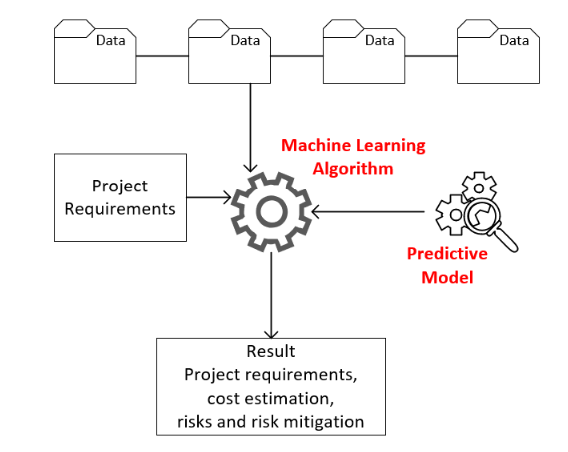
Experimental results
Research questions
- RQ1How has the application of AI in software project management evolved from 1992 to 2022?
- RQ2What are the primary AI-driven applications in risk mitigation, cost estimation, and requirement allocation in software engineering?
- RQ3What are the key technical and ethical challenges in deploying AI for project management in software development?
- RQ4How do current AI frameworks compare to traditional manual methods in terms of accuracy and scalability?
- RQ5What future research directions and integration strategies are envisioned for AI in software engineering project management?
Key findings
- AI and machine learning show strong potential to reduce project failure rates by improving accuracy in risk assessment and cost estimation.
- Artificial neural networks combined with orthogonal arrays significantly reduce estimation errors in software project effort and cost prediction.
- Automated risk management systems outperform manual methods by reducing reliance on individual experience and enabling scalable prioritization.
- AI-driven requirement allocation tools improve version planning by considering priority, dependency, and development time, though subjectivity in input values remains a limitation.
- Agile and distributed development environments benefit most from AI integration, particularly in dynamic task assignment and real-time analytics.
- Despite progress, challenges such as data quality, model interpretability, and ethical concerns remain critical barriers to widespread adoption.

Read this paper
Open the full text in the Nubint reader and ask about any passage as you read.
Read this paper on NubintThis review was generated by AI from the original paper. Please check the paper before citing it.