
[Paper Review] Alchemical diastereomers from antisymmetric alchemical perturbations
This paper introduces alchemical diastereomers via antisymmetric alchemical perturbations, showing that even-order energy contributions vanish when using an averaged electronic reference Hamiltonian. The leading-order term—twice the Hellmann-Feynman derivative at the averaged reference—accurately predicts relative energies with mean absolute errors of 4.3 mHa for 35 BN-doped toluene isomers, enabling efficient exploration of multi-dimensional chemical space.
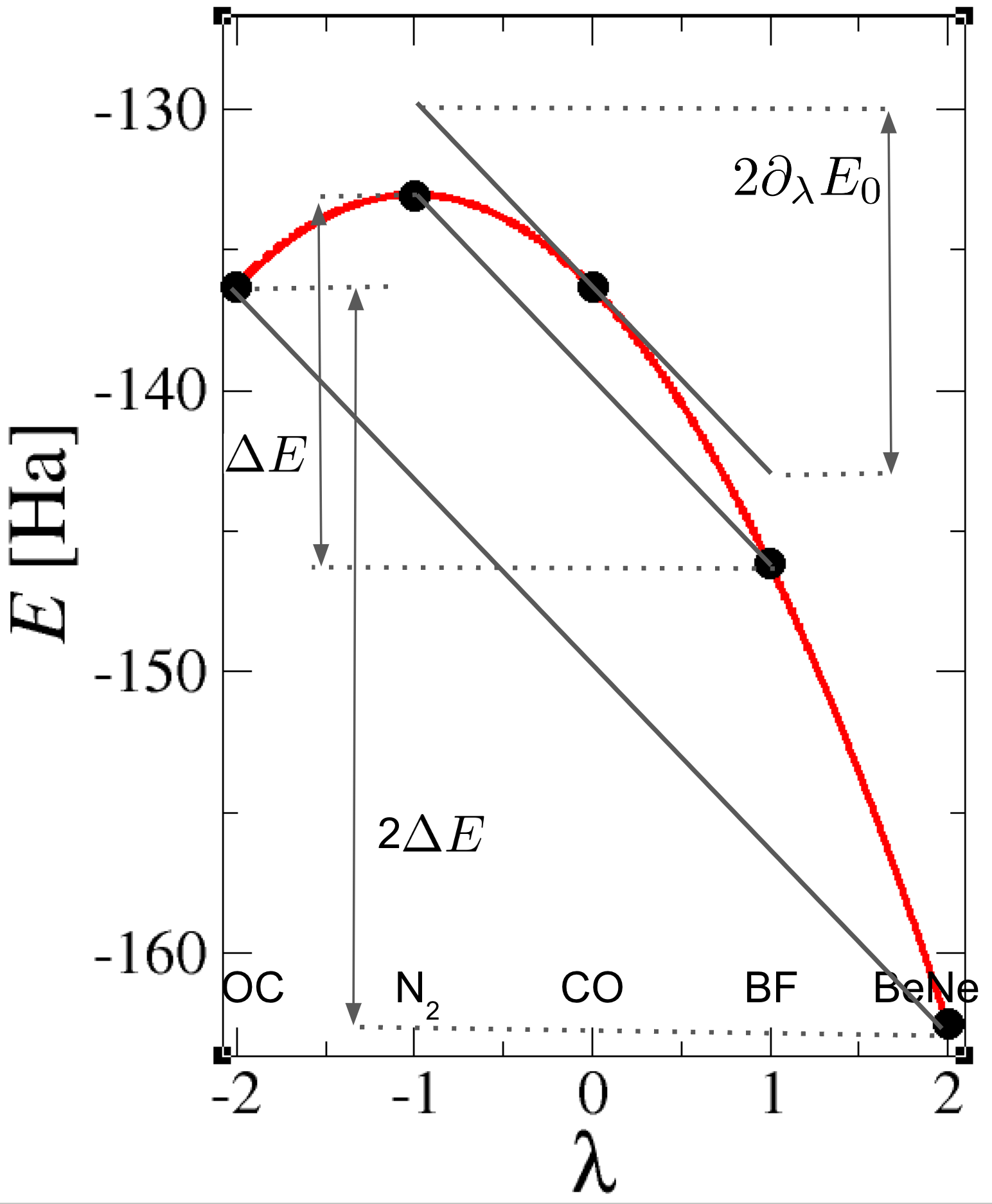
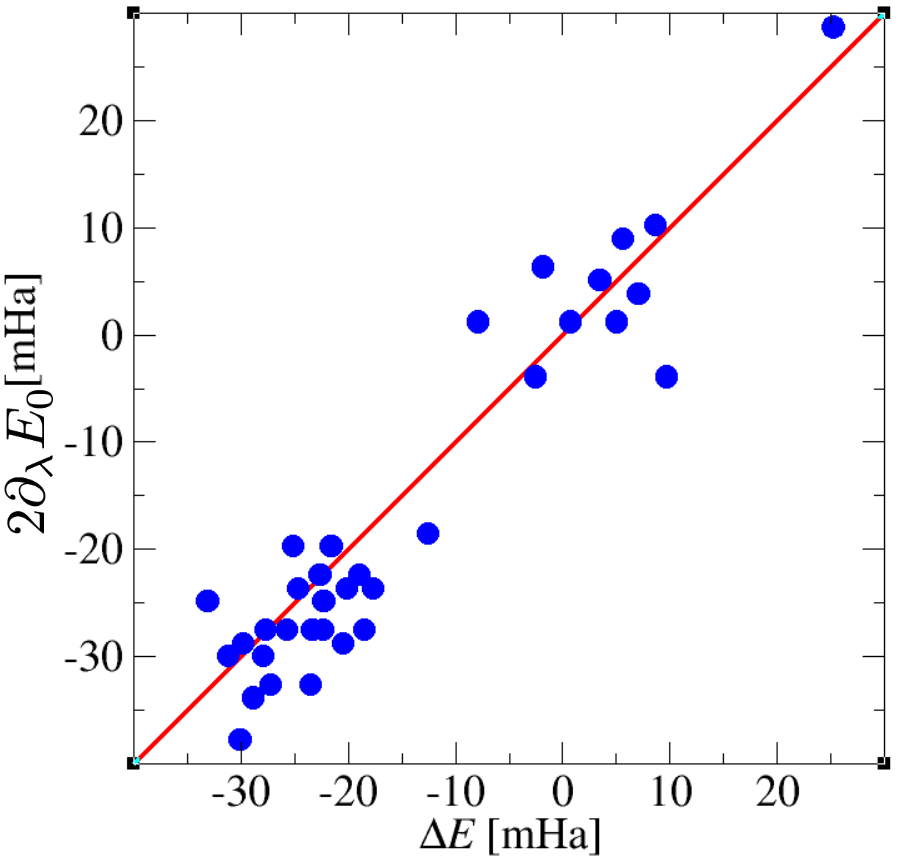
The energy difference between two iso-electronic systems can be accurately approximated by the alchemical first order Hellmann-Feynmann derivative for the averaged Hamiltonian. This approximation is exact up to third order because even-order contributions cancel out. This finding holds for any iso-electronic compound pair (dubbed `alchemical diastereomers'), regardless of differences in configuration, composition, or energy, and consequently, relative energy estimates for all possible iso-electronic alchemical diastereomer pairs, require only O(1) self-consistent field cycles for any given averaging reference Hamiltonian. We discuss the relation to the Verlet algorithm, alchemical harmonic approximation (AHA) [J. Chem. Phys. 162, 044101 (2025)], relative properties such as forces, ionization potential or electron affinities, and Levy's formula for relative energies among iso-electronic systems that uses the averaged electron density of the two systems [J. Chem. Phys. 70, 1573 (1979)]. Numerical estimates accurately reflect trends in the charge-neutral iso-electronic diatomic molecule series with 14 protons (N$_2$, CO, BF, BeNe, LiNa, HeMg, HAl), with systematically increasing errors. Using alchemical Hellmann-Feynman derivatives for toluene, we demonstrate the concept's broader applicability by estimating relative energies for all 36 possible alchemical diastereomer pairs from vertical iso-electronic charge-neutral antisymmetric BN doping of toluene's aromatic ring, with mean absolute errors of a few milli-Hartrees.
Motivation & Objective
- To generalize the alchemical chirality concept by relaxing symmetry constraints on iso-electronic reference systems.
- To investigate the behavior of energy differences under antisymmetric alchemical perturbations in iso-electronic compounds.
- To assess the predictive power of the leading-order term in perturbation theory for relative energy estimation.
- To demonstrate the framework’s scalability in exploring high-dimensional chemical space using a single reference electron density.
- To interpret Mel Levy’s formula in the context of antisymmetric perturbations and identify its overestimation of higher-order odd contributions.
Proposed method
- Perturbation theory is applied to iso-electronic compounds using a linear coupling parameter λ, with the Hamiltonian defined as H(λ) = H₀ + λH′, where H₀ is the averaged reference Hamiltonian.
- The energy difference ΔE is expanded in powers of λ, and it is analytically shown that all even-order contributions vanish under antisymmetric perturbations.
- The leading-order term is derived as 2∂λE₀, corresponding to twice the Hellmann-Feynman derivative evaluated at the averaged reference Hamiltonian.
- Density functional theory (DFT) with the PBE0 functional and pcX-2 basis sets is used to compute electronic structures and Hellmann-Feynman derivatives.
- The method is applied to a 14-proton iso-electronic series (N₂, CO, BF, etc.) and to 35 BN-doped isomers of toluene, using a fixed toluene geometry.
- Energy differences are computed from Hellmann-Feynman derivatives using the same electron density, minimizing computational overhead.
Experimental results
Research questions
- RQ1What happens to even-order energy contributions when antisymmetric alchemical perturbations are applied to iso-electronic compounds?
- RQ2How does the leading-order term in the perturbation expansion compare to Mel Levy’s formula for relative energies?
- RQ3Can the first-order Hellmann-Feynman derivative at the averaged reference Hamiltonian accurately predict relative energies between alchemical diastereomers?
- RQ4To what extent can a single electron density enable the efficient exploration of multi-dimensional chemical space in alchemical perturbation theory?
- RQ5How does the accuracy of the leading-order approximation scale with perturbation magnitude and system complexity?
Key findings
- Even-order contributions to relative energies vanish for all antisymmetric alchemical perturbations when using an averaged electronic reference Hamiltonian.
- The leading-order term corresponds to twice the Hellmann-Feynman derivative evaluated at the averaged reference Hamiltonian.
- Mel Levy’s formula includes the first-order contribution but overestimates higher odd-order contributions by a factor that increases linearly with order.
- For the 14-proton iso-electronic series, the leading-order term provides accurate estimates of relative energies with minimal computational cost.
- In the case of 35 BN-doped alchemical diastereomers of toluene, the mean absolute error (MAE) in predicted potential energy differences is 4.3 mHa, approaching chemical accuracy.
- The framework enables simultaneous exploration of multiple chemical space dimensions using only one reference electron density, drastically reducing computational overhead.
Read this paper
Open the full text in the Nubint reader and ask about any passage as you read.
Read this paper on NubintThis review was generated by AI from the original paper. Please check the paper before citing it.