
[Paper Review] An Adventure in Topological Phase Transitions in 3 + 1-D: Non-abelian Deconfined Quantum Criticalities and a Possible Duality
This paper proposes non-abelian deconfined quantum critical points (DQCPs) in 3+1 dimensions for both bosonic and fermionic systems, realizing critical theories as non-abelian gauge theories that flow to Banks-Zaks fixed points. It introduces the concept of 'unnecessary quantum critical points'—continuous transitions within the same phase—and suggests a novel 3+1D duality between SU(2) gauge theory with one adjoint Dirac fermion and a single Dirac fermion coupled to a topological field theory.
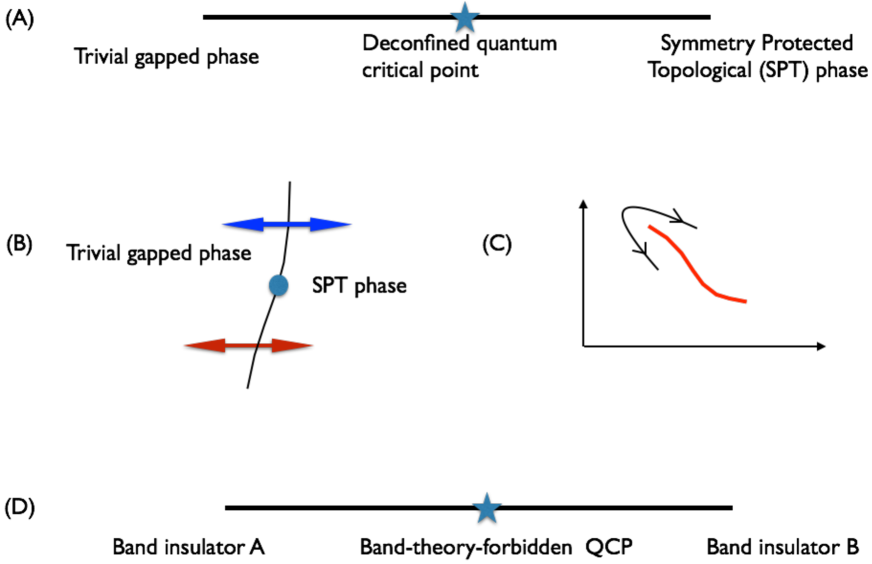
Continuous quantum phase transitions that are beyond the conventional paradigm of fluctuations of a symmetry breaking order parameter are challenging for theory. These phase transitions often involve emergent deconfined gauge fields at the critical points as demonstrated in 2+1-dimensions. Examples include phase transitions in quantum magnetism as well as those between Symmetry Protected Topological phases. In this paper, we present several examples of Deconfined Quantum Critical Points (DQCP) between Symmetry Protected Topological phases in 3+1-D for both bosonic and fermionic systems. Some of the critical theories can be formulated as non-abelian gauge theories either in their Infra-Red free regime, or in the conformal window when they flow to the Banks-Zaks fixed points. We explicitly demonstrate several interesting quantum critical phenomena. We describe situations in which the same phase transition allows for multiple universality classes controlled by distinct fixed points. We exhibit the possibility - which we dub "unnecessary quantum critical points" - of stable generic continuous phase transitions within the same phase. We present examples of interaction driven band-theory- forbidden continuous phase transitions between two distinct band insulators. The understanding we develop leads us to suggest an interesting possible 3+1-D field theory duality between SU(2) gauge theory coupled to one massless adjoint Dirac fermion and the theory of a single massless Dirac fermion augmented by a decoupled topological field theory.
Motivation & Objective
- To explore continuous quantum phase transitions in 3+1 dimensions beyond the Landau-Ginzburg-Wilson paradigm.
- To identify and characterize deconfined quantum critical points (DQCPs) between symmetry-protected topological (SPT) phases in 3+1D.
- To investigate the emergence of non-abelian gauge theories at criticality, particularly in the conformal window of Banks-Zaks fixed points.
- To propose a novel 3+1D field theory duality involving SU(2) gauge theory with one adjoint Dirac fermion and a topological field theory.
- To demonstrate interaction-driven, band-theory-forbidden continuous transitions between band insulators.
Proposed method
- Formalizing critical theories in 3+1D using non-abelian gauge theories, particularly SU(2) with fundamental or adjoint fermions.
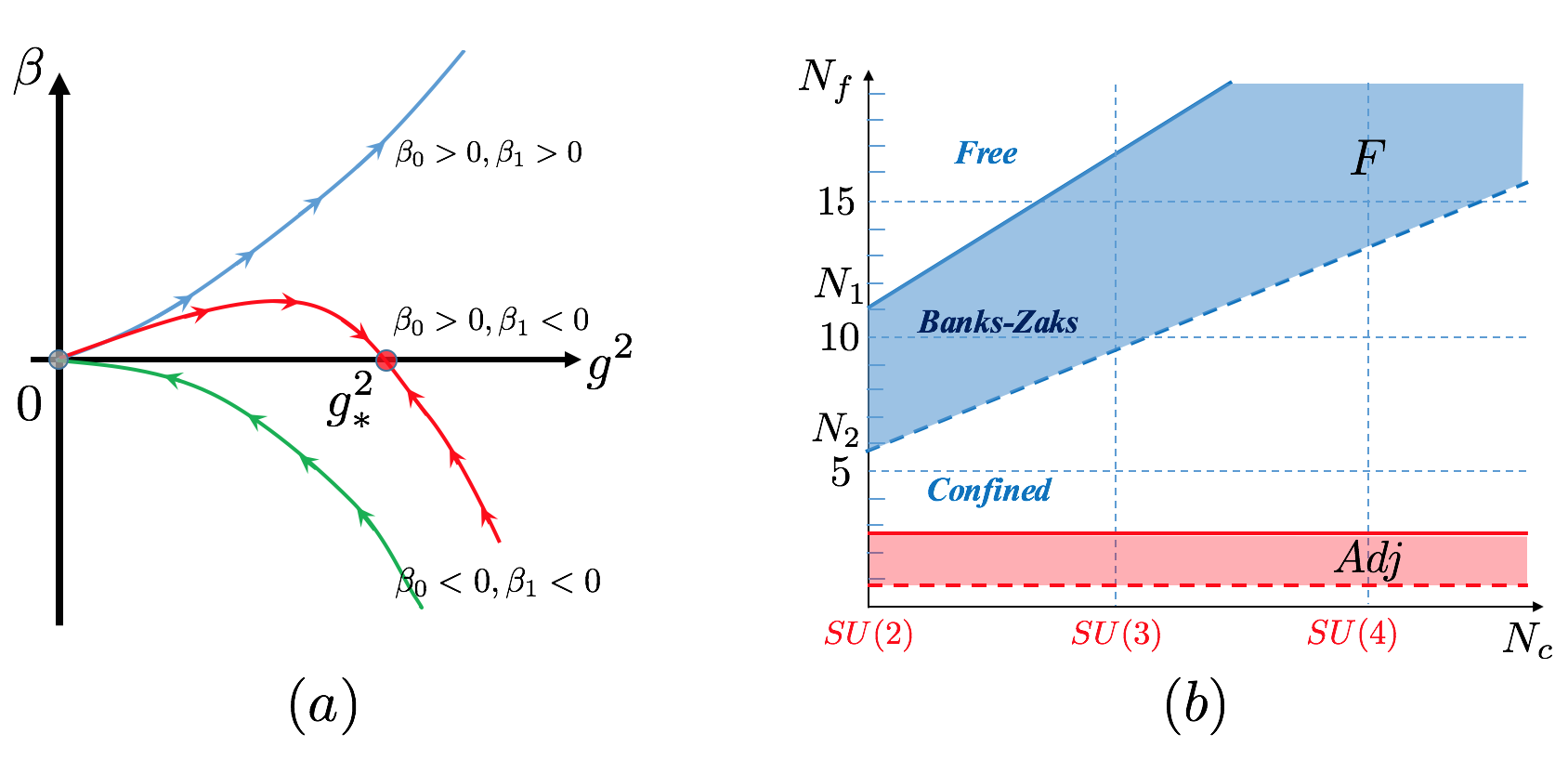
- Analyzing the infrared behavior of these gauge theories using the Banks-Zaks fixed point framework to identify conformal field theories.
- Employing global symmetry and anomaly matching to identify emergent symmetries and topological order at criticality.
- Constructing dual field theories via duality webs, particularly relating SU(2) gauge theory with one adjoint Dirac fermion to a single Dirac fermion plus a topological field theory.
- Using 1-form symmetry anomalies and topological response functions to classify phases and detect non-trivial topological order.
- Applying time-reversal and charge conjugation symmetries (denoted as CT) to classify gauge-invariant operators and their transformation properties.
Experimental results
Research questions
- RQ1Can deconfined quantum criticality exist in 3+1 dimensions between symmetry-protected topological phases?
- RQ2What are the critical theories governing such transitions, and can they be described by non-abelian gauge theories in the conformal window?
- RQ3Can the same phase transition support multiple universality classes controlled by distinct fixed points?
- RQ4Is it possible to have continuous phase transitions within the same phase—'unnecessary quantum critical points'—without symmetry breaking?
- RQ5Does a duality exist between SU(2) gauge theory with one adjoint Dirac fermion and a single Dirac fermion coupled to a topological field theory in 3+1D?
Key findings
- The paper constructs explicit examples of 3+1D DQCPs between SPT phases for both bosonic and fermionic systems, with critical theories described by non-abelian gauge theories.
- For SU(2) gauge theory with $ N_f = 3 $ adjoint fermions, the critical point lies in the conformal window and flows to a Banks-Zaks fixed point.
- Multiple universality classes are shown to coexist for the same phase transition, with distinct fixed points governing different critical behaviors.
- The concept of 'unnecessary quantum critical points' is established: stable continuous transitions can occur within the same phase, even without symmetry breaking.
- A novel 3+1D duality is proposed between SU(2) gauge theory with one adjoint Dirac fermion and a single Dirac fermion augmented by a decoupled topological field theory.
- The duality is supported by matching anomalies, including 1-form symmetry anomalies and time-reversal symmetry anomalies, and is consistent with topological response functions and global symmetry structures.
Read this paper
Open the full text in the Nubint reader and ask about any passage as you read.
Read this paper on NubintThis review was generated by AI from the original paper. Please check the paper before citing it.