
[Paper Review] An Attention-Aided Deep Learning Framework for Massive MIMO Channel Estimation
This paper proposes an attention-aided deep learning framework for massive MIMO channel estimation that leverages the narrow angular spread of channels by implementing a 'divide-and-conquer' strategy through learned attention maps. By integrating attention into fully connected and convolutional neural networks for hybrid analog-digital architectures, the method improves estimation accuracy with minimal complexity overhead, achieving strong robustness and interpretability across diverse system parameters.
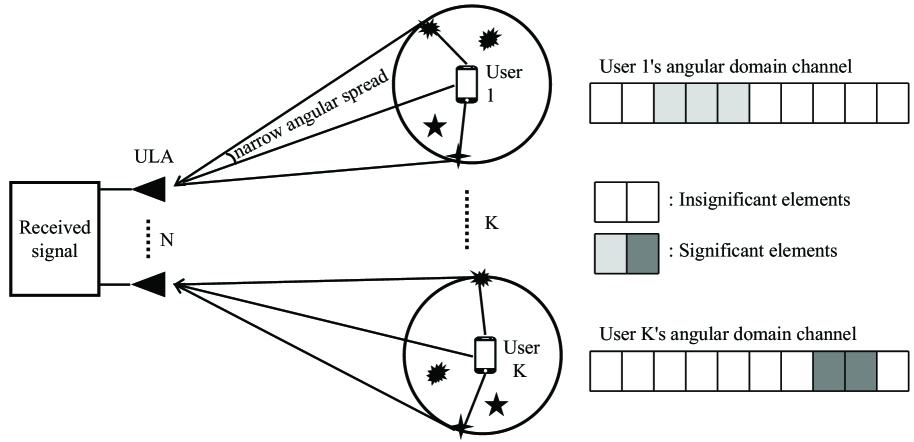
Channel estimation is one of the key issues in practical massive multiple-input multiple-output (MIMO) systems. Compared with conventional estimation algorithms, deep learning (DL) based ones have exhibited great potential in terms of performance and complexity. In this paper, an attention mechanism, exploiting the channel distribution characteristics, is proposed to improve the estimation accuracy of highly separable channels with narrow angular spread by realizing the "divide-and-conquer" policy. Specifically, we introduce a novel attention-aided DL channel estimation framework for conventional massive MIMO systems and devise an embedding method to effectively integrate the attention mechanism into the fully connected neural network for the hybrid analog-digital (HAD) architecture. Simulation results show that in both scenarios, the channel estimation performance is significantly improved with the aid of attention at the cost of small complexity overhead. Furthermore, strong robustness under different system and channel parameters can be achieved by the proposed approach, which further strengthens its practical value. We also investigate the distributions of learned attention maps to reveal the role of attention, which endows the proposed approach with a certain degree of interpretability.
Motivation & Objective
- To address the challenge of accurate and efficient channel estimation in massive MIMO systems, especially under hybrid analog-digital (HAD) architectures with limited RF chains.
- To exploit the narrow angular spread characteristic of massive MIMO channels to improve estimation performance beyond conventional methods.
- To integrate an attention mechanism into deep neural networks for dynamic feature weighting, enabling a 'divide-and-conquer' strategy that adapts to channel distribution patterns.
- To achieve high performance-complexity trade-off and robustness across varying system and channel conditions.
Proposed method
- Introduces a novel attention-aided deep learning framework that dynamically adjusts feature importance based on channel distribution, particularly exploiting narrow angular spread.
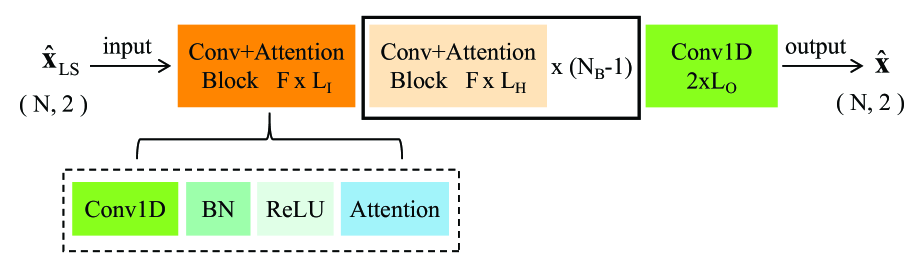
- Employs a learnable attention mechanism embedded within fully connected and convolutional neural networks to selectively emphasize relevant channel features.
- Uses a two-stage attention design: first dividing the channel estimation task into subproblems based on angular spread, then refining estimates via attention-weighted feature fusion.
- Applies Sigmoid activation to predict attention maps and ReLU to control sparsity, enabling sample-specific attention that enhances model interpretability.
- Customizes separate network architectures—CNN for full-radiosignal scenarios and FNN for HAD systems—to match system constraints and improve efficiency.
- Removes redundant attention layers during inference (e.g., the last layer with zero output) to reduce computational overhead without performance loss.
Experimental results
Research questions
- RQ1How can attention mechanisms be effectively integrated into deep learning models for massive MIMO channel estimation to exploit channel sparsity and angular characteristics?
- RQ2What is the impact of attention-based feature weighting on estimation accuracy and robustness across varying channel and system parameters?
- RQ3How does the proposed attention-aided framework compare in complexity and performance to conventional MMSE and compressed sensing-based methods?
- RQ4Can the attention mechanism provide interpretability by revealing learned channel structure, such as angular spread patterns?
- RQ5What is the optimal design of attention modules for HAD architectures where only partial channel observations are available?
Key findings
- The attention-aided framework significantly improves channel estimation accuracy in both full-radiosignal and hybrid analog-digital massive MIMO systems, outperforming conventional LS and MMSE methods.
- The method achieves a 19.86% increase in parameters and negligible FLOPs overhead when added to a CNN, indicating low complexity cost for performance gains.
- In HAD scenarios, the attention-aided fully connected network (FNN) reduces FLOPs by 98% compared to S-VBI and is hundreds of times faster on CPU, with better performance than attention-aided CNN.
- Attention maps reveal that the model learns to divide the estimation task into subproblems based on angular spread, with higher binarization and distinct patterns across sine-value ranges of average AoAs.
- The model demonstrates strong robustness across different system settings, including varying numbers of antennas, users, and pilot overheads, due to its adaptive attention mechanism.
- Analysis of attention maps shows sample-specific behavior—even with similar average AoAs, attention patterns differ, indicating the model captures fine-grained channel features beyond coarse angular information.
Read this paper
Open the full text in the Nubint reader and ask about any passage as you read.
Read this paper on NubintThis review was generated by AI from the original paper. Please check the paper before citing it.