
[Paper Review] An Evaluation of Edge TPU Accelerators for Convolutional Neural Networks
This paper evaluates three classes of Edge TPU accelerators across 423,000 convolutional neural networks, revealing microarchitectural insights into performance trade-offs based on model structure and accelerator configuration. It proposes a graph neural network-based learned model that estimates latency and energy with ~97% accuracy and >99% rank correlation to cycle-accurate simulators, enabling fast hardware/software co-design.
Edge TPUs are a domain of accelerators for low-power, edge devices and are widely used in various Google products such as Coral and Pixel devices. In this paper, we first discuss the major microarchitectural details of Edge TPUs. Then, we extensively evaluate three classes of Edge TPUs, covering different computing ecosystems, that are either currently deployed in Google products or are the product pipeline, across 423K unique convolutional neural networks. Building upon this extensive study, we discuss critical and interpretable microarchitectural insights about the studied classes of Edge TPUs. Mainly, we discuss how Edge TPU accelerators perform across convolutional neural networks with different structures. Finally, we present our ongoing efforts in developing high-accuracy learned machine learning models to estimate the major performance metrics of accelerators such as latency and energy consumption. These learned models enable significantly faster (in the order of milliseconds) evaluations of accelerators as an alternative to time-consuming cycle-accurate simulators and establish an exciting opportunity for rapid hard-ware/software co-design.
Motivation & Objective
- To evaluate the performance of three distinct Edge TPU accelerator classes across a diverse set of 423,000 convolutional neural networks with varying architectures.
- To extract interpretable microarchitectural insights into how Edge TPU performance varies with model size, operation types (e.g., 3×3 convolutions), and parameter count.
- To investigate the impact of accelerator tile size and configuration parameters such as I/O bandwidth and parameter caching on inference latency.
- To develop and validate a learned machine learning model that accurately estimates key performance metrics (latency, energy) of Edge TPUs as a fast alternative to cycle-accurate simulation.
Proposed method
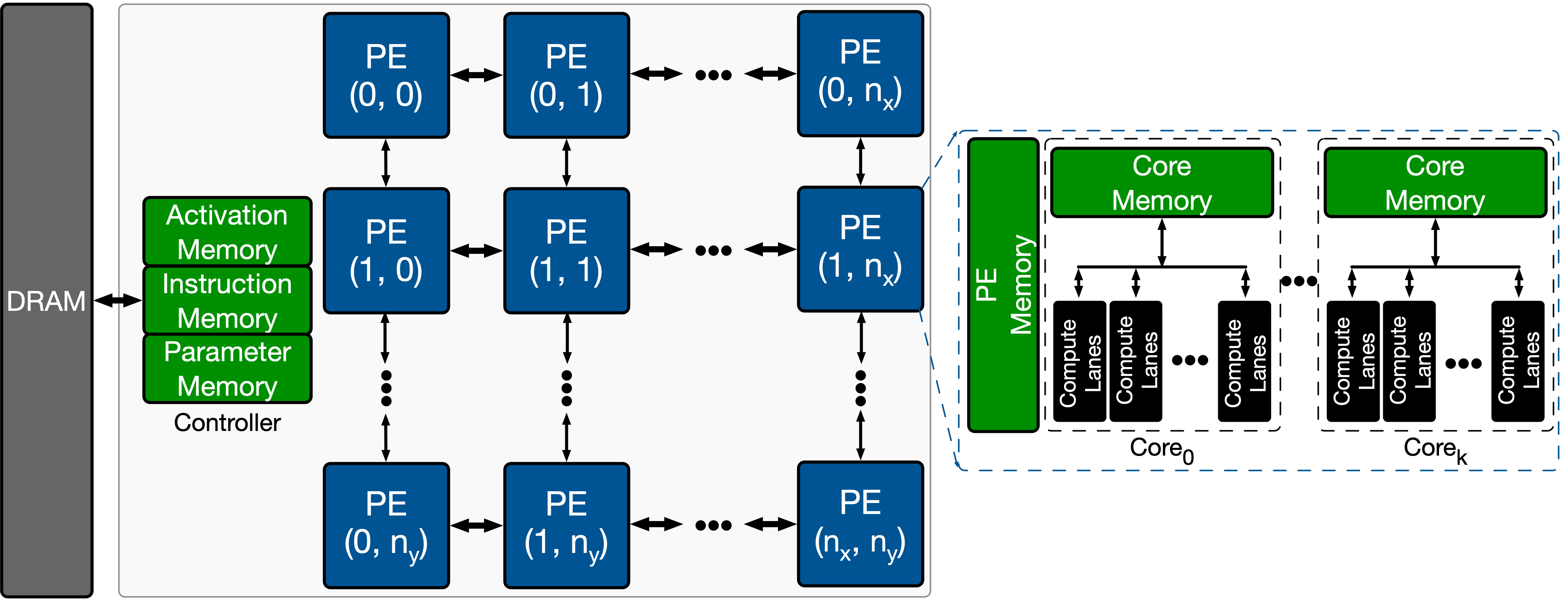
- The study uses a template-based, parameterized Edge TPU microarchitecture with a 2D array of processing elements (PEs), each containing multiple compute lanes with SIMD MAC units.
- Each PE features shared PE memory for activations and partial results, and multi-banked core memory for storing model parameters to support high-throughput computation.
- The software stack uses TensorFlow Lite models, and workloads are compiled and executed via a full-stack stack including compiler, runtime, and hardware simulation.
- A graph neural network (GNN) is trained to learn latent representations of neural network graphs and predict performance metrics such as inference latency and energy consumption.
- The GNN model is trained on a dataset of 254,160 NASBench models, with evaluation on 84,680 held-out test examples, using hyperparameters like a learning rate of 0.001 and batch size of 16.
- Performance estimation accuracy is evaluated using mean absolute error, Spearman rank-order correlation, and Pearson correlation against ground truth from cycle-accurate simulators.
Experimental results
Research questions
- RQ1How does Edge TPU performance vary across convolutional neural networks with different architectures, sizes, and operation types?
- RQ2What is the impact of accelerator tile size and I/O bandwidth on inference latency for models with varying numbers of trainable parameters?
- RQ3How effective is a learned model in estimating Edge TPU performance metrics compared to cycle-accurate simulation?
- RQ4In what scenarios does parameter caching improve performance, and when do diminishing returns set in?
- RQ5Can a learned model with high rank correlation replace expensive simulators in hardware/software co-design and design space exploration?
Key findings
- The learned model estimates inference latency with an average accuracy of 96.8% to 97.9% across three Edge TPU configurations, with a mean absolute error of approximately 3%.
- The model achieves a Spearman rank-order correlation of 0.99977 to 0.99981 and a Pearson correlation of 0.99959 to 0.99975 with ground truth latency, indicating near-perfect ranking fidelity.
- For large models with high parameter counts (e.g., many 3×3 convolutions), accelerator configuration V2 outperforms others due to higher I/O bandwidth, while parameter caching provides diminishing returns.
- For smaller models with fewer parameters, configuration V1 benefits more from parameter caching, resulting in lower latency.
- Inference latency is most strongly correlated with the number of trainable parameters, suggesting I/O bandwidth is the dominant performance bottleneck, not the number of PEs or compute cores.
- Reducing accelerator tile size can maintain similar performance, indicating that smaller, more efficient tiles are viable for many workloads.

Read this paper
Open the full text in the Nubint reader and ask about any passage as you read.
Read this paper on NubintThis review was generated by AI from the original paper. Please check the paper before citing it.