
[Paper Review] An HSC view of the CMASS galaxy sample. Halo mass as a function of stellar mass, size and Sérsic index
This study uses deep HSC photometry and weak gravitational lensing to measure the dark matter halo mass of CMASS galaxies as a function of stellar mass, size, and Sérsic index. It finds that halo mass scales with stellar mass as $ M_{\text{halo}} \propto M_*^{1.7} $, with no significant dependence on size or Sérsic index at fixed stellar mass, disfavoring models where size growth is more efficient in high-mass halos.
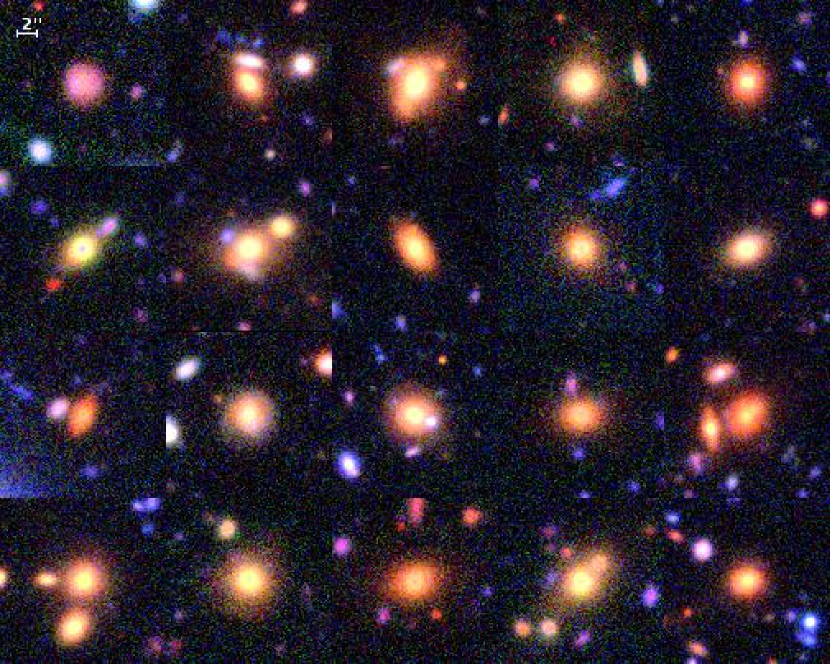
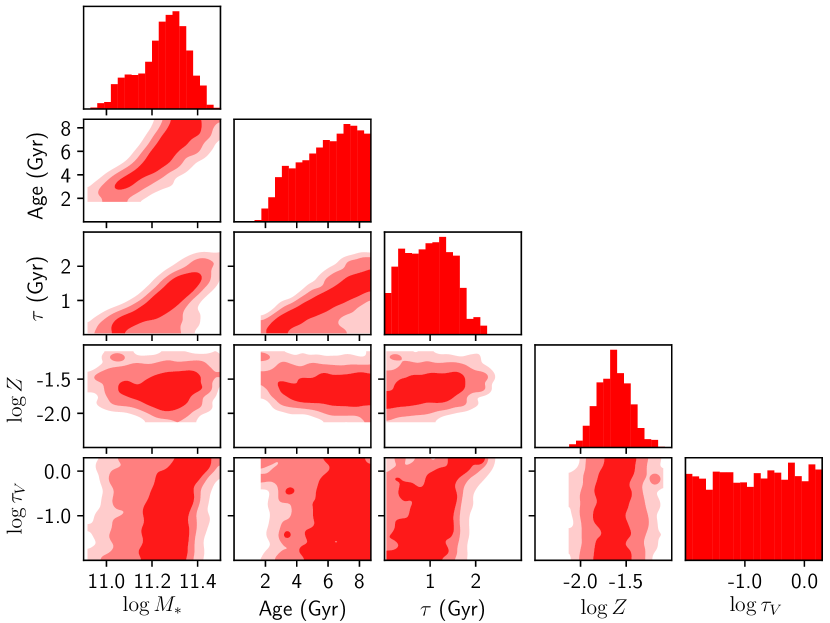
Aims. We wish to determine the distribution of dark matter halo masses as a function of the stellar mass and the stellar mass profile, for massive galaxies in the BOSS CMASS sample. Methods. We use grizy photometry from HSC to obtain Sérsic fits and stellar masses of CMASS galaxies for which HSC weak lensing data is available, visually selected to have spheroidal morphology. We apply a cut in stellar mass, $\log{M_*/M_\odot} > 11.0$,selecting $\sim$10, 000 objects. Using a Bayesian hierarchical inference method, we first investigate the distribution of Sérsic index and size as a function of stellar mass. Then, making use of shear measurements from HSC, we measure the distribution of halo mass as a function of stellar mass, size and Sérsic index. Results. Our data reveals a steep stellar mass-size relation $R_e \propto M_*^{β_R}$, with $β_R$ larger than unity, and a positive correlation between Sérsic index and stellar mass: $n \propto M_*^{0.46}$. Halo mass scales approximately with the 1.7 power of the stellar mass. We do not find evidence for an additional dependence of halo mass on size or Sérsic index at fixed stellar mass. Conclusions. Our results disfavour galaxy evolution models that predict significant differences in the size growth efficiency of galaxies living in low and high mass halos.
Motivation & Objective
- To determine how dark matter halo mass correlates with stellar mass, size, and Sérsic index in massive CMASS galaxies.
- To test galaxy evolution models that predict different size growth efficiencies in low- versus high-mass halos.
- To improve the accuracy of halo mass measurements using Bayesian hierarchical inference on deep HSC photometry and weak lensing data.
- To investigate the stellar mass-size-Sérsic index relation in a sample of ~10,000 visually selected spheroidal CMASS galaxies with $ \log M_* / M_\odot > 11.0 $.
Proposed method
- Applied Bayesian hierarchical inference to model the joint distribution of Sérsic index, half-light radius, and stellar mass from HSC $grizy$ photometry.
- Used Sérsic and Sersic-Exponential (SerExp) profile fits to model galaxy light profiles and derive stellar masses and sizes.
- Combined weak lensing shear measurements from HSC to infer the distribution of dark matter halo masses around CMASS galaxies.
- Performed stacked weak lensing analysis to measure halo mass as a function of stellar mass, size, and Sérsic index, accounting for measurement uncertainties.
- Compared results from different surface brightness profile models (Sérsic vs. SerExp) to assess systematic effects on halo mass inference.
- Used a flat $ \Lambda $CDM cosmology with $ \Omega_M = 0.3 $, $ H_0 = 70 \, \text{km} \, \text{s}^{-1} \, \text{Mpc}^{-1} $.
Experimental results
Research questions
- RQ1How does the stellar mass-size relation of CMASS galaxies depend on their Sérsic index?
- RQ2Is there a significant correlation between halo mass and galaxy size at fixed stellar mass?
- RQ3Does the Sérsic index of CMASS galaxies correlate with their stellar mass, and how does this affect halo mass scaling?
- RQ4To what extent do different surface brightness profile models (Sérsic vs. SerExp) affect the inferred halo mass distribution?
- RQ5How do weak lensing-based halo mass estimates compare to those from galaxy clustering in the CMASS sample?
Key findings
- The stellar mass-size relation for CMASS galaxies is very steep, with $ R_e \propto M_*^{\beta_R} $, where $ \beta_R > 1 $, indicating strong size evolution with mass.
- The Sérsic index increases with stellar mass as $ n \propto M_*^{0.46} $, and at fixed stellar mass, size is positively correlated with Sérsic index.
- Halo mass scales with stellar mass as $ M_{\text{halo}} \propto M_*^{1.7} $, indicating a strong but sub-linear scaling.
- No significant dependence of halo mass on size or Sérsic index is found at fixed stellar mass, implying that size growth is not more efficient in high-mass halos.
- The discrepancy of 0.2–0.3 dex between weak lensing and clustering-based halo mass estimates is likely due to differences in photometric modeling and surface brightness profile assumptions.
- Systematic uncertainties from extrapolating surface brightness profiles at large radii—especially between Sérsic and SerExp models—pose a major challenge for future high-precision measurements.
Read this paper
Open the full text in the Nubint reader and ask about any passage as you read.
Read this paper on NubintThis review was generated by AI from the original paper. Please check the paper before citing it.