
[Paper Review] Analysis of a positivity-preserving splitting scheme for some nonlinear stochastic heat equations
This paper proposes a positivity-preserving Lie–Trotter splitting scheme combined with finite differences for nonlinear stochastic heat equations with multiplicative space-time white noise. The scheme ensures mean-square convergence with convergence rates of 1/4 in time and 1/2 in space under CFL conditions, while preserving positivity in numerical simulations where standard methods fail.
We construct a positivity-preserving Lie--Trotter splitting scheme with finite difference discretization in space for approximating the solutions to a class of nonlinear stochastic heat equations with multiplicative space-time white noise. We prove that this explicit numerical scheme converges in the mean-square sense, with rate $1/4$ in time and rate $1/2$ in space, under appropriate CFL conditions. Numerical experiments illustrate the superiority of the proposed numerical scheme compared with standard numerical methods which do not preserve positivity.
Motivation & Objective
- To develop a numerical scheme that preserves the positivity of solutions to nonlinear stochastic heat equations with multiplicative space-time white noise.
- To analyze the mean-square convergence of a fully discrete splitting scheme under appropriate CFL conditions.
- To address the lack of positivity-preserving numerical methods for SPDEs on compact domains with Dirichlet boundary conditions.
- To provide a computationally efficient and explicit time integrator that maintains physical consistency in stochastic PDE simulations.
Proposed method
- A Lie–Trotter splitting strategy decomposes the SPDE into deterministic and stochastic subsystems, allowing exact or semi-analytical solution of each subproblem.
- The deterministic part is spatially discretized using central finite differences, approximating the Laplacian via a matrix $ N^2 D^N $.
- The stochastic part is solved exactly as a geometric Brownian motion by freezing the nonlinearity coefficient $ f(u_{m,n}^{ ext{LT}}) $ at each time step.
- The time integration uses an explicit recursion: $ u_{m+1}^{ ext{LT}} = \exp(\tau N^2 D^N) \hat{u}_{m+1}^{ ext{LT}} $, where $ \hat{u}_{m+1,n}^{ ext{LT}} $ includes the stochastic exponential term.
- The scheme is applied to both scalar and system forms of the stochastic heat equation with globally Lipschitz nonlinearities.
- Convergence analysis is conducted under assumptions that $ g $ is globally Lipschitz, $ C^1 $, and satisfies $ g(0) = 0 $, with initial data $ u_0 \geq 0 $.
Experimental results
Research questions
- RQ1Can a fully discrete splitting scheme preserve the positivity of solutions to nonlinear SPDEs with multiplicative space-time white noise?
- RQ2What are the mean-square convergence rates of an explicit positivity-preserving scheme for such SPDEs?
- RQ3How does the proposed scheme compare to standard methods like Euler–Maruyama in preserving positivity?
- RQ4Does the scheme maintain stability and convergence under standard CFL conditions?
- RQ5Can the splitting approach be extended to systems of coupled stochastic heat equations while preserving positivity?
Key findings
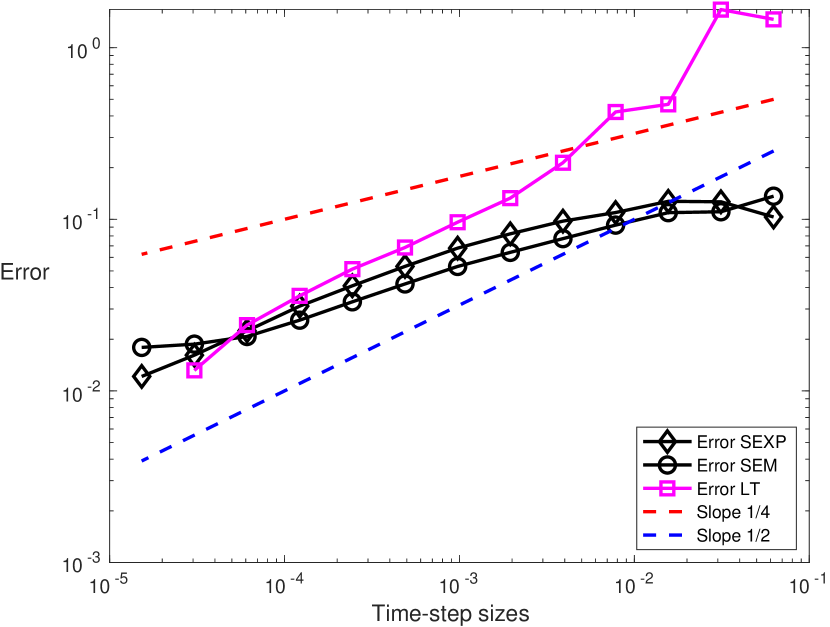
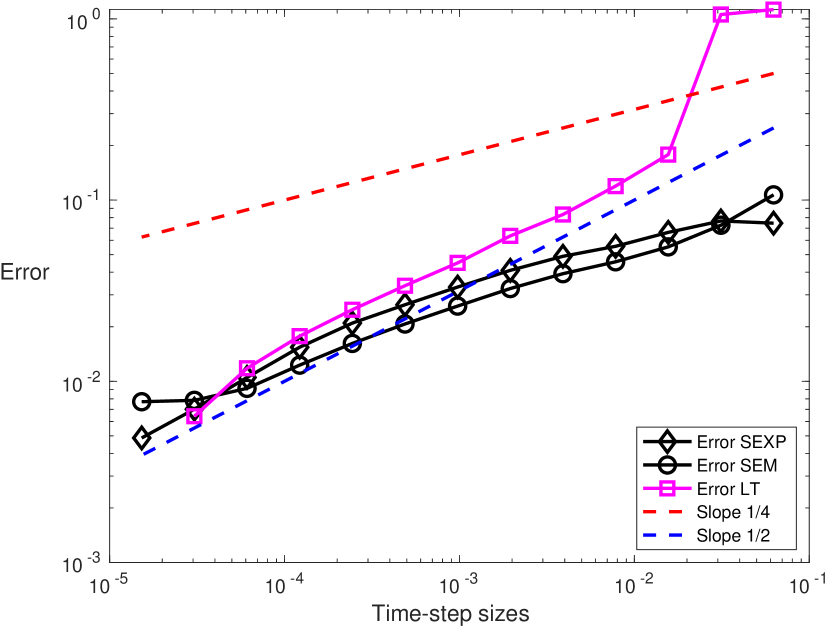
- The proposed Lie–Trotter splitting scheme achieves mean-square convergence with a rate of $ 1/4 $ in time and $ 1/2 $ in space under appropriate CFL conditions.
- Numerical experiments show that the Lie–Trotter scheme preserves positivity in 500 out of 500 sample paths, while the Euler–Maruyama scheme fails completely in this regard.
- The stochastic exponential Euler and semi-implicit Euler–Maruyama schemes preserve positivity in 99.8% and 99.2% of samples, respectively, but still underperform the proposed scheme in consistency and stability.
- The scheme is computationally efficient and explicit, avoiding the need for solving nonlinear systems at each time step.
- The convergence analysis is supported by rigorous estimates of the difference between continuous and discrete Green's functions, leading to a $ \mathcal{O}(\tau^{1/2}) $ bound on the time discretization error.
- The method is the first known positivity-preserving numerical scheme for nonlinear SPDEs driven by space-time white noise on compact domains with Dirichlet boundary conditions.
Better researchstarts right now
From reading papers to final review, dramatically reduce your research time.
No credit card · Free plan available
This review was created by AI and reviewed by human editors.