
[Paper Review] Anisotropy of the anomalous Hall effect in the altermagnet candidate Mn$_5$Si$_3$ films
This study demonstrates that the anomalous Hall effect (AHE) in epitaxial Mn₅Si₃ thin films exhibits strong anisotropy dependent on the orientation of the Néel vector relative to the crystal lattice, providing direct evidence for altermagnetism. The anisotropic AHE persists only in high-quality films and is distinct from magnetocrystalline anisotropy, confirming Mn₅Si₃ as a robust altermagnetic candidate material.
Altermagnets are compensated magnets belonging to spin symmetry groups that allow alternating spin polarizations both in the coordinate space of the crystal and in the momentum space of the electronic structure. In these materials the anisotropic local crystal environment of the different sublattices lowers the symmetry of the system so that the opposite-spin sublattices are connected only by rotations, which results in an unconventional spin-polarized band structure in the momentum space. This low symmetry of the crystal structure is expected to be reflected in the anisotropy of the anomalous Hall effect. In this work, we study the anisotropy of the anomalous Hall effect in epitaxial thin films of Mn$_5$Si$_3$, an altermagnetic candidate material. We first demonstrate a change in the relative Néel vector orientation when rotating the external field orientation through systematic changes in both the anomalous Hall effect and the anisotropic longitudinal magnetoresistance. We then show that the anomalous Hall effect in this material is anisotropic with the Néel vector orientation relative to the crystal structure and that this anisotropy requires high crystal quality and unlikely correlates with the magnetocrystalline anisotropy. Our results provide further systematic support to the case for considering epitaxial thin films of Mn$_5$Si$_3$ as an altermagnetic candidate material.
Motivation & Objective
- To investigate the field-dependent anisotropy of the anomalous Hall effect (AHE) in epitaxial Mn₅Si₃ thin films.
- To determine whether the observed AHE anisotropy arises from altermagnetic order rather than conventional magnetocrystalline anisotropy.
- To establish the controllability of the Néel vector orientation via external magnetic fields using AHE and anisotropic magnetoresistance (AMR) measurements.
- To correlate the symmetry of the crystal structure with the directional dependence of the AHE response.
- To provide experimental validation for the theoretical prediction that altermagnets exhibit symmetry-protected, anisotropic AHE.
Proposed method
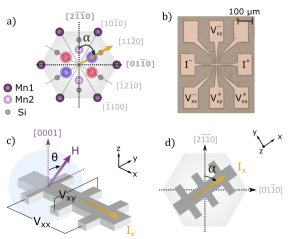
- Epitaxial Mn₅Si₃ thin films were grown on single-crystal substrates to ensure high structural quality and well-defined crystallographic orientation.
- The anomalous Hall effect (AHE) was measured as a function of external magnetic field orientation, specifically tracking the in-plane and out-of-plane components of the Hall conductivity σ_AHE.
- Anisotropic longitudinal magnetoresistance (AMR ||) was measured under identical field conditions to probe the Néel vector orientation and its evolution with field direction.
- Symmetry analysis of the hexagonal crystal structure was performed to predict allowed AHE vector orientations based on the Néel vector (L) alignment relative to crystal axes.
- The angular dependence of σ_AHE and AMR || was analyzed for two sets of Hall bar orientations (α = 0°, 60°, 120° and α = 30°, 90°, 150°) to distinguish crystalline and non-crystalline contributions.
- Theoretical symmetry considerations were used to rule out AHE contributions from time-reversal-odd vectors when L is aligned along [0001] or high-symmetry in-plane directions.
Experimental results
Research questions
- RQ1Does the anomalous Hall effect in Mn₅Si₃ films exhibit anisotropy dependent on the orientation of the external magnetic field?
- RQ2Can the Néel vector in Mn₅Si₃ be experimentally manipulated using an external magnetic field, and is this controllability reflected in the AHE and AMR?
- RQ3Is the observed AHE anisotropy in Mn₅Si₃ attributable to altermagnetic order rather than magnetocrystalline anisotropy?
- RQ4How does the crystal quality of Mn₅Si₃ films influence the emergence of anisotropic AHE?
- RQ5What is the role of the Néel vector orientation relative to the crystal axes in determining the direction and magnitude of the AHE?
Key findings
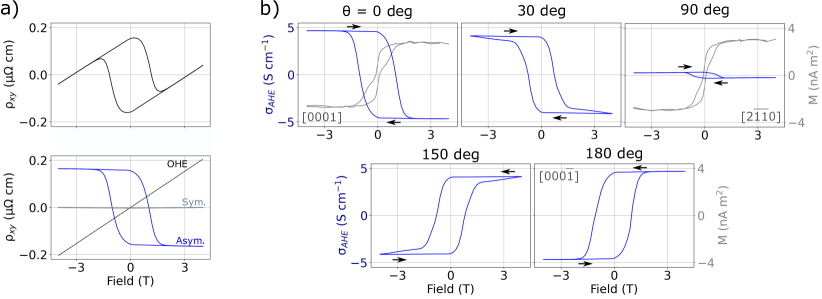
- The anomalous Hall conductivity (σ_AHE) in Mn₅Si₃ films shows a strong dependence on the orientation of the external magnetic field, indicating field-tunable Néel vector reorientation.
- The AHE anisotropy is only observed in high-quality epitaxial films, indicating a strong correlation with crystal perfection and structural symmetry.
- The anisotropic AHE cannot be explained by conventional magnetocrystalline anisotropy, as it depends on the Néel vector orientation relative to the crystal axes rather than the magnetization direction.
- The angular dependence of the AHE and AMR || measurements for two distinct Hall bar orientations (α = 0°, 60°, 120° vs. α = 30°, 90°, 150°) reveals distinct symmetry patterns, with the former showing a dominant cos(2θ) behavior.
- Symmetry analysis confirms that non-zero AHE is forbidden when the Néel vector is aligned along [0001] or along high-symmetry in-plane directions, consistent with the observed angular dependence.
- The combined AHE and AMR measurements provide strong, systematic evidence that the main AHE response in Mn₅Si₃ arises from altermagnetic order, supporting its classification as a candidate altermagnet.
Read this paper
Open the full text in the Nubint reader and ask about any passage as you read.
Read this paper on NubintThis review was generated by AI from the original paper. Please check the paper before citing it.