
[Paper Review] Coexistence of Anomalous Hall Effect and Weak Net Magnetization in Collinear Antiferromagnet MnTe
This study demonstrates the coexistence of a measurable anomalous Hall effect (AHE) and a weak net magnetization in bulk hexagonal MnTe, a collinear antiferromagnet. Using a phenomenological macrospin model incorporating Dzyaloshinskii–Moriya-like interactions, the authors show that this weak ferromagnetic-like moment breaks Néel vector degeneracy, enabling hysteretic AHE behavior even in the absence of full magnetic compensation. The key contribution is the identification of a mechanism where finite net magnetization prevents AHE signal averaging to zero, linking transport response to Néel vector orientation.
Anomalous Hall effect (AHE) plays important role in the rapidly developing field of antiferromagnetic spintronics. It has been recently discussed that it can be a feature of not only uncompensated magnetic systems but also in altermagnetic materials. Hexagonal MnTe belongs to this appealing group of compounds exhibiting AHE and is commonly perceived as magnetically compensated. Here, we demonstrate that bulk form of MnTe exhibits small but detectable magnetic moment correlating with hysteretic behaviour of the AHE. We formulate a phenomenological model which explains how this feature allows to create a disbalance between states with opposite Néel vector and prevent the AHE signal from averaging out to zero. Moreover, we show how the dependence of AHE on the Néel vector arises on microscopical level and highlight the differences in Berry curvature between magnetically compensated and uncompensated systems.
Motivation & Objective
- To investigate the origin of the anomalous Hall effect (AHE) in bulk hexagonal MnTe, a collinear antiferromagnet traditionally considered magnetically compensated.
- To determine whether a weak net magnetization exists in bulk MnTe and its correlation with AHE and magnetic hysteresis.
- To develop a phenomenological macrospin model that explains the hysteretic behavior of AHE in terms of Dzyaloshinskii–Moriya-like interactions and Néel vector reorientation.
- To clarify the role of Berry curvature and spin-orbit coupling in enabling AHE in systems with near-zero net magnetization.
- To distinguish between intrinsic AHE mechanisms and extrinsic contributions from net magnetization in transport measurements.
Proposed method
- Fabrication of high-quality, free-standing bulk MnTe single crystals via vapor-phase transport to eliminate substrate and strain effects.
- Conducting quantitative volume magnetometry and resistivity measurements to detect weak ferromagnetic-like (WFL) moment and hysteretic AHE.
- Employing a phenomenological macrospin model with Dzyaloshinskii–Moriya-type interaction to describe energy landscape and Néel vector reorientation under external magnetic field.
- Simulating the energy dependence on the Néel vector angle (α₁, α₂) under varying magnetic fields (B_J, B_K, B_D) to reproduce hysteretic behavior.
- Analyzing Berry curvature distributions to compare AHE mechanisms in compensated vs. uncompensated systems.
- Using Raman spectroscopy and multiple independent methods to precisely determine the Néel transition temperature (T_N).
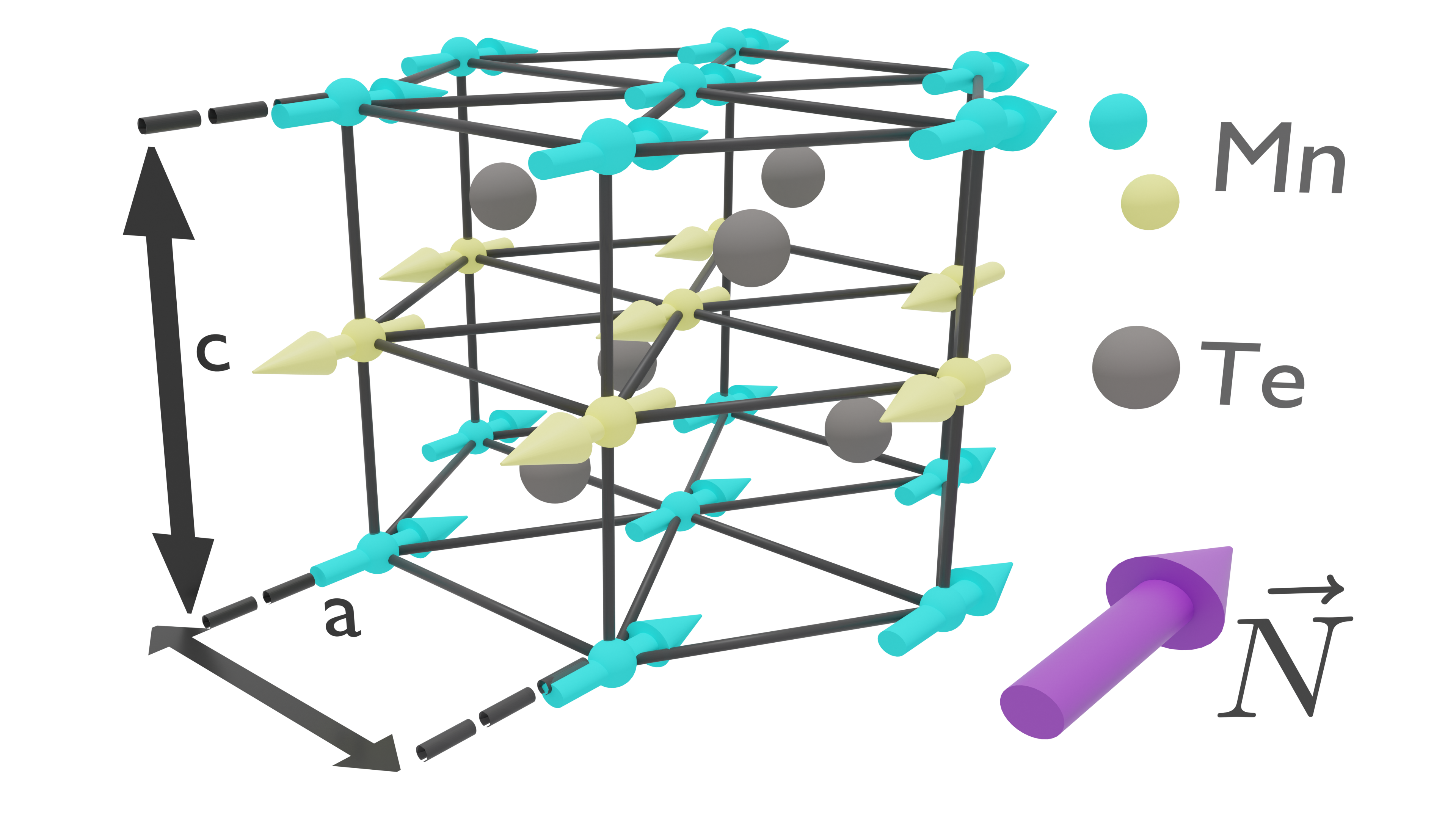
Experimental results
Research questions
- RQ1Can a measurable anomalous Hall effect coexist with a weak net magnetization in a bulk collinear antiferromagnet like MnTe?
- RQ2What is the origin of the hysteretic behavior observed in the AHE and magnetization of MnTe?
- RQ3How does a finite net magnetization break the degeneracy between opposite Néel vector states, allowing a non-zero AHE signal?
- RQ4To what extent can a Dzyaloshinskii–Moriya-like interaction explain the observed hysteretic magnetization and AHE in MnTe?
- RQ5What role does Berry curvature play in enabling AHE in systems with near-zero net magnetization, and how does it differ from compensated antiferromagnets?
Key findings
- Bulk MnTe exhibits a small but detectable net magnetic moment that correlates with the hysteretic behavior of the anomalous Hall effect.
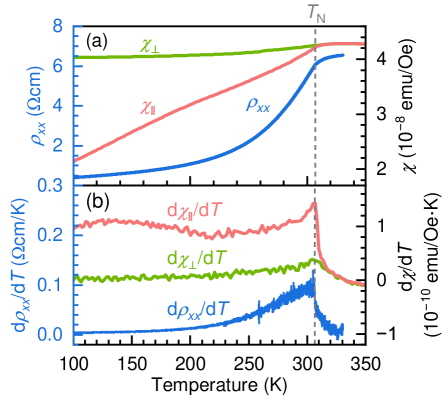
- The anomalous Hall effect in MnTe shows a temperature dependence identical to that of the remnant magnetization, both vanishing above the Néel temperature (T_N), which was precisely determined via multiple independent methods.
- A phenomenological macrospin model incorporating Dzyaloshinskii–Moriya-like interactions successfully reproduces the hysteretic behavior of AHE and magnetization, with the DMI field (B_D) on the order of a few teslas.
- The model predicts that increasing the DMI field (B_D) or anisotropy field (B_K) enhances the hysteresis width, consistent with experimental temperature evolution.
- Theoretical analysis of Berry curvature shows that AHE can persist even in the absence of net magnetization if the Néel vector is not fully degenerate, highlighting a key distinction from fully compensated systems.
- The study demonstrates that a finite net magnetization is not a prerequisite for AHE in MnTe, but it is essential for breaking Néel vector degeneracy and enabling observable, non-zero AHE signals in real samples.
Read this paper
Open the full text in the Nubint reader and ask about any passage as you read.
Read this paper on NubintThis review was generated by AI from the original paper. Please check the paper before citing it.