
[Paper Review] AnyFace: Free-style Text-to-Face Synthesis and Manipulation
AnyFace proposes the first free-style text-to-face synthesis and manipulation framework, enabling high-quality, high-diversity face generation from arbitrary text descriptions using a two-stream architecture with CLIP-based feature alignment and a novel Diverse Triplet Loss. It achieves state-of-the-art results on Multi-modal CelebA-HQ and CelebAText-HQ, supporting open-world, multi-caption, and continuous text-guided face manipulation without constraints on caption count, content, or format.
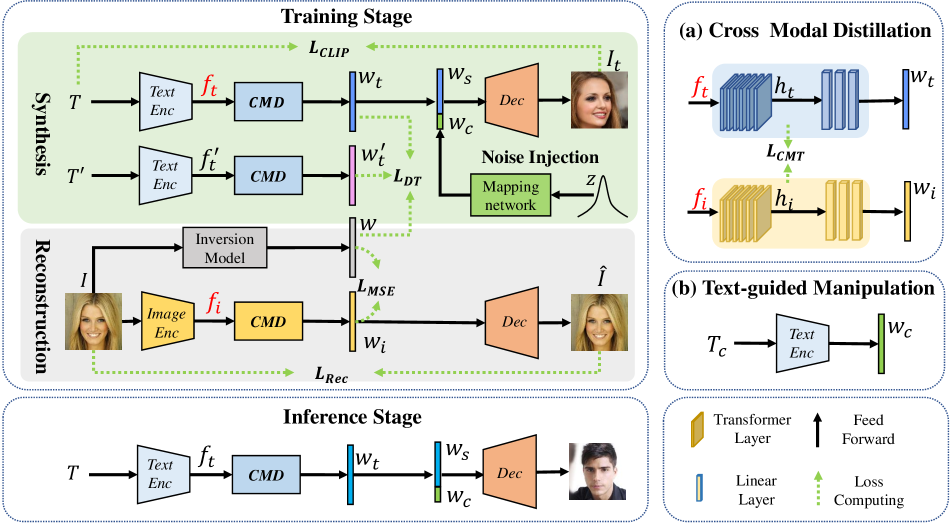
Existing text-to-image synthesis methods generally are only applicable to words in the training dataset. However, human faces are so variable to be described with limited words. So this paper proposes the first free-style text-to-face method namely AnyFace enabling much wider open world applications such as metaverse, social media, cosmetics, forensics, etc. AnyFace has a novel two-stream framework for face image synthesis and manipulation given arbitrary descriptions of the human face. Specifically, one stream performs text-to-face generation and the other conducts face image reconstruction. Facial text and image features are extracted using the CLIP (Contrastive Language-Image Pre-training) encoders. And a collaborative Cross Modal Distillation (CMD) module is designed to align the linguistic and visual features across these two streams. Furthermore, a Diverse Triplet Loss (DT loss) is developed to model fine-grained features and improve facial diversity. Extensive experiments on Multi-modal CelebA-HQ and CelebAText-HQ demonstrate significant advantages of AnyFace over state-of-the-art methods. AnyFace can achieve high-quality, high-resolution, and high-diversity face synthesis and manipulation results without any constraints on the number and content of input captions.
Motivation & Objective
- To address the limitation of existing text-to-image models that are restricted to fixed, in-dataset captions for face synthesis.
- To enable free-style text-to-face generation and manipulation with arbitrary numbers, contents, and formats of text descriptions.
- To improve facial diversity and semantic consistency in text-guided face synthesis beyond one-to-one text-image alignment.
- To develop a framework that supports open-world applications such as metaverse, social media, and digital cosmetics.
- To overcome the constraints of fixed caption templates and limited vocabulary in prior methods through a novel cross-modal distillation and triplet loss mechanism.
Proposed method
- A two-stream framework is proposed: one stream for text-to-face synthesis and another for face image reconstruction, trained independently with cross-modal interaction.
- CLIP encoders extract text and image features, enabling zero-shot generalization to out-of-dataset descriptions.
- A Cross Modal Distillation (CMD) module aligns linguistic and visual features across streams via a cross-modal transfer loss, avoiding strict one-to-one feature matching.
- A Diverse Triplet Loss (DT loss) is introduced to encourage diverse, fine-grained facial attributes (e.g., hairstyles, accessories) while preserving text relevance.
- The framework supports continuous control in face manipulation by adjusting text embedding size, enabling smooth transitions across attributes.
- The model leverages StyleGAN-based generation with CLIP-encoded text prompts to synthesize realistic, high-resolution faces.
Experimental results
Research questions
- RQ1Can a text-to-face model generalize to arbitrary, out-of-dataset text descriptions without requiring fixed templates or vocabulary?
- RQ2How can facial diversity be improved in text-to-image synthesis while maintaining high semantic alignment with complex, multi-caption descriptions?
- RQ3What is the impact of replacing one-to-one text-image feature matching with a more flexible, one-to-many alignment strategy?
- RQ4Can a two-stream framework with cross-modal distillation and triplet loss achieve better performance than existing multi-caption T2I methods in face synthesis and manipulation?
- RQ5To what extent can the model support continuous, fine-grained face manipulation using natural language descriptions?
Key findings
- AnyFace achieves state-of-the-art performance on Multi-modal CelebA-HQ and CelebAText-HQ, with significant improvements in FID and visual quality over prior methods.
- The Diverse Triplet Loss (DT loss) significantly enhances facial diversity, reducing overfitting to common features like smiles or short hair.
- The Cross-Modal Transfer Loss (CMT) accelerates convergence and improves FID, with the full model achieving lower FID values faster than ablated versions.
- Qualitative results show that AnyFace generates realistic, diverse faces even with abstract or multi-sentence descriptions, such as 'bad news' producing a sad expression.
- Text-guided manipulation demonstrates continuous control: increasing text relevance leads to smoother, more accurate attribute changes (e.g., hair color, expression, age).
- The model successfully generalizes to out-of-dataset descriptions, such as 'mortarboard' for 'PhD' or 'bald' for 'programmer', demonstrating zero-shot understanding of semantic concepts.

Read this paper
Open the full text in the Nubint reader and ask about any passage as you read.
Read this paper on NubintThis review was generated by AI from the original paper. Please check the paper before citing it.