
[Paper Review] Applications and Advances of Artificial Intelligence in Music Generation:A Review
This paper systematically reviews AI-based music generation, detailing symbolic, audio, and hybrid approaches, key models and datasets, evaluation methods, and applications across domains, and discusses challenges and future directions.
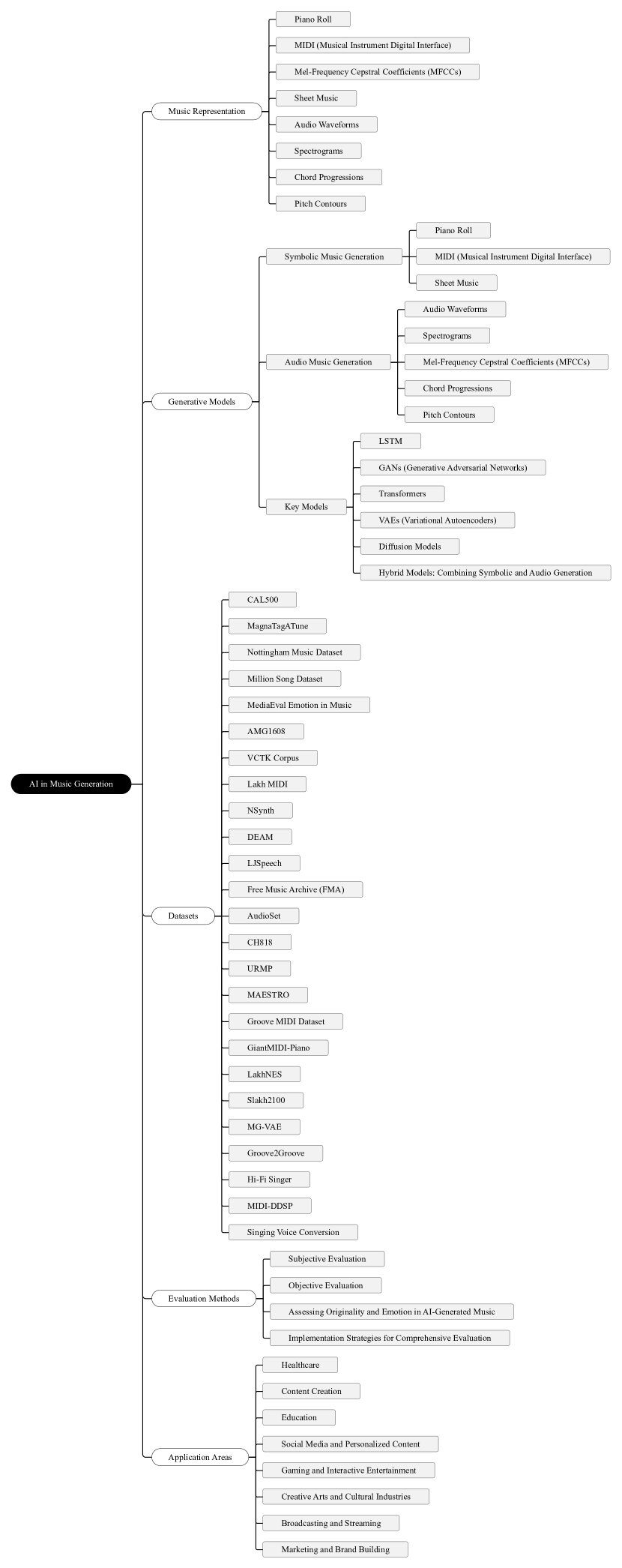
In recent years, artificial intelligence (AI) has made significant progress in the field of music generation, driving innovation in music creation and applications. This paper provides a systematic review of the latest research advancements in AI music generation, covering key technologies, models, datasets, evaluation methods, and their practical applications across various fields. The main contributions of this review include: (1) presenting a comprehensive summary framework that systematically categorizes and compares different technological approaches, including symbolic generation, audio generation, and hybrid models, helping readers better understand the full spectrum of technologies in the field; (2) offering an extensive survey of current literature, covering emerging topics such as multimodal datasets and emotion expression evaluation, providing a broad reference for related research; (3) conducting a detailed analysis of the practical impact of AI music generation in various application domains, particularly in real-time interaction and interdisciplinary applications, offering new perspectives and insights; (4) summarizing the existing challenges and limitations of music quality evaluation methods and proposing potential future research directions, aiming to promote the standardization and broader adoption of evaluation techniques. Through these innovative summaries and analyses, this paper serves as a comprehensive reference tool for researchers and practitioners in AI music generation, while also outlining future directions for the field.
Motivation & Objective
- Provide a comprehensive framework that categorizes and compares symbolic, audio, and hybrid AI music generation approaches.
- Survey current literature on models, datasets, and evaluation methods in AI music generation.
- Analyze practical applications of AI-generated music across domains and real-time interaction.
- Identify challenges in music quality evaluation and propose directions for standardization and future research.
Proposed method
- Develop a systematic framework to categorize symbolic, audio, and hybrid generation methods.
- Survey representative models (GANs, Transformers, VAEs, diffusion) and their capabilities/limitations.
- Summarize commonly used datasets and their roles in model training.
- Discuss evaluation methods and the challenges in assessing music quality.
- Explore hybrid symbolic-audio frameworks and cascaded diffusion/hierarchical approaches.
- Outline future research directions for standardization and broader adoption.
Experimental results
Research questions
- RQ1What are the main AI approaches (symbolic, audio, hybrid) used in music generation and their relative strengths/weaknesses?
- RQ2What datasets and evaluation methods are prevalent, and how do they affect generated music quality?
- RQ3What are the practical application domains for AI-generated music and their requirements?
- RQ4What are the key challenges in music quality, coherence, and timbre control, and what future directions address them?
Key findings
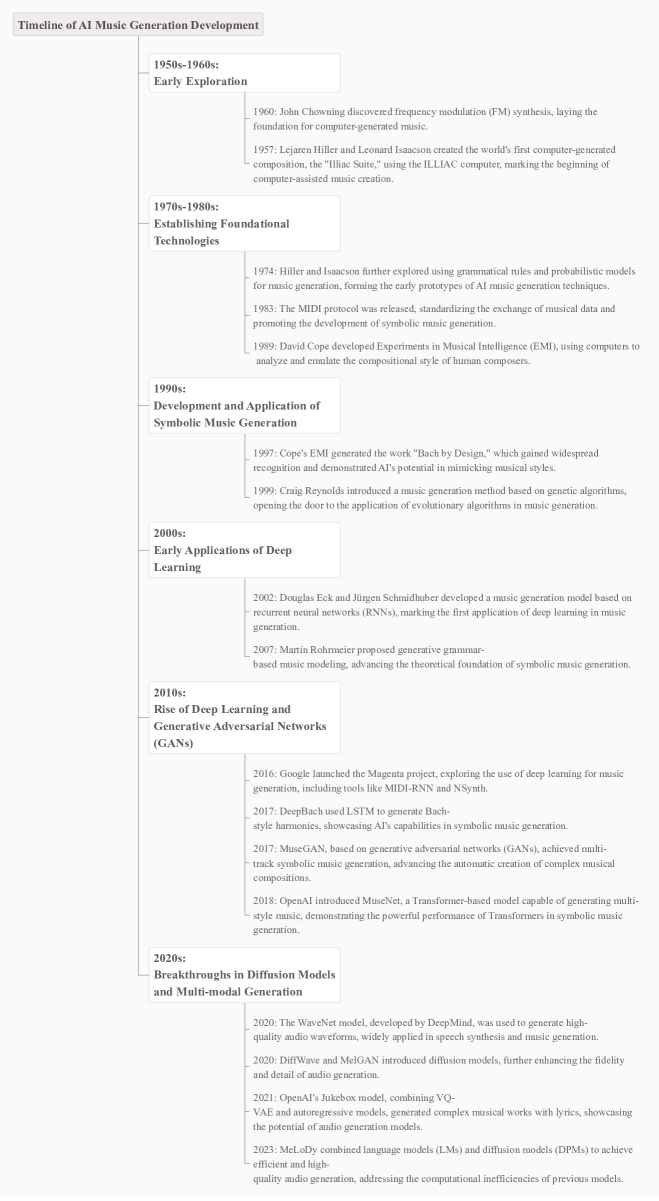
- AI music generation advances from symbolic (MIDI/piano rolls) to audio (waveforms, spectrograms) and increasingly hybrid models.
- Transformers, GANs, and diffusion models are central to generating structured, diverse, and high-quality music, with diffusion models enabling high-fidelity audio.
- Hybrid frameworks combine symbolic structure with rich audio timbre, improving coherence and expressiveness.
- Large datasets and self-supervised or hierarchical learning enhance model robustness but raise computation and evaluation challenges.
- Evaluation of music quality remains a major challenge, prompting calls for standardized methods and broader evaluation frameworks.
- A wide range of applications exists, including real-time interaction, education, healthcare, and content creation.
Read this paper
Open the full text in the Nubint reader and ask about any passage as you read.
Read this paper on NubintThis review was generated by AI from the original paper. Please check the paper before citing it.