
[Paper Review] Arecibo Wow! I: An Astrophysical Explanation for the Wow! Signal
This paper proposes that the 1977 Wow! Signal was caused by a transient burst of radiation—likely from a magnetar flare or soft gamma repeater—triggering stimulated emission in a cold interstellar hydrogen (HI) cloud, creating a brief, intense maser-like flare at 1420 MHz. The authors detect similar, weaker signals in Arecibo data, identifying them as HI emission, and suggest the Wow! Signal was a rare, naturally occurring astronomical maser flare, not extraterrestrial or terrestrial interference.
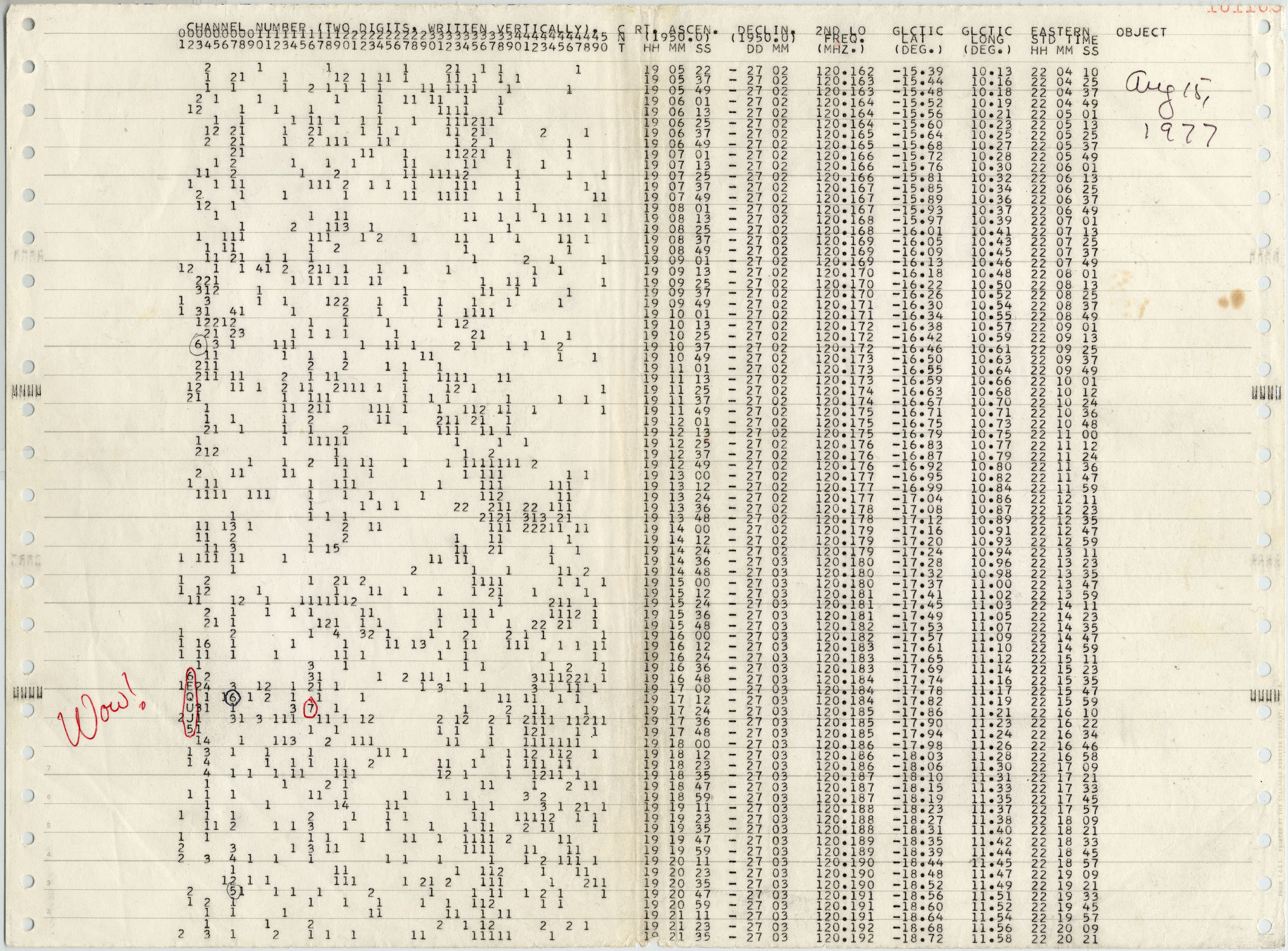
The Ohio State University Big Ear radio telescope detected in 1977 the Wow! Signal, one of the most famous and intriguing signals of extraterrestrial origin. Characterized by its strong relative intensity and narrow bandwidth near the 1420 MHz hydrogen line, its source has never been detected again despite numerous follow-up attempts. Arecibo Wow! is a new technosignature project using archived data from the Arecibo Observatory. Here we present our first results of drift scans made between February and May 2020 at 1420 MHz. The methods, frequency, and bandwidth of these observations are similar to those used to detect the Wow! Signal. However, our observations are more sensitive, have better temporal resolution, and include polarization measurements. We report the detection of narrowband signals (10 kHz) near the hydrogen line similar to the Wow! Signal, although two-orders of magnitude less intense and in multiple locations. Despite the similarities, these signals are easily identifiable as small interstellar clouds of cold hydrogen (HI) in the galaxy. We hypothesize that the Wow! Signal was caused by a sudden brightening of the hydrogen line in these clouds triggered by a strong transient radiation source, such as a magnetar flare or a soft gamma repeater (SGR). A maser flare or superradiance mechanisms can produce stimulated emission consistent with the Wow! Signal. Our hypothesis explains all observed properties of the Wow! Signal, proposes a new source of false positives in technosignature searches, and suggests that the Wow! Signal could be the first recorded event of an astronomical maser-like flare in the hydrogen line.
Motivation & Objective
- To explain the origin of the enigmatic 1977 Wow! Signal, which remains unexplained despite decades of search.
- To test whether the Wow! Signal could be a naturally occurring astrophysical phenomenon rather than extraterrestrial or terrestrial interference.
- To identify similar narrowband signals in archived Arecibo data to validate the proposed mechanism.
- To provide a testable hypothesis for the transient, narrowband, and intense nature of the Wow! Signal using stimulated emission in HI clouds.
- To propose that such maser flares could be a source of false positives in technosignature searches, urging caution in interpreting similar signals.
Proposed method
- Conducted drift scans at 1420 MHz with the Arecibo 305-meter telescope (2020) and 12-meter telescope (2023), using similar observing parameters to the original Big Ear observations.
- Employed high-sensitivity, high-temporal-resolution observations with full Stokes polarization measurements to distinguish astrophysical signals from RFI.
- Analyzed narrowband signals (Δν ≤ 10 kHz) near the hydrogen line, comparing their spectral and polarization characteristics to known HI emission features.
- Modeled the physical mechanism of stimulated emission in cold HI clouds irradiated by a short-duration, intense burst of radiation (e.g., magnetar flare or SGR burst).
- Used theoretical framework of maser amplification to explain how a transient source behind a cloud could produce a brief, intense, narrowband signal at 1420 MHz.
- Proposed follow-up observations using high-resolution telescopes (e.g., VLA) to localize the progenitor source behind identified HI clouds.
Experimental results
Research questions
- RQ1Could the Wow! Signal be explained by a natural astrophysical process rather than extraterrestrial or terrestrial interference?
- RQ2What physical mechanism could produce a narrowband, intense, transient radio signal at 1420 MHz, matching the Wow! Signal’s characteristics?
- RQ3Are there detectable analogs of the Wow! Signal in archival Arecibo data, and do they share the same physical origin?
- RQ4Can stimulated emission in cold interstellar HI clouds explain the signal’s intensity, duration, and frequency without requiring artificial origin?
- RQ5What observational strategies can be used to test and falsify the hypothesis that the Wow! Signal was a hydrogen maser flare?
Key findings
- Narrowband signals (Δν ≤ 10 kHz) near 1420 MHz were detected in Arecibo data, similar in bandwidth and frequency to the Wow! Signal but two orders of magnitude weaker.
- These signals were identified as originating from cold hydrogen (HI) clouds in front of the galactic hydrogen background, based on spectral and polarization characteristics.
- The authors propose that the Wow! Signal resulted from a transient burst of radiation (e.g., magnetar flare or SGR burst) triggering stimulated emission in a foreground HI cloud, creating a brief maser flare.
- The progenitor source must be located behind the cloud, explaining why the original source was not detected—due to line-of-sight alignment and signal amplification via stimulated emission.
- The hypothesis explains the signal’s 72-second duration (telescope beam transit time), narrow bandwidth, and lack of repeat detections due to the rarity of such alignments and transient events.
- The Wow! Signal may represent the first recorded astronomical maser flare in the hydrogen line, introducing a new class of transient radio phenomena and a potential source of false positives in SETI.

Read this paper
Open the full text in the Nubint reader and ask about any passage as you read.
Read this paper on NubintThis review was generated by AI from the original paper. Please check the paper before citing it.