
[Paper Review] Asymptotic Convergence and Performance of Multi-Agent Q-Learning Dynamics
This paper establishes a sufficient condition on exploration rates in smooth Q-Learning dynamics that guarantees asymptotic convergence to a unique equilibrium in any general N-player game. By leveraging monotonicity and perturbation analysis, the authors prove convergence for weighted potential and weighted zero-sum polymatrix games as special cases, and further show that non-convergent dynamics can outperform equilibria in social welfare under specific conditions.
Achieving convergence of multiple learning agents in general $N$-player games is imperative for the development of safe and reliable machine learning (ML) algorithms and their application to autonomous systems. Yet it is known that, outside the bounds of simple two-player games, convergence cannot be taken for granted. To make progress in resolving this problem, we study the dynamics of smooth Q-Learning, a popular reinforcement learning algorithm which quantifies the tendency for learning agents to explore their state space or exploit their payoffs. We show a sufficient condition on the rate of exploration such that the Q-Learning dynamics is guaranteed to converge to a unique equilibrium in any game. We connect this result to games for which Q-Learning is known to converge with arbitrary exploration rates, including weighted Potential games and weighted zero sum polymatrix games. Finally, we examine the performance of the Q-Learning dynamic as measured by the Time Averaged Social Welfare, and comparing this with the Social Welfare achieved by the equilibrium. We provide a sufficient condition whereby the Q-Learning dynamic will outperform the equilibrium even if the dynamics do not converge.
Motivation & Objective
- Address the critical challenge of ensuring convergence to a unique equilibrium in multi-agent reinforcement learning for general N-player games.
- Overcome the non-stationarity and instability issues common in multi-agent learning, where cycles and chaos often emerge.
- Provide a general convergence guarantee for smooth Q-Learning across arbitrary games by parameterizing exploration rates.
- Analyze performance via Time-Averaged Social Welfare and compare it to equilibrium performance, identifying conditions where non-convergent dynamics are preferable.
- Unify prior results on convergence in potential and zero-sum games under a single theoretical framework based on monotonicity and perturbation.
Proposed method
- Introduce a smooth Q-Learning dynamics model that balances exploration and exploitation through a parameterized exploration rate.
- Apply perturbation theory to transform the original game into a perturbed game with a strictly monotone pseudo-gradient, ensuring convergence.
- Use the concept of weighted monotonicity and the properties of concave potential functions to establish convergence conditions.
- Leverage results from replicator dynamics (RD) and their convergence properties under monotonicity to infer Q-Learning convergence via equivalence under perturbation.
- Define and analyze the Time-Averaged Social Welfare as a performance metric to compare learning dynamics against equilibrium outcomes.
- Derive sufficient conditions under which non-convergent Q-Learning dynamics can yield higher social welfare than the equilibrium, even when convergence is not achieved.
Experimental results
Research questions
- RQ1Under what conditions on exploration rates does smooth Q-Learning converge to a unique equilibrium in any general N-player game?
- RQ2Can the convergence results for specific game classes—such as weighted potential games and weighted zero-sum polymatrix games—be unified under a single theoretical framework?
- RQ3Is there a scenario in which non-convergent Q-Learning dynamics can achieve better social welfare than the equilibrium outcome?
- RQ4How does the performance of Q-Learning dynamics, measured by Time-Averaged Social Welfare, compare to the social welfare at the equilibrium?
- RQ5Can monotonicity properties of the game’s pseudo-gradient be preserved or induced via parameter tuning to ensure convergence?
Key findings
- A sufficient condition on the exploration rate—dependent on game size and number of players—guarantees that smooth Q-Learning dynamics converge to a unique equilibrium in any N-player game.
- Weighted potential games with concave potentials and weighted zero-sum polymatrix games are shown to be special cases of the main convergence result, with convergence proven via monotonicity and perturbation analysis.
- The perturbed game $Γ^H$ has a strictly monotone pseudo-gradient when the potential is concave, ensuring convergence of Q-Learning via established results on replicator dynamics.
- For weighted zero-sum polymatrix games, the game is proven to be weighted monotone due to the zero-sum property and symmetric payoff structure, leading to convergence to a unique Quantal Response Equilibrium (QRE).
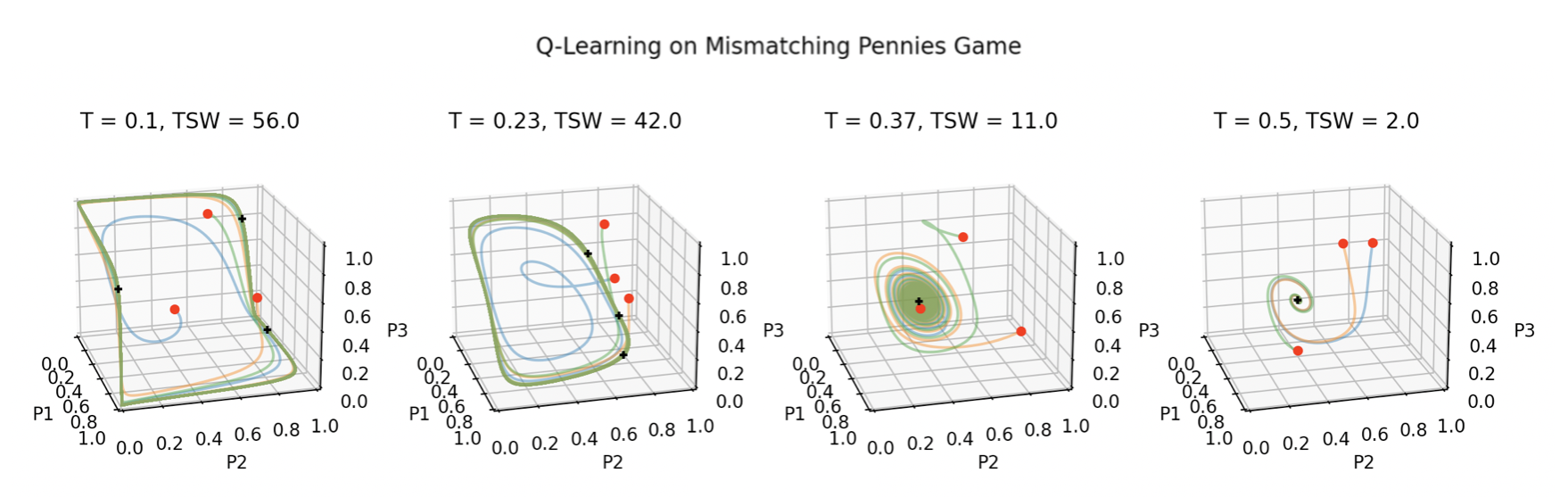
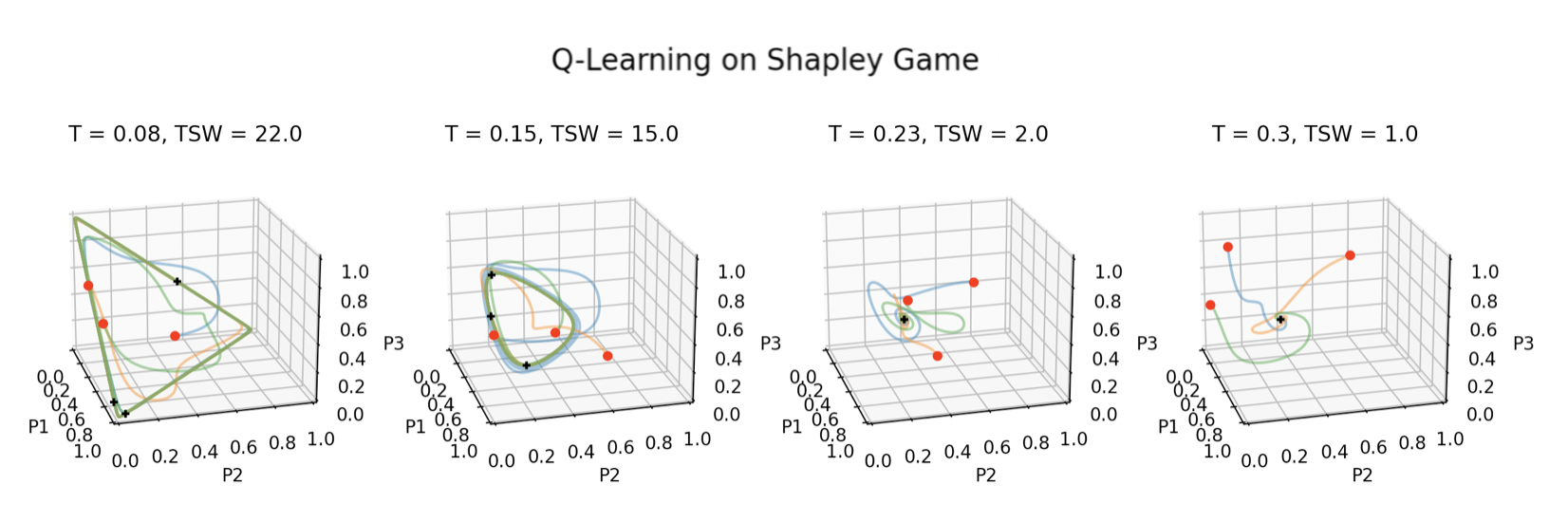
- When dynamics do not converge, a sufficient condition exists under which the Time-Averaged Social Welfare of Q-Learning exceeds that of the equilibrium, indicating potential benefits of avoiding full convergence.
- Experiments demonstrate that increased exploration can degrade payoff performance, suggesting that in some games, minimal or no exploration may yield better social welfare than pushing agents toward equilibrium.
Read this paper
Open the full text in the Nubint reader and ask about any passage as you read.
Read this paper on NubintThis review was generated by AI from the original paper. Please check the paper before citing it.