
[Paper Review] Asynchronous Trajectory Matching-Based Multimodal Maritime Data Fusion for Vessel Traffic Surveillance in Inland Waterways
This paper proposes DeepSORVF, a deep learning-based method for asynchronous, multimodal data fusion of AIS and video data in inland waterway vessel traffic surveillance. By extracting trajectory features from AIS and video streams and using a trajectory matching mechanism with prior knowledge-driven anti-occlusion tracking, the method achieves high-accuracy, real-time fusion even under occlusion and asynchronous data conditions, validated on the new FVessel benchmark dataset with 97.02% MOFA and 0.196 MOFP on average.
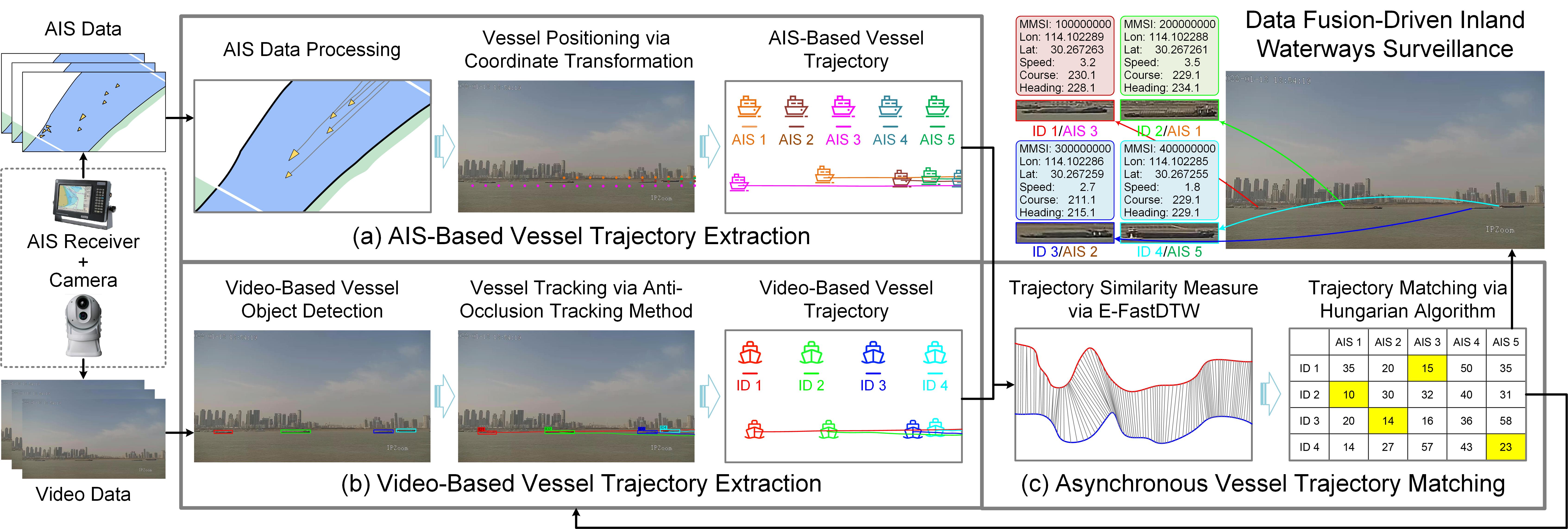
The automatic identification system (AIS) and video cameras have been widely exploited for vessel traffic surveillance in inland waterways. The AIS data could provide the vessel identity and dynamic information on vessel position and movements. In contrast, the video data could describe the visual appearances of moving vessels, but without knowing the information on identity, position and movements, etc. To further improve vessel traffic surveillance, it becomes necessary to fuse the AIS and video data to simultaneously capture the visual features, identity and dynamic information for the vessels of interest. However, traditional data fusion methods easily suffer from several potential limitations, e.g., asynchronous messages, missing data, random outliers, etc. In this work, we first extract the AIS- and video-based vessel trajectories, and then propose a deep learning-enabled asynchronous trajectory matching method (named DeepSORVF) to fuse the AIS-based vessel information with the corresponding visual targets. In addition, by combining the AIS- and video-based movement features, we also present a prior knowledge-driven anti-occlusion method to yield accurate and robust vessel tracking results under occlusion conditions. To validate the efficacy of our DeepSORVF, we have also constructed a new benchmark dataset (termed FVessel) for vessel detection, tracking, and data fusion. It consists of many videos and the corresponding AIS data collected in various weather conditions and locations. The experimental results have demonstrated that our method is capable of guaranteeing high-reliable data fusion and anti-occlusion vessel tracking.
Motivation & Objective
- To address the challenge of fusing asynchronous, multimodal data from AIS and video cameras in inland waterway vessel traffic surveillance.
- To improve data fusion accuracy and robustness under conditions of occlusion, missing data, and time delays.
- To develop a practical, real-time method that integrates identity, dynamic, and visual features for enhanced situational awareness.
- To construct a new benchmark dataset (FVessel) for evaluating vessel detection, tracking, and data fusion in diverse environmental conditions.
Proposed method
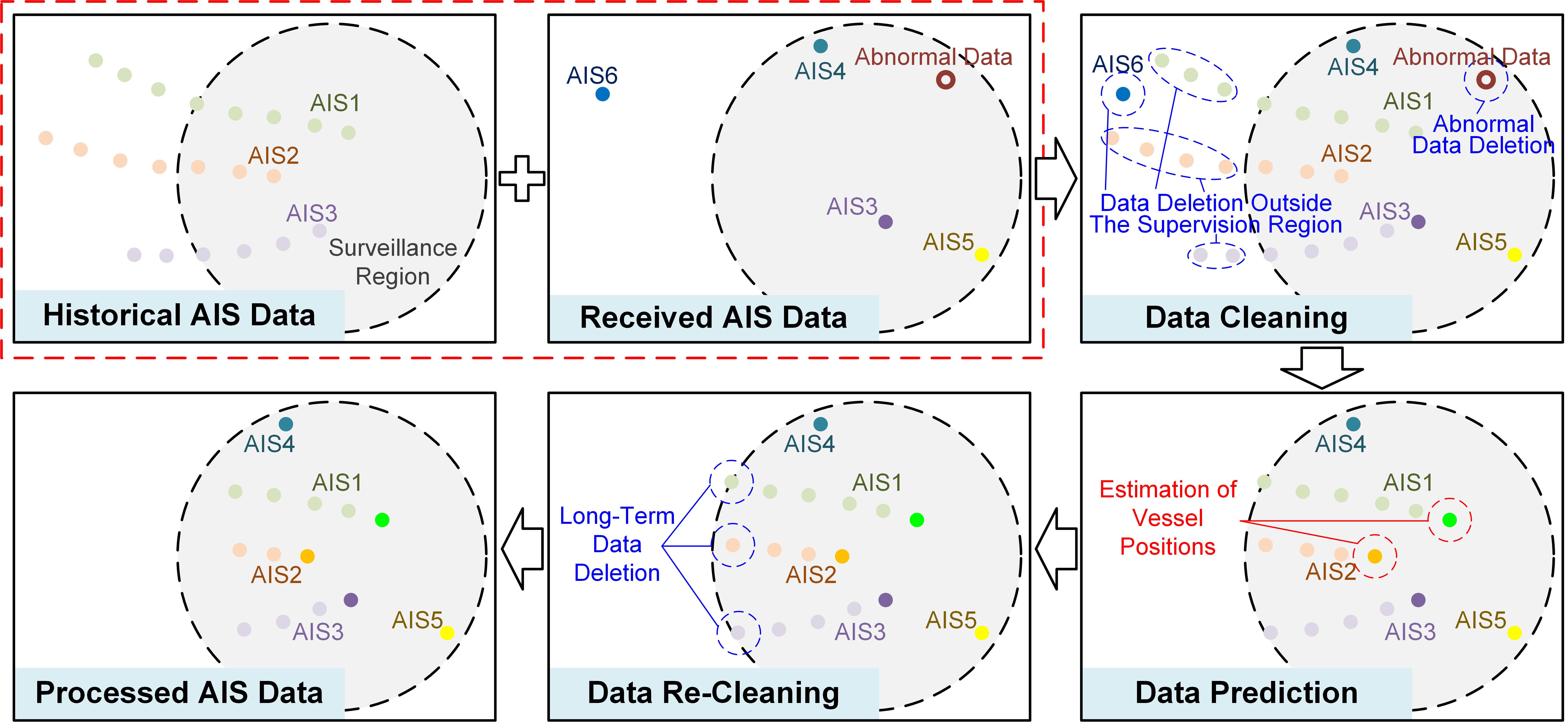
- Extract AIS-based trajectories using vessel dynamic information (e.g., MMSI, speed, course) and spatio-temporal positioning.
- Extract video-based trajectories using object detection and tracking models to identify and follow visual vessel targets.
- Implement a deep learning-enabled asynchronous trajectory matching mechanism (DeepSORVF) to align AIS and visual trajectories despite temporal misalignment.
- Integrate prior knowledge of vessel navigation behavior into a motion model to improve tracking robustness during occlusion.
- Use a hybrid fusion strategy combining movement features from both modalities to predict and correct for occluded vessel positions.
- Apply a trajectory matching loss function that minimizes the distance between matched AIS and visual targets across time.
Experimental results
Research questions
- RQ1How can asynchronous AIS and video data be effectively matched to enable reliable vessel identity and motion tracking in inland waterways?
- RQ2To what extent can prior knowledge of vessel navigation behavior improve tracking performance under occlusion conditions?
- RQ3What is the impact of trajectory matching on data fusion accuracy when dealing with time delays and missing data?
- RQ4How does the proposed method compare to baseline fusion and tracking approaches in real-world, complex scenarios?
Key findings
- The proposed DeepSORVF method achieved an average Multiple Object Fusion Accuracy (MOFA) of 97.02% and a Multiple Object Fusion Precision (MOFP) of 0.196 on the FVessel dataset, demonstrating high fusion accuracy.
- The inclusion of the anti-occlusion tracking strategy significantly improved MOFA by up to 11.7 percentage points (e.g., from 87.77% to 99.47% on clip-02), indicating strong robustness to occlusion.
- Despite a slight increase in MOFP (from 0.110 to 0.140 on clip-02), the anti-occlusion strategy improved overall fusion reliability by correctly matching occluded vessels.
- The method processes one second of data in an average of 0.2562 seconds, with a range of 0.175–0.500 seconds, confirming its real-time feasibility for practical deployment.
- Visual comparisons in Fig. 9 show that DeepSORVF successfully predicts and matches occluded vessels, though minor bounding box bias persists in complex occlusion scenarios.
Read this paper
Open the full text in the Nubint reader and ask about any passage as you read.
Read this paper on NubintThis review was generated by AI from the original paper. Please check the paper before citing it.