
[Paper Review] AT-DDPM: Restoring Faces degraded by Atmospheric Turbulence using Denoising Diffusion Probabilistic Models
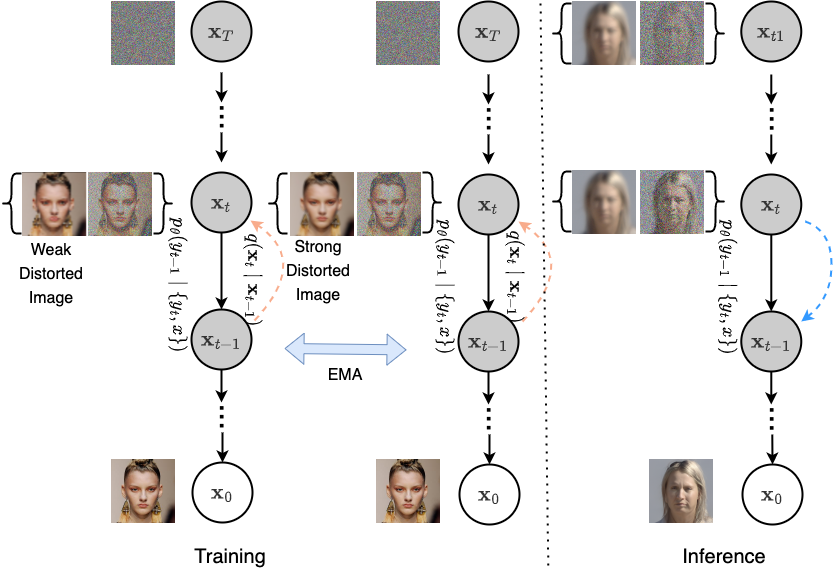
This paper proposes AT-DDPM, the first denoising diffusion probabilistic model (DDPM)-based method for restoring faces degraded by atmospheric turbulence. By leveraging a pre-trained DDPM on clean faces and applying knowledge distillation through progressive training, the model learns to reconstruct realistic, high-fidelity faces from turbulent inputs using a novel efficient sampling strategy that starts from the distorted image, achieving state-of-the-art performance on synthetic and real-world datasets.
Although many long-range imaging systems are designed to support extended vision applications, a natural obstacle to their operation is degradation due to atmospheric turbulence. Atmospheric turbulence causes significant degradation to image quality by introducing blur and geometric distortion. In recent years, various deep learning-based single image atmospheric turbulence mitigation methods, including CNN-based and GAN inversion-based, have been proposed in the literature which attempt to remove the distortion in the image. However, some of these methods are difficult to train and often fail to reconstruct facial features and produce unrealistic results especially in the case of high turbulence. Denoising Diffusion Probabilistic Models (DDPMs) have recently gained some traction because of their stable training process and their ability to generate high quality images. In this paper, we propose the first DDPM-based solution for the problem of atmospheric turbulence mitigation. We also propose a fast sampling technique for reducing the inference times for conditional DDPMs. Extensive experiments are conducted on synthetic and real-world data to show the significance of our model. To facilitate further research, all codes and pretrained models are publically available at http://github.com/Nithin-GK/AT-DDPM
Motivation & Objective
- To address the challenge of restoring facial images degraded by atmospheric turbulence, which causes blur and geometric distortion.
- To overcome limitations of existing CNN- and GAN-based methods, including unstable training, mode collapse, and poor generalization on real-world data.
- To explore the potential of Denoising Diffusion Probabilistic Models (DDPMs) as a stable and high-quality generative prior for image restoration.
- To reduce the slow inference time typical of DDPMs through a novel sampling strategy that starts from the turbulent image rather than pure noise.
- To improve reconstruction fidelity and identity preservation in high-turbulence scenarios using a continual learning-based knowledge distillation framework.
Proposed method
- A pre-trained DDPM is fine-tuned via knowledge distillation to perform facial image super-resolution on a large clean face dataset.
- The super-resolution model is further adapted via knowledge distillation to learn the conditional distribution of clean faces given turbulent inputs.
- A progressive training (PT) framework is introduced to stabilize training and improve reconstruction quality by gradually adapting the model to the restoration task.
- An efficient sampling strategy is proposed that initializes the reverse diffusion process from the turbulent input image rather than from pure Gaussian noise, improving identity consistency.
- The method enforces feature consistency by ensuring that the generated face remains close to the input in terms of facial structure, even under strong turbulence.
- The model leverages the learned manifold of realistic faces to generate photo-realistic outputs, even when the input is severely degraded.
Experimental results
Research questions
- RQ1Can DDPMs be effectively adapted as a generative prior for single-image atmospheric turbulence mitigation in facial images?
- RQ2How does progressive knowledge distillation improve the quality and stability of DDPM-based image restoration for turbulent inputs?
- RQ3Does initializing the DDPM reverse process from the turbulent image rather than from pure noise improve identity preservation and reduce inference time?
- RQ4How does the proposed method compare to GAN-based and CNN-based approaches in terms of visual quality, fidelity, and robustness on real-world data?
- RQ5What is the impact of the efficient sampling strategy on inference speed and output consistency?
Key findings
- The proposed AT-DDPM model achieves state-of-the-art performance on both synthetic (LRFID) and real-world (BRIAR) datasets, outperforming existing methods in visual quality and structural fidelity.
- On the LRFID dataset, the model achieves a Top-1 facial verification accuracy of 54.8% with progressive training, a significant improvement over the 48.7% achieved without it.
- The model reduces NIQE (a no-reference image quality metric) from 6.985 (without PT) to 6.824, indicating improved perceptual quality.
- LPIPS scores decrease from 0.5358 to 0.5255, showing better perceptual similarity between reconstructed and ground-truth images.
- The efficient sampling strategy reduces inference time while maintaining high-quality outputs, as validated by error bar analysis on facial verification accuracy.
- Qualitative results show that AT-DDPM preserves facial identity better than GFPGAN, LTTGAN, and ATNet, avoiding color shifts and artifact generation.

Read this paper
Open the full text in the Nubint reader and ask about any passage as you read.
Read this paper on NubintThis review was generated by AI from the original paper. Please check the paper before citing it.