
[論文レビュー] Atmospheric Chemistry of Secondary and Hybrid Atmospheres of Super Earths and Sub-Neptunes
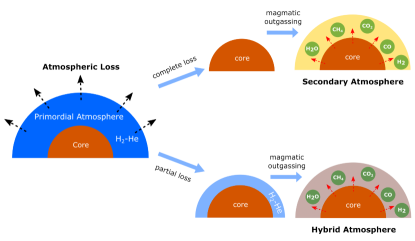
本論文は、超地球および準海王星系の二次的大気およびハイブリッド大気のAtmospheric chemistryを統一的理論枠組みでモデル化するものであり、非理想気体挙動および混合効果を考慮している。CO/CO₂比はマントル酸素活量の頑健な診断指標であることが示され、メタンを主体とする大気は、表面圧力が10 bar以上、還元的マントル、および現代の地球より低いマグマ温度を必要とする。
The atmospheres of small exoplanets likely derive from a combination of geochemical outgassing and primordial gases left over from formation. Secondary atmospheres, such as those of Earth, Mars and Venus, are sourced by outgassing. Persistent outgassing into long-lived, primordial, hydrogen-helium envelopes produces hybrid atmospheres of which there are no examples in the Solar System. We construct a unified theoretical framework for calculating the outgassing chemistry of both secondary and hybrid atmospheres, where the input parameters are the surface pressure, oxidation and sulfidation states of the mantle, as well as the primordial atmospheric hydrogen, helium and nitrogen content. Non-ideal gases (quantified by the fugacity coefficient) and non-ideal mixing of gaseous components (quantified by the activity coefficient) are considered. Both secondary and hybrid atmospheres exhibit a rich diversity of chemistries, including hydrogen-dominated atmospheres. The abundance ratio of carbon dioxide to carbon monoxide serves as a powerful diagnostic for the oxygen fugacity of the mantle, which may conceivably be constrained by James Webb Space Telescope spectra in the near future. Methane-dominated atmospheres are difficult to produce and require specific conditions: atmospheric surface pressures exceeding $\sim 10$ bar, a reduced (poorly oxidised) mantle and diminished magma temperatures (compared to modern Earth). Future work should include photochemistry in these calculations and clarify the general role of atmospheric escape. Exoplanet science should quantify the relationship between the mass and oxygen fugacity for a sample of super Earths and sub-Neptunes; such an empirical relationship already exists for Solar System bodies.
研究の動機と目的
- 超地球および準海王星系の二次的およびハイブリッド的大気における脱ガス化学の統一的理論枠組みの構築を目的とする。
- 二次的およびハイブリッド的大気の両状態をカバーする一貫性のある第一原理モデルの欠如を解消することを目的とする。
- 混合相平衡計算における非理想効果(活量係数および活性係数)を組み込み、より高い精度を実現することを目的とする。
- 多様な惑星的条件下におけるマントル酸化状態および大気組成の主要な化学的診断指標を同定することを目的とする。
- 将来的なバイオシグネチャー解釈を可能にするために、系外惑星大気における地球化学的背景を定量的に把握することを目的とする。
提案手法
- 鉱物-マグマ-ガス系からの熱力学的制約を用いた混合相化学平衡計算に基づく形式的枠組み。
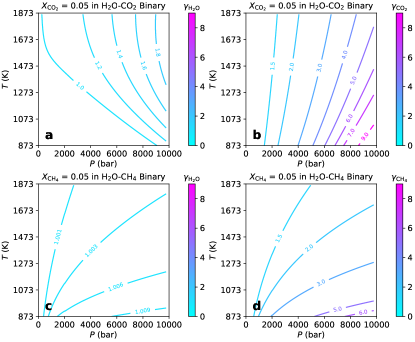
- 非理想気体の活量係数および気体混合物における非理想混合の活性係数の組み込み。
- マントルのfO₂(酸素活量)を中心的制御パラメータとし、IW(鉄-ウストァイト)バッファー尺度に沿って体系的に変化させる。
- H₂、N₂、CO、CO₂、CH₄、H₂O、H₂Sの部分圧を関数として大気組成を体系的に探索する。
- 理想気体仮定と非理想気体仮定を比較し、複数の化学系(H-O、C-H-O、C-H-O-N-S)においてその妥当性を評価する。
- 階層的モデリングアプローチ:溶け出しのない理想化モデルから出発し、その後に溶解度効果を組み込む。
実験結果
リサーチクエスチョン
- RQ1系外惑星の大気におけるCO/CO₂比は、マントルの酸素活量にどのように依存するか。また、内部酸化状態の診断指標として有効であるか。
- RQ2超地球および準海王星系でメタン主体の大気を形成するにはどのような大気的条件が必要か。
- RQ3非理想気体および混合効果は、二次的およびハイブリッド的大気の予測される組成にどのように影響を与えるか。
- RQ4モデルが示唆するように、ガスのマグマ海洋への溶解度にかかわらず、H₂OおよびH₂の混合比がほとんど変化しないのはどの程度まで成立するか。
- RQ5初期のH₂/He含有量は、ハイブリッド的大気の化学的進化にどのような役割を果たすか。
主な発見
- CO/CO₂比はマントル酸素活量の頑健な診断指標であり、ガスの溶解度や総水素予算にほとんど依存しない。
- メタン主体の大気は、表面圧力が約10 barを超える、還元的マントル(活量 < IW)、および現代の地球より低いマグマ温度を必要とする。
- H₂OとH₂の混合比の交差点は、ガスの溶解度や系の複雑さ(H-O、C-H-O、C-H-O-N-S)に依存せず、おおよそIW酸素活量で発生する。
- 非理想効果(活量係数および活性係数)は、極端な条件(例:P_H₂ > 10³ bar または f_O₂ > IW+2)を除き、総圧力の予測にほとんど影響しない。
- モデルは、ガスの溶解度を組み込んでもH₂OおよびH₂の混合比が不変のままであることを示しており、熱力学的制約からの解析的予想を確認している。
- 本フレームワークにより、二次的およびハイブリッド状態の両方において大気組成を一貫して予測可能となり、ジェームズ・ウェッブ宇宙望遠鏡の観測解釈に影響を与える。
より良い研究を、今すぐ始めましょう
論文の読解から最終レビューまで、研究時間を劇的に削減しましょう。
クレジットカード登録不要
このレビューはAIが作成し、人間の編集者が確認しました。