
[Paper Review] Attention-aware Resource Allocation and QoE Analysis for Metaverse xURLLC Services
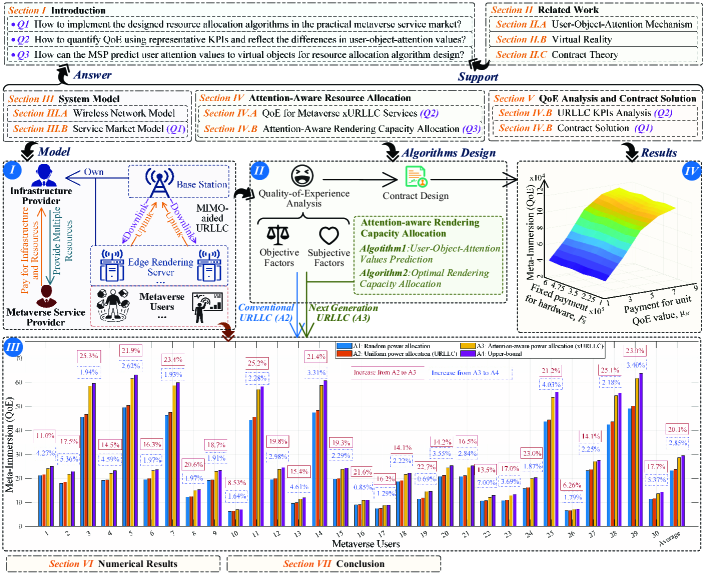
This paper proposes an attention-aware resource allocation framework for Metaverse xURLLC services using contract theory to maximize user Quality of Experience (QoE). By introducing the novel Meta-Immersion metric that combines objective KPIs and subjective attention, the scheme achieves a 20.1% average QoE gain over conventional URLLC with uniform allocation.
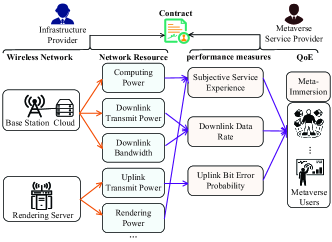
Metaverse encapsulates our expectations of the next-generation Internet, while bringing new key performance indicators (KPIs). Although conventional ultra-reliable and low-latency communications (URLLC) can satisfy objective KPIs, it is difficult to provide a personalized immersive experience that is a distinctive feature of the Metaverse. Since the quality of experience (QoE) can be regarded as a comprehensive KPI, the URLLC is evolved towards the next generation URLLC (xURLLC) with a personalized resource allocation scheme to achieve higher QoE. To deploy Metaverse xURLLC services, we study the interaction between the Metaverse service provider (MSP) and the network infrastructure provider (InP), and provide an optimal contract design framework. Specifically, the utility of the MSP, defined as a function of Metaverse users' QoE, is to be maximized, while ensuring the incentives of the InP. To model the QoE mathematically, we propose a novel metric named Meta-Immersion that incorporates both the objective KPIs and subjective feelings of Metaverse users. Furthermore, we develop an attention-aware rendering capacity allocation scheme to improve QoE in xURLLC. Using a user-object-attention level dataset, we validate that the xURLLC can achieve an average of 20.1% QoE improvement compared to the conventional URLLC with a uniform resource allocation scheme. The code for this paper is available at https://github.com/HongyangDu/AttentionQoE
Motivation & Objective
- To address the gap in personalized immersive experiences within Metaverse xURLLC services, which conventional URLLC fails to support due to its focus on objective KPIs.
- To model Quality of Experience (QoE) in a way that captures both technical performance and user subjective attention to virtual objects.
- To design an incentive-compatible contract between the Metaverse Service Provider (MSP) and Infrastructure Provider (InP) that maximizes MSP utility while ensuring InP participation.
- To develop an attention-aware rendering capacity allocation scheme that prioritizes virtual objects with higher user-object-attention values.
- To validate the proposed framework using real user-attention data and demonstrate significant QoE improvement over baseline URLLC schemes.
Proposed method
- Introduces the Meta-Immersion metric as a composite QoE measure combining objective KPIs (e.g., latency, reliability) and subjective user attention to virtual objects.
- Applies contract theory to design an optimal incentive mechanism between the MSP and InP, ensuring the InP’s participation while maximizing MSP’s utility.
- Develops an attention-aware resource allocation algorithm that dynamically assigns higher rendering capacity to virtual objects with higher predicted user attention values.
- Uses a user-object-attention level dataset to train and validate the attention prediction model for real-time resource allocation decisions.
- Employs mathematical optimization to solve for optimal resource allocation under power and latency constraints, with closed-form solutions derived using convexity analysis.
- Validates the framework using a real-world attention dataset, comparing performance against uniform and random allocation schemes.
Experimental results
Research questions
- RQ1How can QoE in Metaverse xURLLC services be modeled to incorporate both objective KPIs and subjective user attention?
- RQ2What contract design ensures mutual incentives between the MSP and InP while maximizing MSP utility?
- RQ3How can resource allocation be made attention-aware to improve user immersion and QoE?
- RQ4What is the quantitative QoE improvement of the proposed attention-aware scheme over conventional URLLC with uniform allocation?
- RQ5How does the proposed framework perform under realistic user-attention patterns and network constraints?
Key findings
- The proposed Meta-Immersion metric successfully integrates objective KPIs and subjective user attention into a unified QoE measure.
- The attention-aware resource allocation scheme improves average QoE by 20.1% compared to conventional URLLC with uniform allocation.
- The contract-based framework ensures the InP’s participation by aligning its incentives with the MSP’s goal of maximizing QoE.
- The optimization problem is shown to be concave, enabling efficient and globally optimal solution via convex optimization techniques.
- The derived closed-form solution for optimal resource allocation ensures low computational overhead for real-time deployment.
- Empirical validation using real user-attention data confirms the robustness and effectiveness of the proposed scheme across diverse user behaviors.
Read this paper
Open the full text in the Nubint reader and ask about any passage as you read.
Read this paper on NubintThis review was generated by AI from the original paper. Please check the paper before citing it.